
Reviewed · EASTER ISLAND TOURS
Private Easter Island Full-Day Tour
Easter Island’s most gripping stories come together on this private tour: cave paintings, a volcano crater, moai quarries, and the cliffside contest that once decided the island’s next leader. At Orongo, you’ll look toward the offshore islets where competitors swam in the annual birdman contest. At Puna Pau, you’ll see where the red stone topknots were cut for many moai.
I like the private format, which lets your guide adjust the pace and explain why each place matters instead of rushing you from one monument to the next. I also like the range of stops, from Ana Kai Tangata’s cave paintings to the seven moai at Ahu Akivi and the old lava tubes at Ana Te Pahu. The drawback is the price: $230 per person, plus an $80 national park pass and your food.
Key points at a glance
- Private group of two to six: You travel only with your own party and can ask questions throughout the day.
- A full circuit of major sites: The route includes Ana Kai Tangata, Rano Kau, Orongo, Vinapu, Puna Pau, Ahu Akivi, and Ana Te Pahu.
- Strong local guiding: Guides including Patricio, Yoyo, Tuhii, and Mark are praised for clear explanations, island history, and personal attention.
- The national park fee is extra: Plan on buying the $80 pass at the airport or online before visiting the sites.
- Hotel pickup is included: The tour begins at 9:30 a.m. and returns you to your hotel after roughly 6.5 to 7 hours.
- Not for cruise passengers: Port pickup is not available, and the tour is not compatible with cruise excursions.
Why this private route works well
A first visit to Easter Island can be hard to organize. The monuments are spread across the island, the stories behind them are layered, and the national park has its own entry rules. This tour gives you a full day with a driver-guide who can connect the sites in a sensible order.
I like that the day is not limited to moai viewing. You’ll see ceremonial sites, volcanic features, caves, stonework, and evidence of everyday life. That variety matters because Rapa Nui is not just an open-air collection of statues. The island’s traditions, political contests, engineering, and survival skills are all part of the story.
The private setup is especially useful if your group has a particular interest. You can ask more questions about the moai, ancient ceremonies, warfare, cave living, or present-day Rapa Nui culture. Guides such as Patricio, Yoyo, Tuhii, and Mark have been praised for making complicated subjects easy to follow and for adding personal context to the places you see.
The published rating is 4.9 from 61 reviews, with 98 percent of customers recommending the experience. That matches the strongest feature of the day: the guide. The monuments are impressive on their own, but a good explanation helps you understand what you are looking at.
A few more Easter Island days worth comparing
- From Hanga Roa: Rapa Nui Culture Sightseeing Tour
★ 4.6 · 307 reviews - From Hanga Roa: Easter Island Highlights 2-Day Tour
★ 4.3 · 205 reviews - From Hanga Roa: Easter Island Sightseeing Full Day Tour
★ 4.5 · 189 reviews
Ana Kai Tangata and the story behind its name
The first stop is Ana Kai Tangata, a cave near Hanga Roa with paintings on its ceiling. The art is a small but important reminder that Rapa Nui’s cultural remains are not limited to the famous moai.
Your guide also explains the cave’s name and its connection to cannibalism during a period of warfare on the island. This is a difficult subject, but it gives useful context for understanding the pressure and conflict that shaped Rapa Nui society. The story is not presented as a sensational sideshow. It helps you see the cave as part of a wider human history rather than simply a photogenic stop.
The cave visit can be physically manageable for most people with moderate fitness, but this is still an outdoor sightseeing day. You should expect uneven ground and exposure to sun and wind at several points. Wear practical shoes and bring water.
Rano Kau offers the day’s great volcanic view
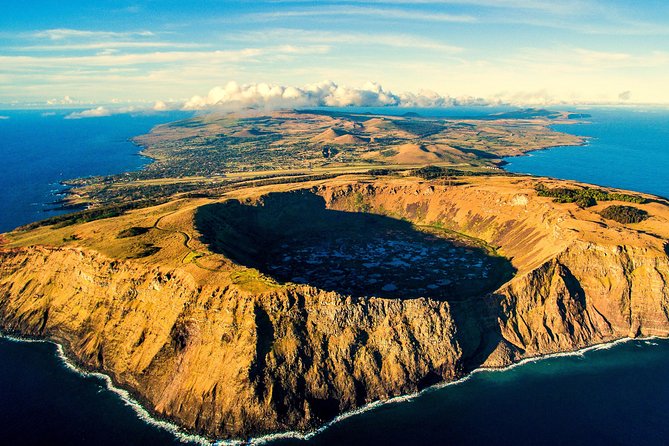
Rano Kau is one of the visual highlights. The volcano rises above a crater lake that drops about 200 meters, or 656 feet, below the rim. From the viewpoint, you get a broad view across the island and the Pacific.
This is a good place to pause and let the scale of Easter Island sink in. The crater is not just a scenic stop. It also shows the volcanic forces that formed the island and supplied the stone, caves, and terrain used by the Rapa Nui people.
You’ll want time here for photographs, but listen to the explanation as well. A guide can help you notice how the crater’s position relates to nearby Orongo and why this part of the island became important for ceremony.
The view is weather dependent. Easter Island can be windy, and cloud or changing light may affect what you see. That is one reason a private tour has an advantage: your guide can spend a little more time at a viewpoint if conditions are good, or keep the day moving if the weather turns rough.
Orongo and the birdman contest
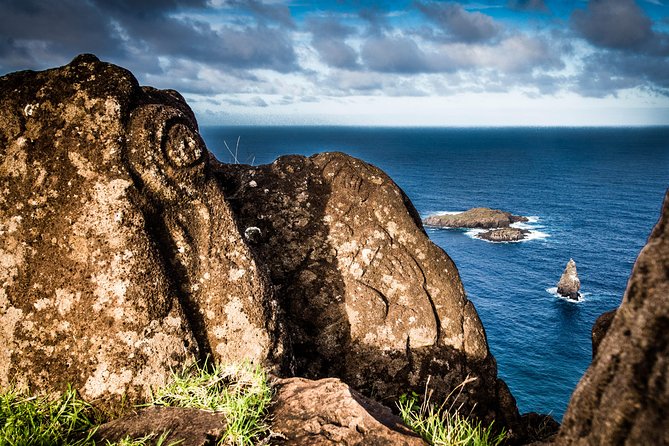
Orongo is one of the most memorable stops because it combines dramatic scenery with a remarkable political ceremony. In the 18th and 19th centuries, rival groups competed for leadership through the birdman contest.
The challenge involved climbing down steep cliffs, swimming to offshore islets, and returning with an egg. The winner’s representative gained authority for the coming period. You do not need to attempt the route to understand how dangerous it was. Looking from Orongo toward the islets is enough to make the contest feel startlingly real.
The site also shows how political power, ceremony, and the natural setting were linked. This is much more than a viewpoint with a dramatic story. Your guide can explain how the annual event helped organize authority on the island and why Orongo became such an important ceremonial center.
You should be ready for walking and uneven surfaces here. The tour requires a moderate fitness level, and the day includes several outdoor sites rather than paved museum-style visits.
Same trip, a completely different kind of day:
- Full Day Tour in Rapa Nui
★ 4.5 · 122 reviews - Full day tour – DREAM
★ 5.0 · 86 reviews - From Hanga Roa: Journey from Orongo to Ana Te Pahu
★ 4.3 · 75 reviews - Journey of the Ancestors: Tongariki, Rano Raraku & Anakena Beach
★ 4.5 · 70 reviews
Vinapu and the island’s precise stonework
At Vinapu, you’ll see some of Easter Island’s most carefully fitted stonework. The blocks have led to comparisons with construction in the great Inca centers of South America, though the site belongs to Rapa Nui’s own building tradition.
This stop is useful because it shifts your attention away from the standing moai and toward the skill involved in shaping and placing stone. The joints and overall construction can help you appreciate the technical work that went into ceremonial platforms.
Vinapu may not have the instant impact of a line of upright statues, but I consider it an important part of the route. It shows that the island’s builders were not simply moving large stones. They were planning formal structures and working with impressive care.
Your guide’s role matters here. Without explanation, you might see a wall and move on. With context, the stonework becomes evidence of design, labor, and social organization.
Puna Pau, where the red topknots began
Puna Pau is the quarry for scoria, a red, cindery volcanic stone used for the adornments fitted onto the heads of many moai. These red elements are often called topknots, and their color makes them easy to distinguish from the darker stone of the statues.
The quarry helps answer a practical question: where did these large red pieces come from? You’ll see the source rather than only the finished objects placed on ceremonial platforms around the island.
This is one of the stops where a guide can make the difference between looking and understanding. You’ll learn how the quarry relates to the wider moai tradition and why the red stone was chosen for the headpieces.
Puna Pau also helps break up the day. After the exposed views at Rano Kau and Orongo, the quarry provides a different setting and another angle on Rapa Nui engineering.
Ahu Akivi and the seven statues facing the sea
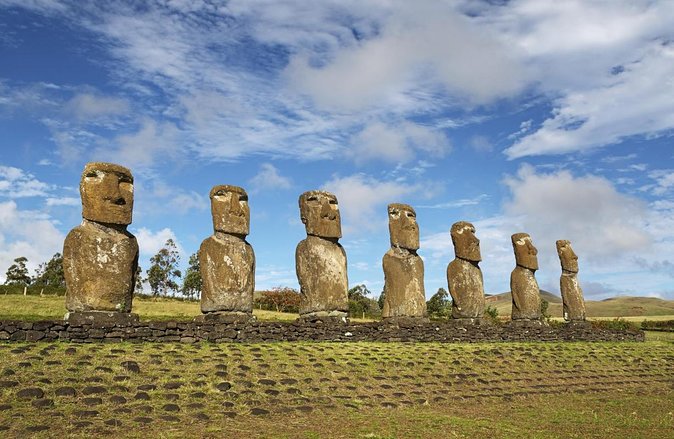
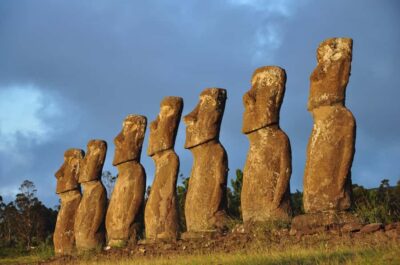
Ahu Akivi is a restored ceremonial site with seven moai. According to Rapa Nui tradition, the statues represent the first seven explorers who came to the island.
These are the only group of moai said to look out toward the sea. That detail makes Ahu Akivi especially memorable. Many visitors arrive expecting every statue to face the ocean, so the orientation here is a useful reminder that each site has its own meaning and arrangement.
The seven figures also provide a chance to consider the island’s origin stories and long connection with voyaging. Your guide can place the statues within those traditions and explain why the site is treated differently from other ahu.
Restoration means the statues are presented as a coherent group, but you should not expect a museum display or a long list of objects with labels. The experience depends on the guide’s explanation and your willingness to look closely.
Ana Te Pahu reveals how people used lava tubes
The final major stop is Ana Te Pahu, one of Easter Island’s more extensive lava tube networks. Like many volcanic islands, Rapa Nui has underground passages formed by ancient lava flows.
The important point is how the caves were used. The Rapa Nui people lived in some of these spaces, collected water, planted vegetables, and hid from aggressive visitors during conflicts in the 18th and 19th centuries.
This adds a human scale to the day. The moai and ceremonial sites can make ancient Rapa Nui seem monumental and distant. Ana Te Pahu shows practical adaptation: people used the island’s volcanic geology for shelter, food growing, water collection, and protection.
Cave visits can be darker and less even underfoot than the open-air sites. The moderate fitness requirement is worth taking seriously, particularly if you have trouble walking on uneven ground. Bring shoes with a secure grip and follow your guide’s instructions.
What the seven-hour schedule feels like
Pickup begins at 9:30 a.m. from your hotel, with the complete day lasting about 6.5 to 7 hours. That gives you a substantial route without requiring a second full day for the main highlights.
The schedule includes many stops, so this is an active sightseeing day. You will spend time getting in and out of the vehicle, walking around sites, listening to explanations, and taking photographs. The private format can make the pace more comfortable, but it cannot remove the distances or outdoor conditions.
Lunch is not included. You’ll have chances to buy food along the way, but I would not wait until you are very hungry to think about it. Carry water and plan to use one of the available food stops during the day.
Hotel transportation is included at the start and end. This is helpful in Hanga Roa, since you do not need to arrange a rental car or figure out how to connect several distant sites on your own.
The tour is not designed for cruise passengers. Port pickup is not provided, and the timing is not compatible with a cruise excursion. You also need at least two people to book, with a maximum of six in the group.
What the $230 price really includes
The price is $230 per person. For two people, that is a substantial cost, especially after adding the $80 national park pass per person and paying for lunch or snacks.
The value comes from the private vehicle, hotel transfers, a full day of guiding, and the ability to ask questions at every stop. If you are traveling with four to six people, the private arrangement becomes easier to justify because you are sharing the guide and vehicle among your own group.
You are also paying for convenience. Renting a car may cost less in some cases, but it leaves you responsible for navigation, timing, site rules, and making sense of what you see. A private guide can help you choose how long to spend at each place and can point out details you might miss alone.
I would not book this tour simply to save money. I would book it if you have limited time on Easter Island, want the main sites explained properly, or value a flexible day with your own group.
Buy the national park pass at the airport when you arrive, or purchase it online through rapanuinationalpark.org. The pass is valid for 10 days after purchase, so it can also cover additional visits during a longer stay.
The guides are the heart of the experience
The most consistently praised part of this tour is the personal quality of the guiding. Patricio has been singled out for bringing together archaeology, history, and social connections. Yoyo is described as making the day fun while explaining the island clearly.
Tuhii has been praised for answering questions and sharing information about the island’s history, culture, and people. Mark is known for giving detailed explanations, taking photographs from different angles, and making a private day feel specially arranged.
Guide availability can vary, so you should not book on the assumption that one particular person will lead your tour unless the operator confirms it. Still, the pattern is clear: the guide is not merely driving between monuments. The guide is the person who turns the route into an understandable story.
One practical benefit of a private tour is that you can use the guide to plan the rest of your stay. A couple who took this route used it to identify sites they wanted to revisit later by rental car. That is a smart way to use the day: get oriented first, then return to your favorite places independently if you have extra time.
Who should book this tour?
I would choose this tour if you are visiting Easter Island for the first time and want a broad introduction in one day. It suits couples, families, and small groups who prefer private transport and do not want to share a vehicle with strangers.
It is also a good match if you care about context. The route covers famous monuments, but it also includes caves, stonework, volcanic geology, traditional ceremonies, and stories of conflict. You get a more complete picture of Rapa Nui than you would from a quick moai-only outing.
You should think twice if your main goal is the lowest possible price. A rental car and independent visits may cost less, though you would give up the guide and the convenience of having the day organized.
You should also avoid it if you are arriving by cruise ship, since port pickup is not offered. Anyone with limited mobility should ask detailed questions before booking, because the day involves outdoor walking, caves, slopes, and uneven surfaces.
Free cancellation is available if you cancel at least 24 hours before the local start time. Changes or cancellations made later are not refunded.
Should you book it?
Book this private tour if you want to see most of Easter Island’s major sites in one well-organized day and understand what you are seeing. The combination of Orongo, Rano Kau, Vinapu, Puna Pau, Ahu Akivi, Ana Kai Tangata, and Ana Te Pahu gives you far more than a short statue circuit.
The price is high, but the value improves for a group of four to six and for anyone who wants a strong local guide. I would especially recommend it for a first visit, a short stay, or anyone who prefers questions and conversation over following a large group.
If you have several days, a rental car, and a tight budget, you may prefer to explore independently after buying the park pass. For everyone else, this is a practical way to get your bearings and see the island’s big stories in a single day.
FAQ
What time does the tour start?
The tour starts at 9:30 a.m. Hotel pickup is provided at the chosen departure time.
How long does the tour last?
The experience lasts approximately 6.5 to 7 hours, including visits to the listed archaeological, volcanic, and cave sites.
Is the national park fee included?
No. The national park pass costs $80 and is not included in the tour price. You can buy it at the airport upon arrival or online through rapanuinationalpark.org.
Is lunch included?
No. Lunch and drinks are not included, but the route includes opportunities to stop and buy food.
Can cruise passengers book this tour?
No. Port pickup is not provided, and the tour is not compatible with cruise excursions.
How many people can join the private tour?
A minimum of two people is required per booking, and the maximum group size is six. Only your own group participates.
Just added around Easter Island
- Ride to the highest point on the island for sunset★ 5.0 · 40 reviews
- Sunrise Tongariki: Sunrise at Tongariki Park Private Tour★ 4.5 · 47 reviews
- Terevaka Horse Excursion: The highest point and 360° view.★ 4.7 · 38 reviews
- Easter island: Snorqueling tour on coral reefs★ 4.4 · 47 reviews
- Private Full-Day Easter Island Highlights South and East★ 5.0 · 60 reviews
- Two days of Full Day Tour of Rapa Nui + Sunrise in Tongariki★ 4.8 · 55 reviews
- Half Day Tour in Rapa Nui★ 5.0 · 48 reviews
- Journey of the Ancestors: Tongariki, Rano Raraku & Anakena Beach★ 4.5 · 70 reviews
Easter Island Tours, compared.
From Hanga Roa: Rapa Nui Culture Sightseeing Tour
Read our review →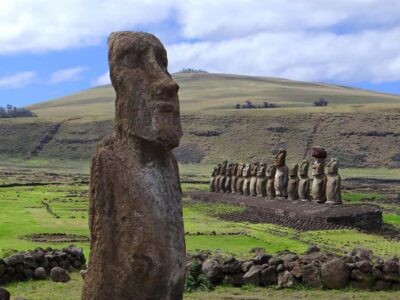
From Hanga Roa: Easter Island Highlights 2-Day Tour
Read our review →
From Hanga Roa: Easter Island Sightseeing Full Day Tour
Read our review →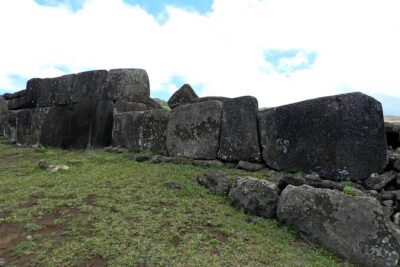
From Hanga Roa: Journey from Orongo to Ana Te Pahu
Read our review →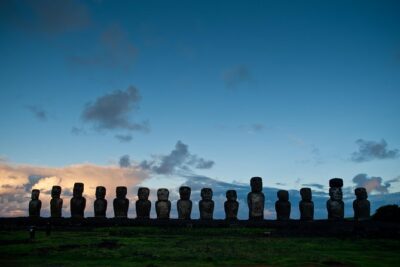
Journey of the Ancestors: Tongariki, Rano Raraku & Anakena Beach
Read our review →
Full Day Private Tour: Factory of the Moai the stone giants
Read our review →Browse the lists this tour appears in