
Reviewed · EASTER ISLAND TOURS
Private Full-Day Easter Island Highlights South and East
Rano Raraku is the heart of this day: a volcanic crater where most of Easter Island’s moai were carved, then left behind when work stopped. Ahu Tongariki follows with 15 huge statues lined along the coast, a fitting finale to a route packed with ancient engineering, village ruins, and strange half-buried figures.
I like the private format, which gives you room to ask about Rapa Nui customs, legends, and statue-making without keeping pace with a large group. I also like the hotel pickup and bilingual guide service, with guides such as Albert, Andres, Simon, Benjamin, Sophia, and Bruna praised for clear explanations and personal attention.
The main drawback is cost. At $280 per person, plus the required $80 national park ticket and lunch, this is not a bargain excursion. You should also confirm the vehicle is comfortable, since one past guest found the van seat difficult to use.
Key points to know before you book
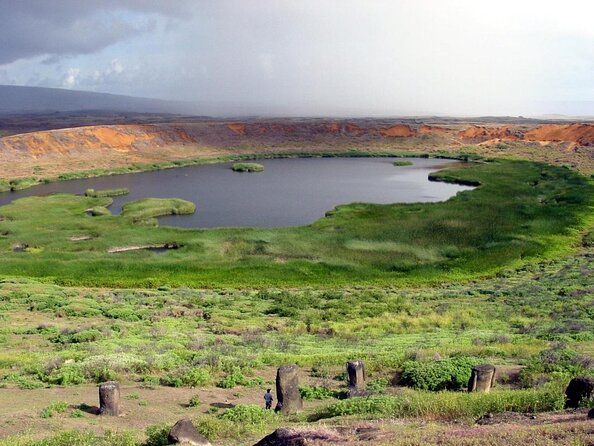
- Rano Raraku is the day’s main event: Allow 1 hour 40 minutes at the volcanic quarry where hundreds of unfinished moai remain.
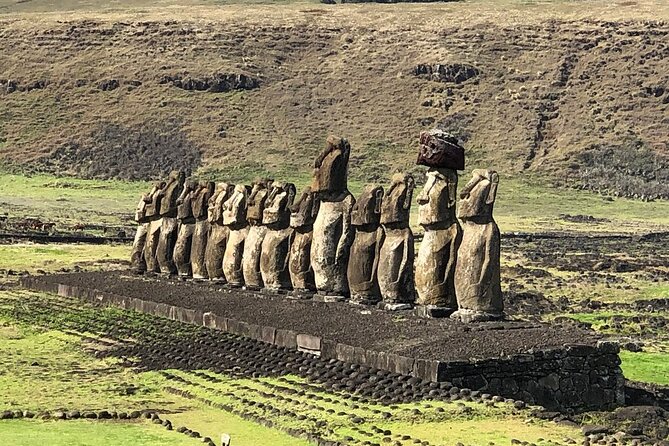
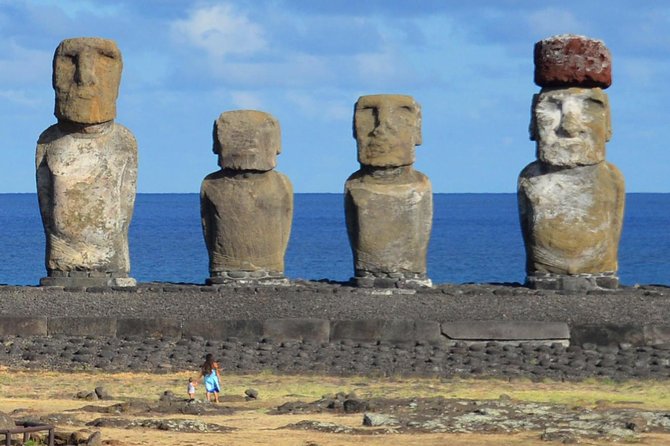
- Ahu Tongariki provides the big finish: Fifteen restored moai face inland from Easter Island’s largest ahu platform.
- The tour is genuinely private: Only your party takes part, so you can ask questions and adjust the pace within the day’s schedule.
- The national park ticket is extra: Buy the $80 ticket online before pickup and carry it with you.
- Lunch is not included: Set aside time and money for a meal during the route.
- This is for hotel guests, not cruise passengers: Pickup and drop-off are provided at hotels in the Hanga Roa area, but not at cruise ship terminals.
Why this south and east route matters
Easter Island can look compact on a map, yet its archaeological sites are spread across open country and rough coastal roads. This private day links several of the island’s most important places without asking you to arrange a car, navigate the route, or interpret the ruins alone.
I like the way the day builds from smaller and more puzzling sites toward the two great icons. Vinapu introduces the island’s precise stonework. Hanga Poukura adds odd buried statues and a coastal blowhole. The village sites at Vaihu and Akahanga show how people lived around the ceremonial platforms. Then Rano Raraku and Tongariki give you the scale that makes Easter Island memorable.
The trip lasts about 6 hours 30 minutes, including transfers and a lunch break. The listed stop times add up to several hours of sightseeing, so the remaining time is used on the road and around the meal. Exact timing can change with traffic and the pace of your guide.
Your day begins around 9:30 a.m. with hotel pickup. The air-conditioned minivan is a practical choice in the island’s strong sun, though you should not assume every vehicle has the same seat adjustment or back support. If comfort is important, ask about the vehicle when confirming your booking.
A few more Easter Island days worth comparing
- From Hanga Roa: Rapa Nui Culture Sightseeing Tour
★ 4.6 · 307 reviews - From Hanga Roa: Easter Island Highlights 2-Day Tour
★ 4.3 · 205 reviews - From Hanga Roa: Easter Island Sightseeing Full Day Tour
★ 4.5 · 189 reviews
Ahu Vinapu and the island’s precise stonework
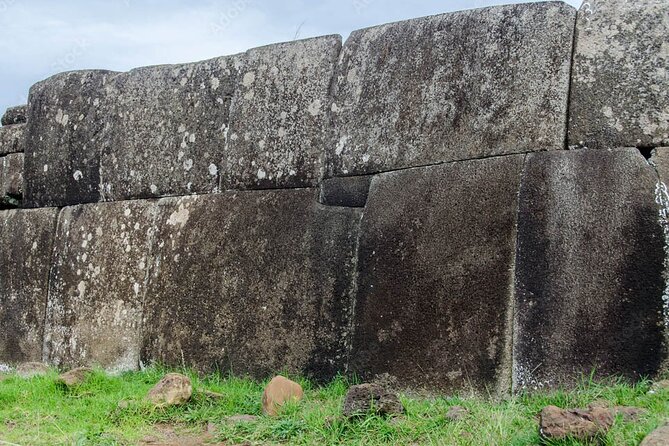
The first major stop is Ahu Vinapu, home to Ahu Tahira, one of the most carefully fitted stone walls on Rapa Nui. Large blocks were shaped and placed with impressive accuracy, creating joints that invite comparison with Inca masonry.
Your guide can help separate what is visible from what remains debated. The stonework has led many people to suggest contact with the Inca Empire, but the site is most valuable even without that theory. You can simply study the construction and consider what kind of planning, labor, and engineering it required.
You get about 30 minutes here. That is enough to examine the platform and hear the main explanation, though not enough for a slow archaeological study. The stop works well early in the day because it gives you a clear example of how much skill went into building an ahu, the ceremonial platform associated with moai.
Hanga Poukura, buried statues, and a coastal blowhole
Near Vinapu, Hanga Poukura changes the mood. Rough lava formations line the coast, and several statues lie partly buried in a row with their backs visible. They are not presented in the familiar upright style, which makes the site feel more mysterious than polished.
The rock itself is part of the attraction. Lava flows formed the area nearly a million years ago, and a blowhole still sends water into the air when waves and conditions line up. You might see a strong spurt, or you might find the sea relatively quiet. The natural feature depends on the ocean, so do not treat it as a guaranteed show.
You have about 30 minutes here. Wear shoes with a firm grip and take care around uneven volcanic rock. The site is less about one famous statue than about seeing how ceremonial remains, raw lava, and the ocean fit together.
Ahu Vaihu and a glimpse of daily life
Ahu Vaihu adds a different layer to the day. Alongside the archaeological remains, you can see a modern reconstruction of an ancient village, including examples of planting methods and replica boat houses.
This stop helps you picture the island as a lived-in society rather than a collection of statues. The moai get most of the attention, but people needed homes, food, storage, and work areas. The reconstructed village gives your guide a chance to explain those practical parts of Rapa Nui life.
The visit lasts about 30 minutes. Because the structures are replicas, you should treat them as teaching tools rather than untouched ruins. Their value is visual: you can step inside a boat house and gain a clearer sense of the compact spaces used by island communities.
Same trip, a completely different kind of day:
- Full Day Tour in Rapa Nui
★ 4.5 · 122 reviews - Full day tour – DREAM
★ 5.0 · 86 reviews - From Hanga Roa: Journey from Orongo to Ana Te Pahu
★ 4.3 · 75 reviews - Journey of the Ancestors: Tongariki, Rano Raraku & Anakena Beach
★ 4.5 · 70 reviews
Ahu Akahanga and fallen moai
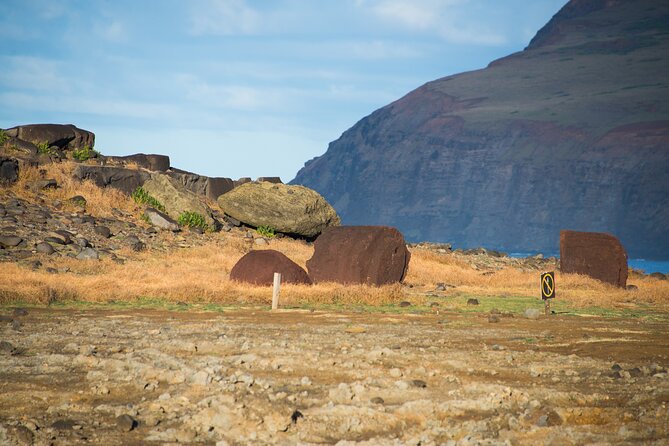
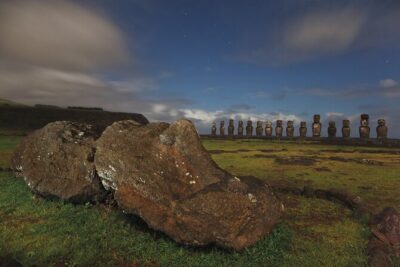
At Ahu Akahanga, the remains are more broken and atmospheric. This was once one of the island’s larger villages, and you can see house foundations, a cave, and a broad ahu with several fallen statues.
The fallen moai are important because they show the damage and upheaval that affected many ceremonial sites. Unlike Tongariki, where the statues were restored to an upright row, Akahanga lets you see the platform in a less repaired state.
You get about 40 minutes here, enough to examine the village remains and listen to the local traditions tied to the site. One legend identifies Akahanga as the burial place of Hotu Matu’a, the leader associated with the island’s first settlement. Your guide can place that story beside the physical evidence without turning the stop into a simple legend recital.
This is a good point to remember that Easter Island is not only about giant heads. The moai have full bodies, and the village foundations, caves, and ceremonial platforms reveal a broader social world.
Rano Raraku, the moai quarry
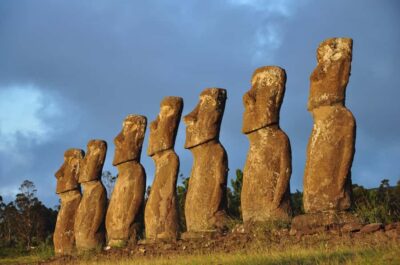
Rano Raraku is the reason many people choose this route. The volcanic crater functioned as the main workshop for carving the island’s moai. Hundreds of statues remain here, including figures that were never finished or transported to a coastal ahu.
You have 1 hour 40 minutes, the longest stop of the day. That extra time matters. Rano Raraku is not a quick roadside photo stop. You need time to look across the slopes, notice statues at different stages of completion, and understand how the crater supplied stone for monuments across the island.
The sight of unfinished moai changes how you think about the finished statues. At the quarry, they are still part of a work process. Some appear embedded in the rock, while others sit abandoned on the slopes. Their presence gives you a direct sense of an interrupted project rather than a finished archaeological display.
Your guide’s explanation is especially useful here. Without context, it is easy to see a hillside full of stone figures and move on. With a good guide, you can connect the quarry to transportation, labor, ceremony, and the social importance of moai.
The paths and ground may be uneven, so allow yourself time rather than rushing for photographs. Bring water, although bottled water is included, and protect yourself from the sun. There is no need to sprint through the quarry. This is the stop where a private schedule has its greatest value.
Ahu Tongariki and 15 moai by the sea
Ahu Tongariki is the grand finale, and the scale is immediate. Fifteen moai line the largest ahu on Easter Island, facing inland across the open ground.
The restored row creates the classic Rapa Nui image, but the site is more than a photo backdrop. After seeing the carving process at Rano Raraku, you can better appreciate the final destination of the statues. Here the figures are arranged as a powerful ceremonial group rather than scattered works in progress.
The planned visit lasts about 45 minutes. That gives you time to take in the full row, study individual statues, and hear how the monument fits into the island’s ceremonial system. It is also a good place to ask your guide to connect the earlier stops: the stonework at Vinapu, the village remains, the fallen figures at Akahanga, and the quarry behind the statues.
The open setting can make the statues look even larger. Give yourself a few minutes simply to stand back and see the whole platform before moving closer for photographs.
What the private guide adds
The main reason to choose this experience over a self-guided drive is interpretation. You could reach several sites by rental car or ATV, but the meaning of the stones is harder to read without help.
The guide service is bilingual, in English and Spanish with the same guide. Several named guides have received especially warm praise, including Albert, Andres, Simon, Benjamin, Sophia, and Bruna. You are not guaranteed one particular person, but the repeated strength of the guide comments points to the importance of local explanation on this route.
A private vehicle also lets you ask practical questions as they arise. You can ask why a statue fell, how an ahu was built, what a boat house was used for, or how a local legend fits with archaeology. That personal exchange is harder to get on a large coach tour.
The private format does not mean the day is fully flexible. There are six scheduled stops, a lunch break, and a fixed start around 9:30 a.m. Think of it as a dedicated outing for your party, not an open-ended custom tour.
Cost, lunch, and overall value
The listed price is $280 per person. Add the required $80 national park ticket, and your minimum practical cost becomes $360 per person before lunch.
That is a serious price, but it includes hotel pickup and drop-off, transport, a local professional driver-guide, and bottled water. For two people, the private arrangement costs more than joining a shared group, yet you are paying for direct attention and a route that covers the quarry and Tongariki in one day.
Lunch is not included. The schedule allows a break, but the supplied details do not specify a particular restaurant or menu. Plan to pay separately and ask your guide how the lunch stop will work.
I see the value most clearly if you have limited time on Easter Island, want strong historical context, or do not want to drive unfamiliar roads. If you have several days, enjoy independent travel, and are comfortable arranging transport, you may decide the premium is too high.
Comfort, timing, and who should book
Most people can take part, and the route is conducted by minivan. Still, this is an outdoor archaeological day with volcanic ground, walking, sun, and several transfers. If you have mobility or seating concerns, ask about the vehicle before booking rather than assuming every van is identical.
The tour does not pick up at cruise ship terminals. It is designed for people staying in hotels around Hanga Roa, with pickup and drop-off included there.
I would book this for a couple, family, or small group that wants a full explanation of the island’s major south and east sites. It also suits solo visitors who want company and structure without joining a large group. The experience has received a 4.8 rating, with 95 percent of customers recommending it, but the one vehicle complaint is worth taking seriously.
Free cancellation is available up to 24 hours before the local start time. Changes or cancellations made inside that window are not accepted for a refund.
Should you book the south and east tour?
Book it if Rano Raraku and Ahu Tongariki are priorities, especially if you have only a short stay on Easter Island. The quarry, the 15 statues at Tongariki, and the private guide make this a strong one-day introduction to the island’s ceremonial sites.
Before paying, budget for the $80 park ticket and lunch, confirm hotel pickup, and ask about the minivan if anyone in your party needs adjustable seating. If you want a slower visit to every corner of Rapa Nui, this route is only one part of the island, but it covers the most important south and east sights in a well-organized half-day-plus outing.
FAQ
How long does the tour last?
The tour lasts approximately 6 hours and 30 minutes, including transfers and a lunch break.
What time does the tour start?
Hotel pickup begins at about 9:30 a.m.
Is the tour private?
Yes. Only your party participates, with a local professional driver-guide.
Is the guide service available in English?
Yes. Tours are bilingual, conducted in English and Spanish by the same guide.
Is the national park ticket included?
No. You must buy the national park ticket online before the tour. It costs $80 per person and is valid for all tours and sites.
Is lunch included?
No. Lunch is not included in the price.
Does the tour pick up cruise ship passengers?
No. Pickup is provided from hotels, but not from cruise ship terminals.
What is included in the tour price?
The price includes a local professional driver-guide, hotel pickup and drop-off, transport, and bottled water.
Just added around Easter Island
- Ride to the highest point on the island for sunset★ 5.0 · 40 reviews
- Sunrise Tongariki: Sunrise at Tongariki Park Private Tour★ 4.5 · 47 reviews
- Terevaka Horse Excursion: The highest point and 360° view.★ 4.7 · 38 reviews
- Easter island: Snorqueling tour on coral reefs★ 4.4 · 47 reviews
- Two days of Full Day Tour of Rapa Nui + Sunrise in Tongariki★ 4.8 · 55 reviews
- Half Day Tour in Rapa Nui★ 5.0 · 48 reviews
- Private Easter Island Full-Day Tour★ 5.0 · 61 reviews
- Full Day Private Tour: Factory of the Moai the stone giants★ 4.5 · 63 reviews
Easter Island Tours, compared.
From Hanga Roa: Rapa Nui Culture Sightseeing Tour
Read our review →
From Hanga Roa: Easter Island Highlights 2-Day Tour
Read our review →
From Hanga Roa: Easter Island Sightseeing Full Day Tour
Read our review →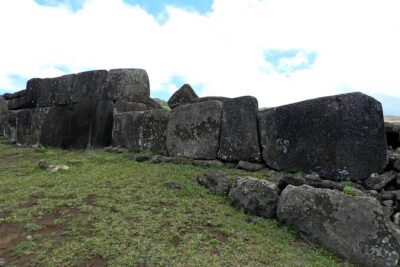
From Hanga Roa: Journey from Orongo to Ana Te Pahu
Read our review →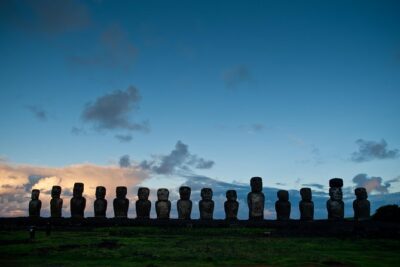
Journey of the Ancestors: Tongariki, Rano Raraku & Anakena Beach
Read our review →
Full Day Private Tour: Factory of the Moai the stone giants
Read our review →Browse the lists this tour appears in