Reviewed · HISTORICAL TOURS
Centro Historico and Lapa – Santa Teresa Walking, Historical and Bohemian Tour
Rio’s past comes into focus on this long, well-packed walk from grand Cinelândia to the hilltop streets of Santa Teresa and the old aqueduct at Lapa. The best part is the change of mood: one hour you are looking at opera houses and imperial buildings, and later you are riding the yellow Bonde tram through Santa Teresa.
I like the way the route joins major sights with smaller details, especially the churches of São Francisco da Penitência and São Bento. I also like the small maximum group of 12, which gives guide Ivan room to explain what you are seeing instead of simply marching from photo stop to photo stop.
The catch is time. Seven to eight hours on foot, with 14 stops and a tram ride, is a serious day. Lunch is not included, and the non-refundable booking policy means you should be sure of your plans before paying the $137.80 price.
Key points to know before you book
- A full-day route through three distinct Rio districts: You move from Centro’s civic squares and churches to Santa Teresa’s old houses, then down into bohemian Lapa.
- The yellow Santa Teresa tram is part of the experience: The included ride lasts about 30 minutes and gives you a moving view of the hill as you climb.
- Guide Ivan brings the history to life: A French-language review praised his explanations and storytelling, a useful sign for anyone choosing this tour for context rather than transport alone.
- The churches are central, not filler stops: You enter the Metropolitan Cathedral, São Francisco da Penitência, and São Bento monastery.
- Several strong viewpoints are built into the day: Parque das Ruínas and the terrace near the Largo da Carioca churches offer broad views over Rio.
- Plan for lunch and a long walk: A drink is included, but food is not, and the itinerary keeps moving for most of the day.
Why this route gives you a useful first look at Rio
The tour begins at 9 a.m. outside the Copacabana Palace and ends back at the same meeting point. That makes the day easy to understand: arrive in one of Rio’s best-known beach districts, then spend the bulk of the day in the historic center, Santa Teresa, and Lapa before returning.
The route is not designed as a relaxed café day. It is a guided introduction to the city’s architecture, religious art, public squares, street murals, old transport, and hillside neighborhoods. If you want to cover a lot of ground without sorting out every stop yourself, the structure makes sense.
The group limit of 12 matters here. In narrow pedestrian streets and inside small historic buildings, a large group would feel clumsy. A smaller party also gives you a better chance to hear the guide when traffic and city noise rise around you.
The French-language feedback about Ivan is especially useful. The strongest praise focused on his explanations of Rio’s past and his skill as a storyteller. That is important because this tour’s value depends heavily on interpretation. Many of the buildings can be photographed on your own. The benefit comes from understanding why they were built and how the city changed around them.
More Historical Tours in Brazil
- Rio de Janeiro: Historic Rio and Santa Teresa Half-Day Tour
★ 4.4 · 228 reviews - Rio de Janeiro: Little Africa Heritage Walking Tour
★ 4.9 · 177 reviews - Explore Little Africa : Unveiling Afro Heritage in Rio de Janeiro
★ 5.0 · 97 reviews
Cinelândia opens with Rio’s grand public face
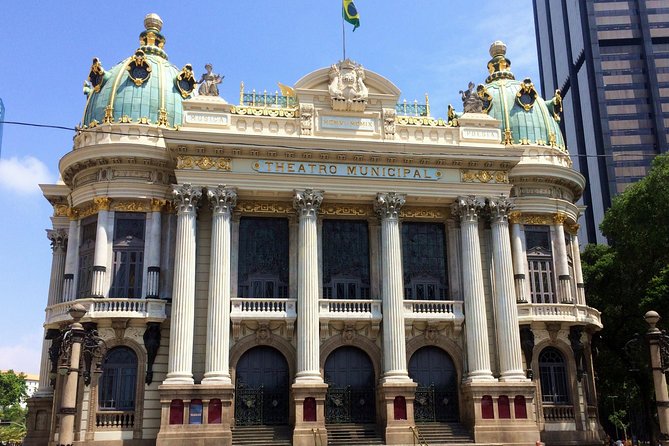
The first stop is Cinelândia, one of the city center’s most impressive urban squares. In about 20 minutes, you take in the Municipal Theater, the Museum of Fine Arts, City Hall, the National Library, and the Odeon Theater.
This is a strong opening because the square gives you Rio’s official, cultural face in one view. The Municipal Theater is the local opera house, while the National Library and Museum of Fine Arts frame the square as a center for performance, art, and public life. The Odeon is also noted as the only cinema in the square still operating.
You do not pay an admission fee at this stop, and the short visit is mainly an exterior presentation. If you want a long look inside the theater or museum, this tour is not built for that. You are getting orientation and context, not a full museum visit.
The cathedral and two very different church interiors
At the Metropolitan Cathedral of Saint Sebastian, the tour goes inside for about 15 minutes. The building is known for its unusual architecture and huge stained-glass windows, so this is more than a quick look at a church door.
The cathedral provides a sharp contrast with the older religious buildings later in the day. Its scale and monumental windows create a modern, dramatic interior, while the churches at Largo da Carioca and São Bento show older decorative traditions.
The next stop is Largo da Carioca, where you see the Church of Saint Anthony and the Church of São Francisco da Penitência. The visit takes about 25 minutes and includes the panoramic terrace beside the churches.
São Francisco da Penitência is presented as one of Brazil’s finest Baroque churches. That makes this a key stop for anyone interested in carved decoration, religious art, and colonial-era design. The terrace also gives you a chance to look over the city rather than simply stare at another facade.
This part of the tour is especially valuable because the churches are close together but offer a different visual experience from the cathedral. You can compare Rio’s religious architecture across periods within a short walk.
Confeitaria Colombo and the old pedestrian streets
The route then follows pedestrian streets through old Rio to Confeitaria Colombo. The stop lasts only about 10 minutes, but the café’s Art Deco style makes it an important piece of Centro.
You should think of this as an exterior introduction rather than a full meal or long coffee break. The schedule does not include lunch, and the tour does not promise a seated tasting here. Still, the stop gives you a sense of Rio’s old café culture and lets you see one of the city center’s most recognizable interiors and facades.
Because the day keeps moving, this is a good place to decide how much independent time you want later. If a historic café matters to you, you may wish you had more time here. The tradeoff is that the tour covers far more of the city than a café-focused outing.
More Historical Tours in Rio de Janeiro
- Learn the History of Rio with an Unforgettable City Center Walking Tour
★ 5.0 · 82 reviews - Rio’s city walking tour: a glimpse of history and olympic legacy
★ 4.5 · 78 reviews - Olympic Boulevard, Museum of Tomorrow & Historical Rio
★ 4.5 · 66 reviews - Rio: Olympic Boulevard, Museum of Tomorrow & History Tour
★ 4.1 · 47 reviews
Praça Quinze connects empire, ferries, and Guanabara Bay
At Praça Quinze de Novembro, the guide presents the Church of Our Lady of Carmelites, the Paço Imperial, the equestrian statue of General Osório, Tax Island, and the ferry pier serving Niterói and Paquetá Island.
The square brings together several layers of Rio’s public life. You see religious buildings, imperial architecture, monuments, and working transport links around Guanabara Bay. The ferry pier also helps you understand that Rio’s historic center is not just a collection of monuments. It remains tied to the water and to movement across the bay.
The stop takes about 20 minutes. That is enough for a guided explanation and photographs, but not enough to board a ferry or explore Paquetá or Niterói. Keep that distinction in mind if you are tempted by the view across the water. The tour shows you the departure point, not those separate destinations.
Praça Pio X and the cultural waterfront
The walk continues through pedestrian streets to Praça Pio X, where you see the Candelária Church, the Olympic Boulevard, the Centro Cultural Banco do Brasil, and Casa França Brasil.
The Candelária Church is another major religious landmark, while the nearby cultural centers show how old Rio and newer public projects sit side by side. The Olympic Boulevard helps connect the historic center to the more recent redevelopment of the waterfront.
The visit lasts about 15 minutes. Like several early stops, it works best as a guided introduction. If you want to see an exhibition at the Banco do Brasil Cultural Center or Casa França Brasil, you would need to return separately with more time.
São Bento brings the morning to a quieter close
The walk to the São Bento monastery leads to one of Rio’s most beautiful church interiors. About 15 minutes are set aside to visit the monastery and hear its story.
This is a compact stop, but it has real weight in the route. After the open squares and broad civic buildings, São Bento offers a more enclosed and richly decorated religious setting. It also gives the morning a clear theme: Rio’s identity was shaped by public institutions and religious communities as much as by beaches and viewpoints.
You will not get an extended monastery visit at this pace. Still, the stop earns its place because it adds another architectural style before the tour shifts toward the waterfront, murals, and hillside neighborhoods.
Mauá Square and Rio’s modern cultural side
Mauá Square is the next major pause, with about 20 minutes for the area. The guide points out the Museum of Tomorrow, the Rio Art Museum, and the panoramic terrace at the top of the art museum.
The Museum of Tomorrow is not visited inside, but its architecture is worth seeing from the square. The terrace at the Rio Art Museum offers views toward Mauá Square, the Niterói Bridge, and the Museum of Tomorrow. This is one of the better places in the route for understanding how the rebuilt waterfront looks as a whole.
Again, the time limit is important. You are not touring either museum. You are seeing their architecture and using the art museum terrace for the view. If you want exhibitions, allow another day.
Kobra’s huge mural adds color before the hills
The Etnias mural, created by Eduardo Kobra for the Olympic Games, represents five ethnic groups and is described as one of the largest murals in the world. The stop lasts about 15 minutes.
This is a welcome change after a morning of churches, libraries, and imperial buildings. The mural gives you a direct connection to Rio’s public art and Olympic-era waterfront. Its scale works best from a little distance, so you can see how the faces fill the wall.
The stop is short and focused. You will have time to take in the artwork and photograph it, but not to make it a full street-art walk. It also sets up the shift from formal Centro to the more informal streets of Santa Teresa and Lapa.
The yellow Bonde climbs into Santa Teresa
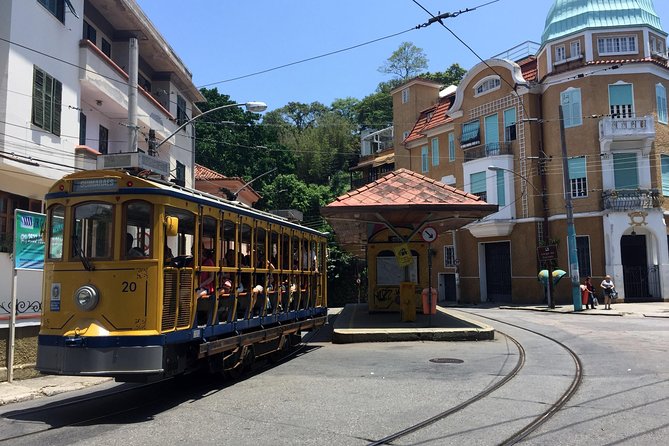
From the tram station, you board the famous yellow Santa Teresa tram, known locally as the Bonde. The included ride lasts about 45 minutes in the schedule, with roughly 30 minutes described as the panoramic journey up toward Santa Teresa.
This is the most distinctive transport section of the tour. Instead of driving uphill, you take an old-style tram and watch the city change as you rise. The ride is not just a way to reach the next stop. It is one of the day’s main experiences.
The tram also gives your feet a break after several hours of walking. That matters, since the route resumes on foot once you reach Santa Teresa. Exact seating and the feel of the ride can vary, so treat it as a shared public experience rather than a private sightseeing vehicle.
Largo dos Guimarães shows Santa Teresa’s local character
In the heart of Santa Teresa, the tour spends about 45 minutes around Largo dos Guimarães. You see late 19th-century and early 20th-century houses, local views, and the restaurants and bars that give the neighborhood its bohemian character.
This is where the tour becomes less about grand institutions and more about the shape of daily life. The old houses and hillside setting feel different from the straight avenues and large squares below. You get time to walk, look at the buildings, and take in the neighborhood rather than simply stop at one monument.
The area is also useful if you want to return later for a meal or drinks. Since lunch is not included, you may be thinking about food by this point. The itinerary does not promise a restaurant stop, so ask the guide how the day’s timing will work for your group.
Parque das Ruínas gives the big Rio view
The Centro Cultural Municipal Parque das Ruínas is one of Santa Teresa’s main viewpoints. The tour allows about 30 minutes at the former home of Laurinda Santos Lobo, now presented as a lookout over the Centro, the Lapa Arches, Christ the Redeemer, and Botafogo.
This is one of the strongest stops for photographs because it ties several parts of the day together. From above, you can look back toward the center you have just walked and ahead toward Lapa. The view may also include Christ and Botafogo, depending on conditions.
The setting adds more than a lookout. The old house and its conversion into a cultural site give you a glimpse of Santa Teresa’s grander past, while the open views show why the neighborhood remains such a popular stop on Rio sightseeing routes.
Selarón Steps lead down toward Lapa
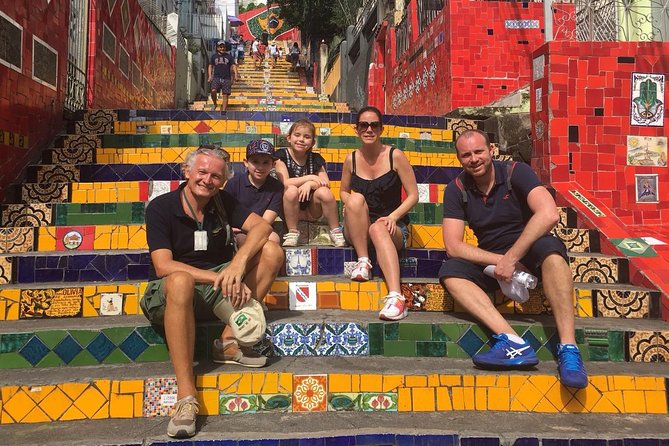
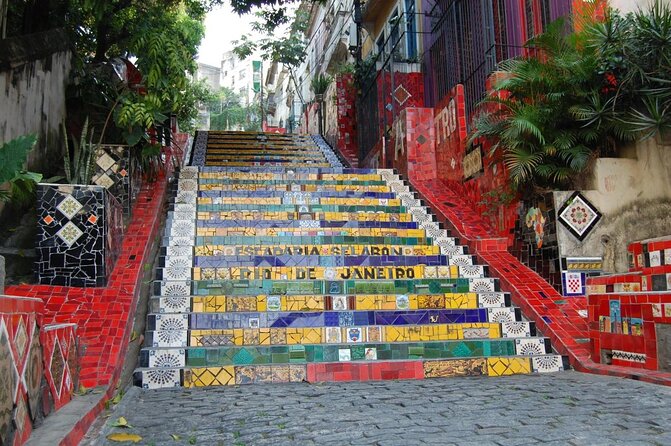
Leaving Santa Teresa, you pass the Escadaria Selarón, the famous multicolored staircase created by Chilean artist Jorge Selarón over roughly two decades. About 30 minutes are set aside here.
The steps are highly visual, but the time allows you to look at the tiles and the way the staircase moves down the hill, not just take one quick picture. Its handmade quality also fits the more informal side of Santa Teresa and Lapa.
This is another stop where crowd levels can affect the pace, though the tour data does not give a fixed crowd forecast. Stay close to the guide and keep track of the group, especially while taking photos.
The Arcos da Lapa finish the walking route
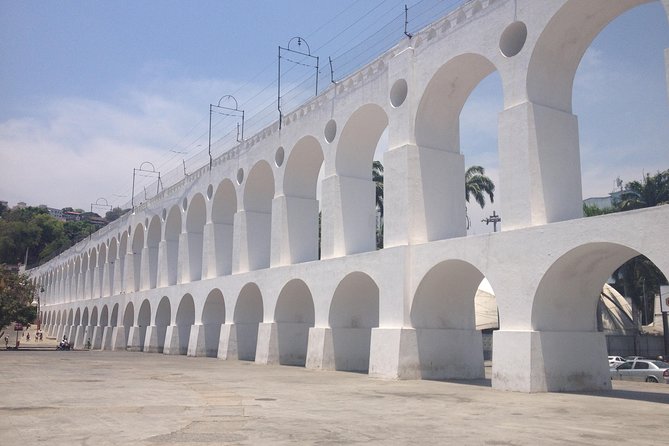
The final stop is the Arcos da Lapa, an 18th-century aqueduct that supplied water to Rio until the end of the 19th century. The tour reaches the arches after passing walls covered with graffiti and explains how the tram uses the aqueduct to reach Santa Teresa.
The arches make a fitting ending because they connect several themes from the day: old infrastructure, hillside transport, public space, and the modern street art around Lapa. You have already ridden above them on the tram, so seeing the structure from below gives the route a satisfying physical link.
About 20 minutes are scheduled here. This is a presentation and photo stop, not a separate Lapa nightlife outing. The tour returns you to the Copacabana Palace meeting point afterward.
Is $137.80 fair for a full day?
At $137.80 per person, this is not a cheap walking tour. The price makes more sense if you value a private guide’s explanations, the small group cap, the included tram ride, and the amount of ground covered in one day.
You also receive a caipirinha, beer, soda, fruit juice, or water during the tour. Lunch is not included, so budget for food separately. The drink is a pleasant extra, but it should not drive your decision.
I would compare the cost against what you want from the day. If you mainly need transport between famous sights, the price may feel high. If you want the city’s history explained in a logical route, with churches, viewpoints, public art, and Santa Teresa included, the value is stronger.
The booking is non-refundable and cannot be changed for any reason. The experience also requires a minimum number of participants, though a full refund or alternate option is offered if the operator cancels because that minimum is not met. Confirmation is provided at booking, and the tour is near public transport.
Who should book this Rio walking tour?
I would choose this for a first or early visit to Rio if you want more than beaches and postcard views. It suits people who like architecture, city history, churches, public art, and neighborhood walks, and who are comfortable spending most of a day on the move.
It is also a good fit if you want Santa Teresa and Lapa handled in one organized outing. The tram ride removes one transport puzzle, while the guide links the districts instead of treating them as unrelated stops.
I would hesitate if you prefer a slow pace, long meals, or extended museum visits. The route has many stops, but several last only 15 or 20 minutes. Anyone who wants to explore the Museum of Tomorrow, Rio Art Museum, Confeitaria Colombo, or the historic churches at length will need separate time.
Should you book it?
Book this tour if you want a history-heavy, small-group day that covers Centro, Santa Teresa, and Lapa without making you plan every turn. The strongest reasons are the church interiors, Parque das Ruínas viewpoint, Kobra mural, Selarón Steps, and the yellow Bonde ride.
Skip it if the price, fixed schedule, lack of included lunch, or non-refundable terms make you uneasy. For an active visitor who wants Rio’s old center and hillside neighborhoods explained by a guide such as Ivan, it offers a focused and unusually varied day.
FAQ
How long does the Centro Histórico and Lapa, Santa Teresa tour last?
The tour lasts approximately 7 to 8 hours. It starts at 9 a.m. and ends back at the Copacabana Palace meeting point.
Where does the tour start and finish?
It starts at the Copacabana Palace, A Belmond Hotel, at Avenida Atlântica, 1702, in Copacabana. The activity ends back at the same meeting point.
Is the Santa Teresa tram ride included?
Yes. The yellow Bonde tram ride to Santa Teresa is included. The panoramic tram portion lasts about 30 minutes, with approximately 45 minutes allocated to the tram stop in the schedule.
Is lunch included?
No. Lunch is not included. A caipirinha, beer, soda, fruit juice, or water is offered during the tour.
How large is the group?
The tour has a maximum of 12 participants. It is near public transportation, and most people can take part.
Can I cancel or change the booking?
No. The experience is non-refundable and cannot be changed for any reason. If the operator cancels because the minimum number of participants is not reached, you will be offered another date or experience, or a full refund.
More Walking Tours in Rio de Janeiro
- Guided Walk to Telegraph Stone
★ 4.5 · 49 reviews - Bossa Nova Walking Tour
★ 5.0 · 48 reviews - Rio de Janeiro: Bossa Nova Walking Tour with Guide
★ 4.9 · 46 reviews - Historical Downtown and Lapa – Walking Tour
★ 5.0 · 44 reviews
More Walking Tours in Brazil
- Rio de Janeiro: Rocinha Favela Walking Tour with Local Guide
★ 4.8 · 3,052 reviews - Rio De Janeiro: Half-Day Rocinha Favela Walking Tour
★ 4.7 · 2,272 reviews - Sunrise and Sunrise Walk Two Brothers with Local Guide
★ 5.0 · 193 reviews - Walking tour of the bohemian neighborhoods of Santa Teresa and Lapa
★ 5.0 · 59 reviews
Just added around Rio de Janeiro
- Walking tour of the bohemian neighborhoods of Santa Teresa and Lapa★ 5.0 · 59 reviews
- Tijuca Forest Hike – Waterfalls & Caves, Nature & Wild Life!★ 5.0 · 51 reviews
- Guided Market Fruit Tasting in Rio with 15+ Exotic Flavors★ 5.0 · 68 reviews
- Rio Highlights: Christ, Sugarloaf, and More in a Private Tour★ 5.0 · 36 reviews
- Guided Tour to Favela Santa Marta★ 5.0 · 60 reviews
- Trail and Rappel on Morro Dois Irmãos★ 5.0 · 77 reviews
- Tijuca National Park and all its wonders★ 5.0 · 88 reviews
- City Tour Full VIP – Corcovado Train + Churrascaria Rodízio★ 5.0 · 43 reviews
Historical Tours, compared.
Historic Center and Getsemaní Shared Walking Tour
Read our review →
Lima’s Vibrant Heritage: Exploring the City’s Landmarks Half-day
Read our review →



Lima: Historic Center Street Food, Market, and Eateries Tour
Read our review →
Nazis in Buenos Aires: a historical walking tour
Read our review →