
Reviewed · WALKING TOURS
Best of Buenos Aires Private Walking Tour
Buenos Aires reveals itself through its buildings, and this private walk gives you a close look at the city’s grandest chapters. In about three hours, you move from the commercial pulse of Florida Street to the Paris-style avenues and family mausoleums of Recoleta.
I like the wide range of sights, from a British clock tower and Art Deco skyscraper to churches, palaces, and a cemetery full of Argentine stories. I also like the guides’ focus on context: Martin, Carlos, and Mariano have been praised for clear English, humor, and sharp explanations of politics, architecture, immigration, and local customs.
The main catch is simple: this is a solid walk, not a gentle sightseeing loop. You cover a lot of ground at a steady pace, and the full route may change with weather, strikes, repairs, or city events. Wear good shoes and expect to finish in Recoleta, not back near your hotel.
Key points at a glance
- A city-spanning route: Walk from Florida Street and Plaza San Martín toward Recoleta, covering at least 25 major sights and smaller details.
- Architecture with stories: See Edificio Kavanagh, Palacio Paz, Palacio San Martín, Palacio Estrugamou, and Avenida Alvear.
- History beyond the postcard: Learn about British influence, immigration, the Falklands War, the 1992 Israeli Embassy bombing, and Argentina’s political past.
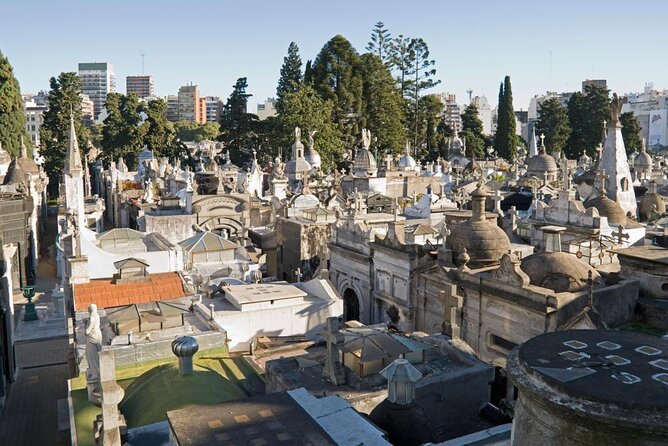
- A thorough Recoleta finish: Spend about an hour around Recoleta Cemetery, including Evita Perón’s family tomb and lesser-known local stories.
- Private format: Only your group takes part, allowing a more personal pace and room for questions.
- Best for active first-time visitors: The walk is a strong introduction if you want to understand how Buenos Aires became known as the Paris of the South.
From Florida Street to the city’s grandest addresses
The meeting point is outside Florida Garden café at Florida 899, near the corner of Paraguay Street. Look for the small BA Walking Tours sign held by the guide or attached to clothing, and arrive before the 10 a.m. start. This is a useful central location, close to public transportation and easy to reach from the downtown core.
The walk begins on Calle Florida, one of Buenos Aires’ oldest commercial streets. It links the Plaza de Mayo area with Plaza San Martín, and your guide uses the street to explain how the city grew from its founding district outward. Florida Street is not just a shopping strip. It is a useful starting point for understanding Buenos Aires as a place shaped by trade, immigration, wealth, and changing urban tastes.
From there, the route quickly turns toward grander buildings and quieter streets. At the Basilica del Santísimo Sacramento, you hear about Mercedes Anchorena, the wealthy woman who had the church built for her family in 1916. The guide also tells the personal and social stories tied to the church, including the mix of family power, wealth, and religious influence that appears repeatedly across this part of the city.
More Walking Tours in Argentina
- Buenos Aires Hop-On Hop-Off Bus, Free Walking Tours & Discounts
★ 4.5 · 2,218 reviews - Buenos Aires: La Boca Guided Walking Tour in English
★ 4.8 · 1,587 reviews - Nazis in Buenos Aires: a historical walking tour
★ 4.9 · 193 reviews
Kavanagh and Plaza San Martín: Art Deco beside British influence
Edificio Kavanagh is one of the walk’s strongest early stops. Built in 1934, it took only 14 months to complete and was commissioned by Corina Kavanagh, an Irish-Argentine millionaire who sold two ranches to finance the project. Its stepped Art Deco form overlooks Plaza San Martín, and it once held the title of the tallest skyscraper in Latin America.
You cannot simply wander through every important building on this route, so having the guide explain what you are looking at matters. Kavanagh is a good example. Its height, design, and financing tell you something about Buenos Aires during an era when private fortunes were reshaping the city.
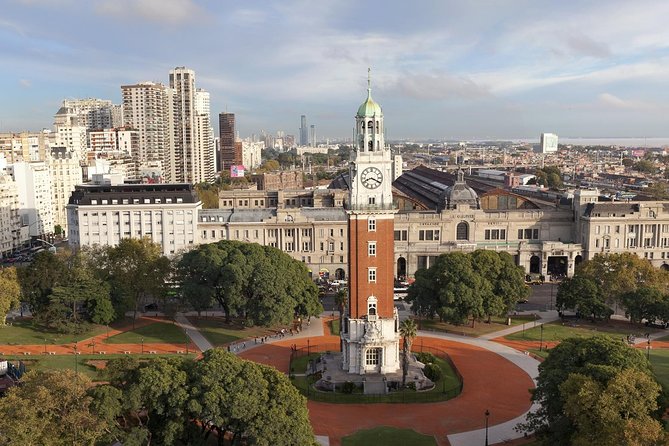
The next major stop is Torre Monumental, formerly called the British Clock Tower. Here, the discussion shifts from architecture to Argentina’s long and complicated relationship with Britain. You learn about British investment, trade, and economic influence, then look across at the memorial to those killed in the 1982 South Atlantic War, known in Argentina as the Malvinas War and in Britain as the Falklands War.
This section is valuable because it avoids a simple tourist version of history. British influence helped shape Argentina’s economy and institutions, while the war remains a painful political and emotional subject. The guide connects the clock tower and memorial instead of treating them as unrelated photo stops.
Palaces, newspapers, and the making of Barrio Norte
Plaza General San Martín provides another layer of history. The park once held a fort, a bullring, and former slave depots. Today, the monument to General José de San Martín dominates the space, giving your guide a chance to explain the military leader’s role in South American independence.
Nearby, Palacio Paz looks like a French city palace dropped into central Buenos Aires. José C. Paz had it built in 1914. He owned one of the city’s major newspapers and hoped to become president, and the building reflects that ambition. Its materials came from France, and its original plan included 120 rooms for a family of four.
Palacio San Martín offers a related story, but with a different family at its center. The building was originally the Anchorena family palace and later received its current name for political reasons. Mercedes Anchorena appears again here, linking the palace to the Basilica del Santísimo Sacramento and to the role wealthy women played in shaping the city’s institutions.
At Palacio Estrugamou, the route reaches the elegant Barrio Norte district. This is where the Paris of the South nickname makes the most sense. You pass grand apartment buildings and mansion-style residences while hearing how Spanish, Italian, French, and British immigrants influenced Argentina’s society and culture.
The value here is not just the view. A guide can help you read the social signals in the architecture: who had money, where the elite wanted to live, and how European styles were adapted to Buenos Aires. If you only walked these streets alone, you would still see handsome buildings, but you might miss why they look the way they do.
Difficult history at the Israeli Embassy and French Embassy
The stop at Plaza de la Embajada de Israel is more sobering. In 1992, a bomb destroyed the Israeli Embassy and killed 24 people. The guide discusses what happened, the political background, and the questions of responsibility and justice in Argentina.
This is not a light sightseeing stop, but it gives the walk needed depth. Buenos Aires is often presented through cafés, tango, and elegant architecture. Its modern political history is also part of the city, and this stop helps place the polished streets in a more serious national context.
The former Ortiz-Basualdo Palace, now the French Embassy, brings the mood back toward architecture and diplomatic history. The building is tied to stories about Edward VII of England and his American future wife. These small episodes give the route its human touch. You are not only hearing dates and building names. You are hearing about social visits, marriages, ambitions, and the people who moved through these rooms.
More Walking Tours in Buenos Aires
- Buenos Aires: Personalized 2 to 8-Hour Private Walking Tour
★ 4.7 · 149 reviews - Buenos Aires: San Telmo and Market Guided Walking Tour
★ 4.8 · 102 reviews - Buenos Aires Walking Tour with Local Guide and Optional Rooftop
★ 4.5 · 87 reviews - Full Day Private Walking Tour of Buenos Aires Neighborhoods
★ 5.0 · 55 reviews
Patio Bullrich and the city’s British fingerprints
Patio Bullrich is an especially useful stop for understanding how Buenos Aires changes over time. Today it is an upscale shopping center, but the building began as a British-designed horse and cattle auction house in 1867. The Bullrich family used it for prize bulls, thoroughbreds, heirlooms, and other valuable goods.
The contrast is the point. A modern mall can hide an earlier commercial world, and your guide shows you how to spot it. English-Argentine architect Juan Waldorp designed the original building, another reminder that British influence reached well beyond the clock tower.
You spend about 15 minutes here, longer than at many of the other exterior stops. That extra time helps because the building’s purpose is not immediately obvious. It is also a useful place to note that Buenos Aires’ grand architecture is not all French. Britain, Italy, Spain, and local Argentine families all left their mark.
Recoleta begins with church, wealth, and the Vatican
The route continues toward the Embassy of the Holy See, also known as the Apostolic Nunciature. The palace once belonged to Adelia Harilaos, and the guide explains why she donated it to the Vatican. This stop also returns to the question of why Argentina produced a pope and how wealthy families, women, and the Catholic Church were connected.
By now, you have walked through several districts and seen a pattern: wealthy families funded churches, palaces, newspapers, and public projects, often to secure social position as much as out of devotion. The guide brings those connections together instead of presenting each building as an isolated attraction.
Recoleta itself is a pleasant change from the busier central streets. The district is known for former palaces, French-style townhouses, expensive shops, and broad avenues. You get a chance to see the city’s most polished side, but the guide keeps the focus on how that wealth was created and how Argentina’s fortunes rose and fell between roughly 1880 and 1930.
Recoleta Cemetery is the main event
The cemetery receives about an hour, making it the longest stop on the route. Admission is included, and the visit is more than a quick look at Eva Perón’s tomb.
You hear the story of Evita, her family memorial, and the political meaning attached to her burial place. The guide also brings up figures and episodes that are less familiar, including Rufina Cambaceres’ tragic fate, Tiburcia Domínguez and her miserly husband, Admiral Brown, and the wealthy Leloir family.
The cemetery is best understood as a miniature map of Argentine society. Its elaborate mausoleums show how powerful families wanted to be remembered, while the names connect military leaders, politicians, artists, business families, and cultural figures. The guide also discusses the old monastery and cultural center, the Basilica del Pilar, and nearby sights such as the Palais de Glace, where tango gained importance.
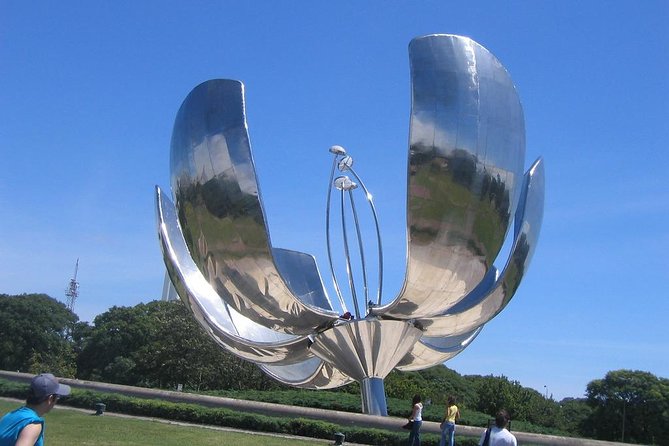
Depending on conditions and timing, the wider Recoleta section may include discussion of Bourdelle’s monument to Alvear, the National Fine Arts Museum, the National Library, the Giant Flower, Palermo Chico, and monuments linking France and Argentina. The full list is ambitious, so do not assume every item will receive equal time. City activity, weather, repairs, and the pace of your group can affect what gets covered.
The cemetery itself is included, but several nearby sights are viewed from outside. The stop is strongest for people who enjoy stories about individuals and families, not just grand design. You will hear curious local tales alongside discussions of tango, immigration, religion, and Argentina’s upper class.
Avenida Alvear and La Biela finish the walk
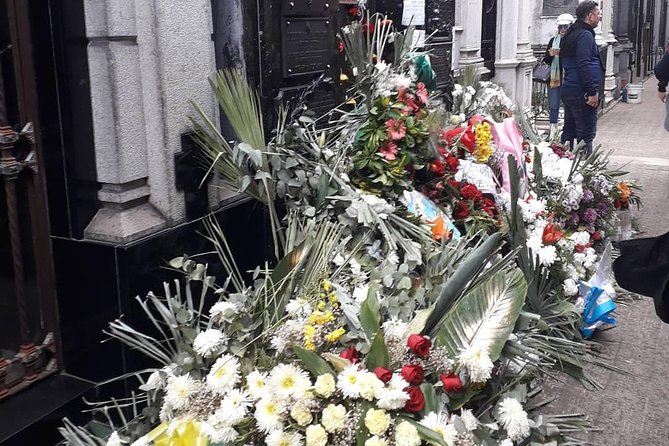
Avenida Alvear is the final grand stretch. Its palatial mansions and Paris-style façades make it one of the clearest expressions of Buenos Aires’ European ambitions. The guide places the buildings within the wider story of immigration, prosperity, and decline.
This is also where the tour’s themes come together. You have seen British commercial power, French architectural taste, Spanish and Italian immigration, local political ambitions, and the influence of old Argentine families. Avenida Alvear gives those threads a polished setting.
The walk ends outside La Biela, a famous café on Avenida Presidente Manuel Quintana. This is a practical finish because you are left in Recoleta, one of the city’s main restaurant and attraction districts. You can continue exploring from there, visit nearby sights, or stop for a drink and a rest.
Do not count on being escorted back to your hotel. The route ends at La Biela, and one past experience found the walk back afterward to be lengthy. Plan your next move before you arrive, especially if you are tired.
How much value do you get for $109?
At $109 per person, this is not the cheapest way to see Buenos Aires. You are paying for a private English-speaking guide, a route that covers several districts, and admission to Recoleta Cemetery. Since only your group participates, the price makes more sense for couples, families, or small groups that value personal attention.
The strongest value is the interpretation. Many stops are free to view, but the point is learning what you are seeing. Kavanagh becomes more interesting when you know Corina Kavanagh’s story. Patio Bullrich becomes more than a mall when you understand its auction-house past. The British clock tower and Malvinas memorial gain meaning when presented together.
The price is harder to justify if you mainly want a quick orientation or prefer wandering alone. You can see many façades without a guide, and the pace may feel brisk if you want lots of time for photographs. Still, for a first day in Buenos Aires, the walk can save you from spending hours looking at impressive buildings without knowing their place in the city’s story.
Who should book this Buenos Aires walk?
I would choose this tour if you are visiting Buenos Aires for the first time and want history, architecture, and local politics in one morning. It also fits anyone who likes detailed storytelling and wants more than the standard Plaza de Mayo circuit.
The walk suits reasonably active adults and children who can keep moving for roughly two and a half to three hours. Children aged eight and under are free with an adult. The tour operates in rain or shine, so bring suitable clothing and shoes.
It is less suitable if you need frequent sitting breaks, want a relaxed photography tour, or dislike changing subjects quickly. The route covers a lot, and some stops last only five minutes. The guides have generally been praised for fluent English, humor, and clear explanations, though one experience found the guide too focused on promoting other tours and less responsive to questions.
Should you book it?
Book this private Buenos Aires walking tour if you want the city explained through its buildings, families, conflicts, and cultural changes. Its best moments come from the connections between places: the church and palace tied to Mercedes Anchorena, the British clock tower opposite the Malvinas memorial, and Recoleta Cemetery as a record of Argentine power.
Skip it if you want a short, easy stroll or need to stay close to your hotel. For most first-time visitors who can handle a steady walk, the route offers a strong introduction to Buenos Aires and finishes in an excellent neighborhood for continuing your day.
FAQ
How long does the tour last?
The experience is advertised as approximately three hours, while the walking portion is also described as about two and a half hours. The actual length can vary with the group’s pace and city conditions.
Where does the tour begin?
It begins outside Florida Garden at Florida 899, Buenos Aires, near the corner of Paraguay Street.
What time does the tour start?
The meeting time is before 10 a.m., and the tour starts no later than 10 a.m.
Where does the tour end?
The walk ends outside La Biela café at Avenida Presidente Manuel Quintana 596 in Recoleta.
Is the tour private?
Yes. Only your group participates in the activity.
Is the guide English-speaking?
Yes. A professional English-speaking guide is included.
Is Recoleta Cemetery admission included?
Yes. Admission to Recoleta Cemetery is included in the tour price.
Are meals included?
No. Meals are not included.
Can children join the tour?
Yes. Children aged eight and under are free when accompanied by an adult.
Does the tour operate in bad weather?
Yes. The tour operates rain or shine, although weather and other city conditions may affect the route and the sights covered.
Just added around Buenos Aires
- Private Airport Transfer In or Out: Aeroparque (AEP)–Buenos Aires★ 5.0 · 73 reviews
- Sailing with Wine Tasting in Buenos Aires★ 5.0 · 50 reviews
- Traditional Argentine FoodTour with optional Michelin Experience★ 4.5 · 56 reviews
- Unique Tailored Tours – The Hummingbird Trip★ 5.0 · 69 reviews
- Experience The Essence of Buenos Aires in San Telmo★ 5.0 · 51 reviews
- Tigre Speedboat – The Delta s Captain – CITYSAILING TIGRE★ 5.0 · 75 reviews
- Private Airport Transfer in or out with english speaking driver.★ 4.5 · 69 reviews
- Tango Porteño Show with Optional Dinner in Buenos Aires★ 4.5 · 58 reviews
Walking Tours, compared.
Historic Center and Getsemaní Shared Walking Tour
Read our review →
La Paz and El Alto: Cable Car Rides and Walking Tour
Read our review →
Punta Arenas: Walk with Penguins on Magdalena & Marta Island
Read our review →
Browse the lists this tour appears in