
Reviewed · HIKING & TREKKING
Stargazing Hiking Valle de Elqui
The best part of this Elqui Valley outing is the way it joins sunset hiking with Indigenous astronomy. You do not simply arrive at a dark site, look through a telescope, and leave. The evening begins with mountain views, then shifts toward meditation, sound therapy, cultural learning, and a close look at the southern sky through powerful astronomical binoculars.
I like the small private format, since your group receives the guide’s full attention. I also like the practical extras: trekking poles, a portable chair, hot coffee or herbal tea, snacks, and astronomical photography. The main consideration is the physical side. You need moderate fitness, proper hiking shoes, and the ability to keep a strict departure time.
Key points to know
- Sunset comes first: Begin at a mountain viewpoint for changing evening color before the stars appear.
- Loreto leads the experience: Her approach combines astronomy, Indigenous worldviews, meditation, and sound therapy.
- Celestron 20×80 binoculars: View Andean constellations through astronomical binoculars mounted on a tripod.
- Private transportation included: Transfer is provided from Vicuña to Villaseca, the activity site.
- Ages 14 and up: The experience is not suitable for children under 14 and requires moderate fitness.
- Photography is included: You receive astronomical photographs as a record of the night.
Why this Elqui Valley evening feels different
Many stargazing outings focus only on equipment. This one gives the evening a wider shape. You begin with the last light on the mountains, move into a quieter period of meditation and bowl sound therapy, then turn your attention to the sky and the cultural meaning attached to it.
That order matters. You have time to adjust from an ordinary day in Vicuña to an evening outdoors. Rather than treating the stars as a show that starts at a fixed moment, Loreto connects them to the place, to ancient ways of reading the heavens, and to your own sense of attention.
The experience is provided by Collasuyo Astronómico SPA and is private, so only your group takes part. That makes this a better match for people who want a calm pace and room for questions. It is less suited to someone looking for a large social outing or a quick, highly technical astronomy session.
The guide named in the experience is Loreto. Her message to one participant highlights her focus on cultural content and respectful participation. That gives you a useful clue about the tone: come ready to listen, not just to photograph the sky.
More Hiking Tours in Chile
- Puerto Natales: Base of the Towers Day Hike
★ 4.8 · 727 reviews - From Santiago: Cajón del Maipo and Volcán San José Hike 8K
★ 4.9 · 418 reviews - Puerto Natales: Base of the Towers Trekking Experience
★ 4.8 · 191 reviews
From Navarino in Vicuña to the Villaseca activity site
The meeting point is on Navarino in Peralillo, Vicuña, in Chile’s Coquimbo Region. You need to arrive 15 minutes before departure. This is not a loose suggestion. A delay of more than 10 minutes can mean exclusion from the activity, with no late adjustment available.
Private transportation from Vicuña to Villaseca is included. The supplied information does not include transfers from La Serena or other places outside the stated pickup arrangement, and the price does not cover an air-conditioned vehicle for those extra transfers.
This makes the outing easiest if you are already based in Vicuña or have arranged your own way to the meeting point. Check the exact meeting instructions before setting out, especially if you are staying somewhere outside the city.
The drive to the activity area is part of the practical plan rather than a separate sightseeing stop. The important point is that you do not need to organize the transfer from Vicuña to Villaseca yourself. Once you arrive, the focus shifts to the walk and the evening program.
A sunset viewpoint before the stars come out
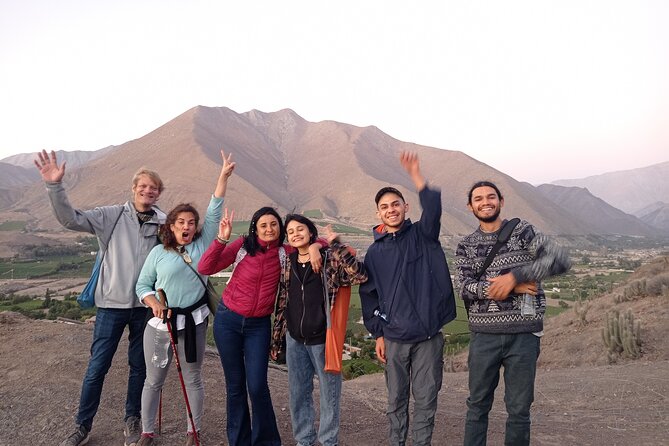
The first major moment is a hike toward a viewpoint above the mountains. You arrive while there is still enough light to see the surrounding form of the valley and watch the sunset change the color of the evening.
This opening gives the experience a clear rhythm. You are not asked to stare into a dark sky as soon as you arrive. Instead, you start with a visible view, then allow your eyes and body to adjust as the sun fades.
Trekking poles are included. They can help on uneven ground and are especially useful if you are not used to walking after dark. Still, poles do not remove the need for suitable footwear. Hiking shoes are required, so leave casual sandals and smooth-soled shoes at your accommodation.
The physical level is described as moderate. The available details do not give a precise distance, elevation gain, or trail surface, so you should not assume this is a flat stroll. If you have limited mobility or are unsure about the walking demand, contact the provider before booking.
The sunset viewpoint also gives photographers an early subject before night photography begins. You can enjoy the changing light without needing special equipment, then settle into the darker part of the program.
Meditation and bowl sound therapy in the open air
After the sunset portion, the evening turns inward. Meditation and sound therapy with bowls are used to help you connect with the surroundings before the astronomy discussion starts.
This is one of the more distinctive parts of the experience. It may appeal to you if you enjoy quiet outdoor activities, mindful pauses, or a gentle transition between daytime and night. It may feel less suitable if you want constant movement, technical astronomy from start to finish, or a fast sequence of sights.
The setting matters here. You are outdoors, away from the usual daytime pace, with the transition from sunset to darkness happening around you. The activity is designed to make that change part of the experience rather than treating it as dead time while waiting for the stars.
A portable chair is included. That small detail has real value during a four-and-a-half-hour evening. You will have a place to sit during the meditation, cultural explanation, sky watching, or photography instead of spending the whole program standing.
More Stargazing Tours in Chile:
- San Pedro de Atacama: Etno-Stargazing Tour with Transfer
★ 4.8 · 629 reviews - San Pedro de Atacama: Stargazing Experience
★ 4.7 · 489 reviews - Astronomical Tour with Guide and Pick Up San Pedro de Atacama
★ 4.5 · 145 reviews - San Pedro de Atacama: Guided Atacama Desert Stargazing Tour
★ 3.9 · 93 reviews
Indigenous skies and Andean constellations
The cultural section explores Indigenous worldviews and the links between different cultures and astronomy. This is not only a lesson in naming stars. It looks at how people have understood the sky and how astronomy connects with ancestral knowledge.
The focus on Andean constellations gives the night a local frame. You are not simply hearing a general explanation of northern-hemisphere stars that could take place anywhere. The guide directs your attention toward the patterns and ideas connected with the southern sky.
The exact amount of technical detail will depend on your group and the guide’s pace. The description promises cultural content and astronomical explanation, but it does not list a formal lecture, printed materials, or a set number of constellations. Think of it as guided interpretation rather than a classroom course.
That balance is useful for a mixed group. You can ask about the sky while also learning why the stars matter within Andean cultural traditions. If you already have strong astronomy skills, you may want to make your questions specific. If you are new to the subject, the guided format should help you know where to look.
Seeing the sky through Celestron 20×80 binoculars
The main viewing equipment is a pair of Celestron 20×80 astronomical binoculars on a tripod. This is a serious step up from ordinary handheld binoculars. The tripod matters because high magnification is difficult to hold steady, especially when you are trying to study faint or distant objects.
The binocular format also gives the sky a natural feel. You look with both eyes rather than through a single eyepiece, and the wide view can make it easier to understand the relationship between stars and constellations.
The guide directs your gaze toward Andean constellations and explains what you are seeing. Since this is a private activity, you can ask for another look or request help finding a particular feature, subject to the time and conditions available that night.
Weather remains important. The outing requires good conditions, so clouds or poor weather can lead to a different date or a full refund. This is worth taking seriously when planning a short visit to the Elqui Valley. You may have only one free evening, and the sky cannot be guaranteed by booking alone.
Astrophotography as your evening keepsake
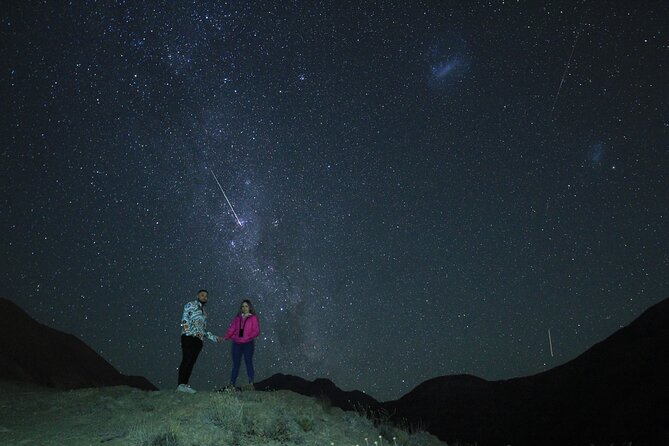
Astronomical photography is included. The available information does not specify whether you receive individual portraits, group images, sky images, or a set format, so ask the provider about delivery and timing if the photographs are important to you.
Either way, the photo service adds value. Night photography can be frustrating without a tripod, suitable camera settings, and a dark location. Having the experience include astronomical images means you can give more attention to the evening instead of spending it trying to produce a usable photograph.
You should still bring a phone or camera if you want personal snapshots, but do not treat your own quick phone photographs as a substitute for the included astronomical photography. The dark conditions that make the sky special also make casual photography difficult.
The sunset viewpoint provides another chance for personal photographs before the light fades. During the meditation and astronomy sections, however, it is wise to keep your device use modest so you can follow the guide and preserve the quiet character of the activity.
Snacks, hot drinks, and the value of the $100 price
The price is $100 per person. That is not a bargain-priced short look at the stars, but the comparison is not simply between a ticket and a viewing platform.
Your fee covers about four and a half hours, private transportation from Vicuña to Villaseca, trekking poles, a portable chair, astronomical binoculars, snacks, coffee or herbal tea, and astronomical photography. It also covers a private guide-led program that combines hiking, sunset viewing, meditation, sound therapy, culture, and astronomy.
I see the price as reasonable for someone who values a personal, carefully structured evening and does not want to arrange each part separately. The value is weaker if you only want a quick star view, have no interest in meditation or cultural interpretation, or are already carrying your own astronomy equipment and arranging transport.
The hot drink and snack are modest additions, but they matter after an evening walk. Coffee, tea, or herbal tea gives you something warm during the cooler night hours, while the snack helps make the long program more comfortable.
No meal is listed, so do not book this as a dinner replacement. If you need a full meal before or after the activity, plan that separately.
Who should book this private hike
I would point this experience toward people aged 14 and older who enjoy several interests at once: outdoor walking, astronomy, cultural learning, quiet reflection, and photography.
It is especially well suited to:
- Couples or families with older teenagers seeking a private evening
- Visitors based in Vicuña who want an organized night activity
- People curious about Andean views of the sky
- Amateur photographers who want astronomical images without managing every technical step
- Hikers comfortable with a moderate level of physical activity
You should think twice if you dislike scheduled activities, cannot walk in hiking shoes, or want a fully accessible, low-effort viewing session. Service animals are allowed, and the meeting point is near public transportation, but the activity itself still involves outdoor walking and moderate fitness.
Alcohol is not permitted before participation. The provider reserves the right to refuse admission to anyone under the influence, so plan a clear-headed evening.
Timing, weather, and cancellation details
The start time changes through the season. In January, the listed window is 8:00 PM to 9:00 PM. In February, it shifts to 7:30 PM to 9:00 PM. In March, it is listed from 7:00 PM to 9:00 PM, Monday through Saturday.
These are evening operating windows rather than a promise that every departure lasts exactly the same amount of time. Your confirmation should provide the specific start time. Since sunset changes across the season, the later or earlier departures help fit the light and darkness portions of the program.
The experience lasts approximately four hours and 30 minutes and returns to the meeting point. It runs Monday through Saturday in March, while the listed January and February schedule covers every day of the week.
You can cancel for a full refund up to 24 hours before the local start time. Cancellations or changes inside 24 hours are not refunded or accepted. Poor weather is handled differently: if the provider cancels, you are offered another date or a full refund.
Should you book Stargazing Hiking Valle de Elqui?
Book it if you want a complete evening rather than a single astronomy stop. The sunset hike, bowl sound therapy, Indigenous sky traditions, Andean constellations, private format, hot drink, and included photographs give the night more depth than a basic star-viewing session.
The strongest reason to choose it is the combination of personal attention and cultural context. Loreto’s approach is built around respectful participation and an interest in the meaning behind the sky, not just the equipment used to view it.
Skip it if you need a short, low-cost activity, cannot manage moderate walking, or want guaranteed clear skies. For everyone else, this is a thoughtful way to experience the Elqui Valley after dark, provided you arrive early, wear hiking shoes, and keep your evening free for the full four-and-a-half-hour program.
FAQ
How long does the experience last?
The activity lasts approximately four hours and 30 minutes.
Where does the activity start?
It starts at Navarino, Peralillo, Vicuña, Coquimbo, Chile.
Where does the activity end?
The experience ends back at the meeting point.
Is transportation included?
Private transportation is included from the city of Vicuña to Villaseca, where the activity takes place. Transfers from other locations are not included.
What equipment is provided?
Trekking poles, a portable chair, and Celestron 20×80 astronomical binoculars on a tripod are included.
Are food and drinks included?
Coffee, tea or herbal tea, and snacks are included. A full meal is not listed.
Is the activity suitable for children?
The experience is designed for people aged 14 and older. Children under 14 may not participate.
What should I wear?
You must wear hiking shoes. Participants should also have a moderate level of physical fitness.
What happens if the weather is poor?
The experience requires good weather. If it is canceled because of poor conditions, you will be offered another date or a full refund.
Just added around Chile
- Ride to the highest point on the island for sunset★ 5.0 · 40 reviews
- Rafting Azul a Macal – Futaleufu River★ 5.0 · 40 reviews
- Rafting Puente a Macal – Futaleufu River★ 5.0 · 35 reviews
- Kayak through the Sunken Forest of the Maullín River★ 5.0 · 41 reviews
- Tour to Huilo Huilo from Pucón, Villarrica★ 5.0 · 51 reviews
- Paragliding Adventure in Maitencillo★ 5.0 · 42 reviews
- Rafting Futaleufu River Bridge to Bridge Section★ 5.0 · 39 reviews
- Torres del Paine Park Full-Day Tour from Puerto Natales★ 4.6 · 42 reviews
Hiking & Trekking, compared.
Perito Moreno Glacier Trekking Tour and Cruise
Read our review →
Tijuca Forest Small Group Hike to Caves and Waterfalls
Read our review →
Pedra do Telégrafo Hike and Beach Full-Day Tour
Read our review →
From Cusco: 7 Lakes Ausangate Trek with Breakfast and Lunch
Read our review →
Salinas Grandes, Purmamarca & Los Colorados Hike
Read our review →Browse the lists this tour appears in