
Reviewed · AREQUIPA TOURS
Sillar Route and Culebrillas Petroglyphs
Arequipa’s famous white buildings begin outside the city, where workers cut sillar, a pale volcanic stone formed by ancient eruptions. This tour takes you from the arches of Yanahuara to the working quarries and then into Culebrillas Canyon, where petroglyphs mark the dark rock walls. I like the clear link between the city’s architecture and the countryside, and I like that the canyon adds a short outdoor walk rather than another bus-side photo stop. The main catch is that the visit can feel rushed, and the dusty, uneven ground is not ideal for everyone.
I especially like the volcano views from Yanahuara and the chance to see local artisans explain how sillar is cut and used. At $19, the tour is a good-value way to get beyond Arequipa’s center in half a day, but you should bring water, sturdy shoes, and a face covering. If you need slow, detailed explanations in English, confirm the language arrangements before booking.
Key points to know before you go
- Sillar connects Arequipa to its volcanic setting: You see the stone used in the city’s churches, homes, and arches at the source.
- Yanahuara gives you the classic opening view: The viewpoint looks across Arequipa toward Misti, Chachani, and Pichu Pichu.
- Culebrillas is the most active part of the outing: Expect about 20 minutes of walking on uneven ground, plus a short slope.
- The petroglyphs can be hard to read: Bright midday sun and weathered volcanic rock make the animal shapes difficult to identify.
- Dust is part of the deal: A face mask or buff is sensible, especially at the quarry.
- The group may include Spanish and English speakers: Guides such as Mike, Alexandra, Sandra, and Christina have been praised for bilingual service, but English explanations may vary by departure.
Why sillar matters to Arequipa
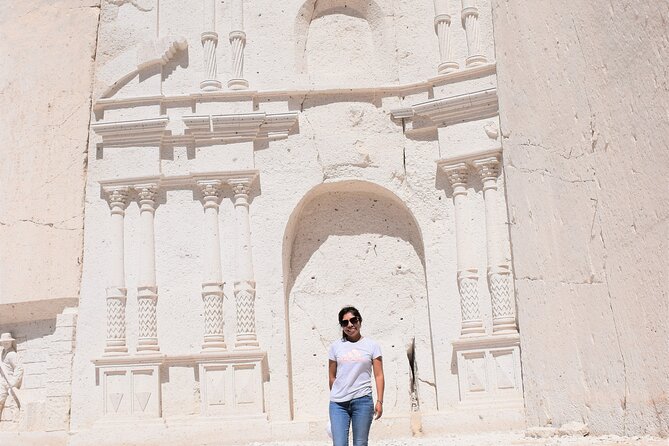
Arequipa is often called the White City because so much of its older architecture uses sillar. The stone is not ordinary white rock. It is volcanic ash that hardened over time, then was cut into blocks by hand and used for walls, arches, churches, and decorative facades.
That makes this excursion more than a quarry visit. You are seeing the raw material behind the city’s appearance. Once you understand that connection, the carved doorways around central Arequipa have more meaning. The city was not simply painted white. Its builders shaped a local volcanic stone into a distinctive style.
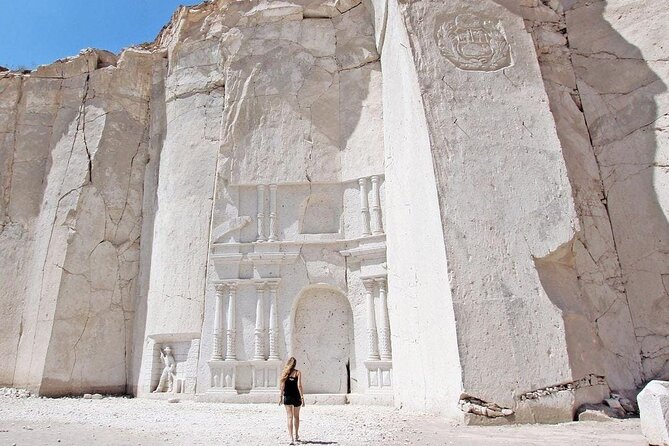
The quarry area near Arequipa is called Añashuayco. Local workers explain their cutting methods and show how the stone is handled. This is one of the strongest parts of the experience when the guide gives enough context. On weaker departures, visitors have been left to wander among sculptures with little explanation, so the quality of the commentary matters.
The setting is dusty, bright, and industrial rather than polished. You may see carved figures and photo-friendly shapes, but you are also looking at a place tied to real manual work. I find that contrast useful. It keeps the stop from becoming just another monument visit.
A few more Arequipa days worth comparing
- From Arequipa: Colca Canyon Full-Day Guided Tour with Meals
★ 4.5 · 982 reviews - Tour to the Salinas Lagoon and National Reserve in Arequipa
★ 4.5 · 548 reviews - From Arequipa: Sillar Route Trek
★ 4.2 · 461 reviews
Yanahuara and the three volcanoes
The first stop is Yanahuara, a traditional district known for its stone arches and broad view over Arequipa. You have about 20 minutes here, with no admission charge.
The arches frame the city and the volcanoes beyond it. On a clear day, you can see Misti, Chachani, and Pichu Pichu, the three best-known snow-capped peaks in the region. Misti is usually the most immediately recognizable, but the point of the stop is the full setting: colonial stonework in the foreground, Arequipa below, and volcanic peaks behind it.
This is a short orientation stop, not a full visit to Yanahuara. If you want careful photographs of every arch or time to explore the neighborhood, the schedule may feel tight. Some departures have also spent less time here because of traffic or delays earlier in the pickup route.
I recommend using these minutes well. Take your main city-and-volcano photograph first, then listen for the guide’s explanation of the arches and sillar. If the morning or afternoon haze is heavy, the volcanoes may not appear sharply. A late return can also reduce visibility, so an on-time start matters.
Inside the Añashuayco sillar quarries
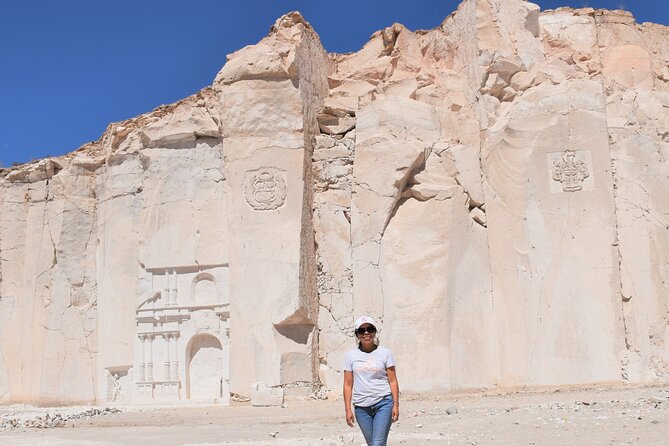
The quarry visit lasts about an hour and includes admission. This is the central stop, and it explains why Arequipa’s architecture looks the way it does.
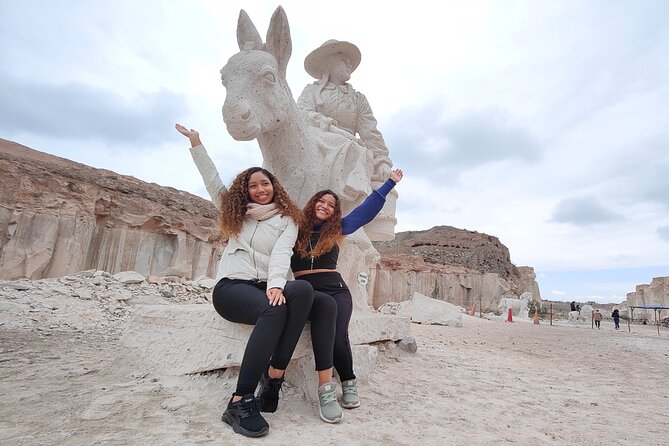
You walk among exposed volcanic stone and see sculptural work shaped from the same pale material used in the city. Workers explain their techniques and the different uses of sillar. Some departures include attractive carved figures and large photo areas, although certain sections or sculptures may require a small extra payment of around three soles.
That extra charge is worth checking before you start taking photographs. The main entrance is included, but not every display area is necessarily part of the basic visit. If you are short on time, ask the guide which carvings are included and which require payment. This avoids discovering the most elaborate pieces only as the group is leaving.
The quarry is not a cool museum. Expect sun, loose dust, and uneven surfaces. A face mask is a smart addition, especially if you have a dust allergy or sensitive lungs. One particularly practical tip is to bring water and wear shoes with a firm grip. The dust can coat clothing and footwear quickly.
The stop works best when you treat it as a place to watch and understand, not just pose beside sculptures. Ask how the blocks are cut, how the stone is transported, and how the work relates to Arequipa’s churches and older buildings. The guide’s role makes a major difference here. Mike, Alexandra, Sandra, and Christina have each been named as friendly bilingual guides on different departures, but the level and pace of English interpretation can change.
Walking through Culebrillas Canyon
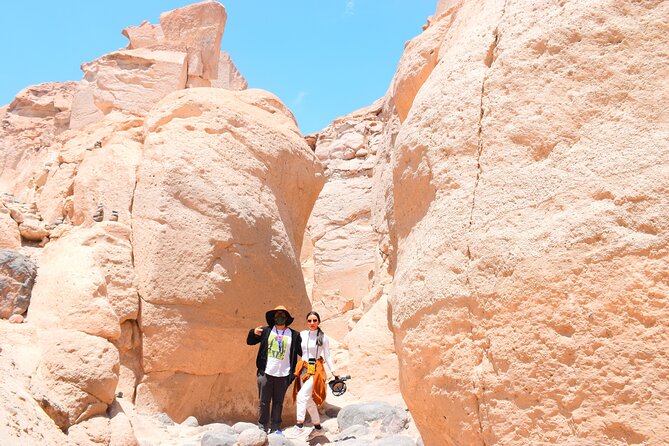
After the quarry, the vehicle travels about 15 minutes to Culebrillas Canyon. This is my favorite part of the route because you leave the display area and enter a narrow natural passage shaped by an ancient river.
The walk takes roughly 20 minutes. The ground is bumpy, and you climb a slope for about five minutes. It is not a long trek, but it is more than a flat stroll. You need to place your feet carefully, especially where the rock surface is uneven.
Culebrillas has curving walls that give the canyon its serpentine character. The walls are made of volcanic material, and the narrow route creates a more memorable sense of place than the open quarry. You can also see petroglyphs marked into the canyon walls.
Keep your expectations sensible. The petroglyphs are weathered and not always easy to make out. In bright midday light, the markings can fade against the volcanic rock. You may need the guide to point out the shapes, and even then, some animals require imagination. This is not a large, sharply defined rock-art gallery.
The canyon is also narrow enough that groups can bunch up. If you want photographs without people in the background, you may need patience and a little independence. At the same time, do not fall behind, since the guide needs to keep the group together and the route has meeting points.
At the end, you see apachetas, small stone mounds connected with a local mystical tradition. They are a quiet finish to the walk and offer a glimpse of living custom rather than a grand monument. The guide’s explanation helps here, since the meaning is not obvious from the stones alone.
Same trip, a completely different kind of day:
- Arequipa: Chili River White Water Rafting with Hotel Pickup
★ 4.8 · 329 reviews - 2-Day Tour Colca Canyon in Arequipa with end in Puno
★ 4.6 · 248 reviews - From Arequipa: 2-Day Colca Canyon Trekking Tour
★ 4.8 · 243 reviews - Colca Canyon Plus
★ 5.0 · 198 reviews
Timing, transport, and group size
The advertised duration is about four hours. That makes this a useful choice for a morning or afternoon when you want to keep space for Arequipa’s historic center, a meal, or another activity.
The tour includes hotel pickup, but the return arrangement deserves attention. The vehicle returns to the city center, and some departures finish at a central tourist stop rather than at each hotel. If you have a timed connection or a later reservation, ask exactly where the return ends.
Traffic can affect the day. A city event once caused a 45-minute delay, which shortened the stops at Yanahuara and the quarry. Pickup can also take time when the vehicle is collecting several people. The stated maximum is 18 participants, though some departures have had closer to 12 passengers. A smaller group is easier to hear and move through the canyon.
The vehicle experience has not been identical on every departure. Some passengers have found the minibus comfortable and well equipped, while others have reported poor air conditioning, crowding, or concern about seatbelt availability. Before setting off, check your seatbelt and tell the guide if you cannot use one. The roads to the quarry and canyon can be rough, and comfort matters during the return drive.
The trip back to the city takes about 40 minutes from Culebrillas. That is a significant part of a four-hour outing, but the sites are outside Arequipa and the drive is what makes this a simple half-day trip rather than a complicated self-guided excursion.
How the bilingual guiding affects the experience
This is a group tour, and English and Spanish may be spoken together. That can work very well when the guide gives both groups equal time and speaks at a steady pace. Guides including Mike, Alexandra, Sandra, and Christina have been praised for friendly bilingual explanations on different departures.
Still, language delivery is worth considering. Some English-speaking visitors have found that fast speech, poor microphones, or a short English explanation made it difficult to follow directions and background information. At a busy stop, missing the meeting point can create real confusion.
You can help yourself by staying close during the formal explanation, asking the guide to repeat directions, and confirming the time to return to the vehicle. Do not assume that free time means you can wander far from the group. At Culebrillas, the route is narrow and the terrain is uneven, so clear instructions are especially useful.
Is $19 a good price?
At $19 per person, this is one of the cheaper ways to visit the sillar quarries and Culebrillas in one outing. The price includes the certified guide, group transportation, and the two listed entrance fees, five soles for Añashuayco and five soles for Culebrillas.
I see the value in the transportation alone. You avoid arranging separate rides to sites outside the city, and the route fits into half a day. The tour also gives you a basic explanation of how Arequipa’s white stone is made and used.
The price does not guarantee a private guide, long stops, or detailed interpretation at every point. Small extras may apply for particular sculpture areas, and you will need to cover personal expenses. If you want a slow photographic visit or a specialist account of pre-Columbian rock art, this may feel too basic.
For a first visit to Arequipa, the low cost makes sense if you want an overview. It is less attractive if your schedule is already packed or if you can arrange a private visit with more control over timing.
Who should book this outing?
I would choose this tour if you have one free half-day and want to connect Arequipa’s architecture with its volcanic setting. It suits couples, solo visitors, families with older children, and anyone who enjoys a short walk without committing to a full-day hike.
You should be comfortable with dust, sun, a bumpy canyon path, and group-tour timing. The activity is not recommended for older adults who may struggle on uneven ground. It is also a poor choice if you have a dust allergy.
Bring water, sturdy shoes, sun protection, and a face covering. Mosquito or biting-insect protection has been suggested for some departures, although the main nuisance described at the quarry was sand flies rather than mosquitoes. Local advice provided the day before the tour may help you prepare.
Should you book the Sillar Route and Culebrillas?
Book it if you want an inexpensive, efficient introduction to the stone that shaped Arequipa. The best moments are the volcano-framed view from Yanahuara, the sight of workers shaping sillar, and the walk through Culebrillas Canyon. The route gives you variety without taking a full day.
Skip it if you need guaranteed slow pacing, polished transport, or extensive English commentary. The experience can be rushed after pickup delays, and the petroglyphs are subtle rather than dramatic. Read the return point carefully, confirm the language, and ask which quarry displays cost extra.
With those limits in mind, I think the tour earns its strong value. It is not a grand archaeological expedition. It is a practical look at Arequipa’s volcanic building stone, paired with a short canyon walk that gives the afternoon some texture.
FAQ
How long does the Sillar Route and Culebrillas tour take?
The tour lasts approximately four hours, including the visits and return journey to central Arequipa.
What places does the tour visit?
The route includes Yanahuara, the Añashuayco sillar quarries, and Culebrillas Canyon with its petroglyphs and apachetas.
Is hotel pickup included?
The tour begins with pickup at your hotel. The return is to the city center, and the exact drop-off may be a central tourist stop rather than your hotel.
Are entrance fees included?
Yes. The listed inclusions cover five soles for Añashuayco and five soles for Culebrillas.
Is the canyon walk difficult?
The walk takes about 20 minutes and includes uneven ground plus a slope of about five minutes. Good-grip footwear is recommended.
Is the tour suitable for older adults?
It is not recommended for older adults because the Culebrillas Canyon path is rugged in places.
Should I bring protection from dust?
Yes. The quarry can be dusty, so a face mask is a sensible precaution. The activity is not recommended for people with a dust allergy.
How many people can join the group?
The maximum group size is 18 participants.
Can I cancel for a full refund?
You can cancel at least 24 hours before the start time for a full refund. Cancellations or changes made less than 24 hours before the experience are not accepted for a refund.
Just added around Arequipa
- Turist Bus Colca Canyon (Chivay) To Puno★ 5.0 · 83 reviews
- 3-Day Colca Canyon trek with Professional Guide★ 5.0 · 40 reviews
- Trekking, Waterfalls and Thermal Baths★ 4.5 · 47 reviews
- Salinas National Reserve PRIVATE TOUR★ 5.0 · 81 reviews
- Sillar Route in Arequipa and viewpoint of the Volcanoes★ 4.0 · 71 reviews
- Private 3 Day Colca Canyon Trekking tour (superior Service)★ 5.0 · 58 reviews
- Full Day Tour / Colca Canyon★ 4.0 · 70 reviews
- Colca Full Day★ 5.0 · 57 reviews
Arequipa Tours, compared.
Tour to the Salinas Lagoon and National Reserve in Arequipa
Read our review →

Arequipa: Chili River White Water Rafting with Hotel Pickup
Read our review →
2-Day Tour Colca Canyon in Arequipa with end in Puno
Read our review →
From Arequipa: 2-Day Colca Canyon Trekking Tour
Read our review →
Walking tour in the Historic Center of Arequipa
Read our review →
From Arequipa: Full Day Tour of Colca Canyon with Meals
Read our review →Browse the lists this tour appears in