
Reviewed · HISTORICAL TOURS
Explore Little Africa : Unveiling Afro Heritage in Rio de Janeiro
Rio’s Little Africa is not a theme park or a polished museum district. It is a real section of the port area where churches, squares, archaeological sites, music, memory, and the legacy of slavery meet. This tour gives you a clear way into that story, from Pretos Novos and the former Valongo Wharf to Pedra do Sal and the streets of Saúde.
I like the way the route links difficult history to living Afro-Brazilian culture. I also like the guides’ personal approach. Carolina, Rafael, Malu, Val, and other guides have been praised for clear explanations, warmth, humor, and the ability to handle serious subjects without turning the walk into a lecture. The main drawback is the amount of walking, and the afternoon finish can bring weaker light for photographs.
Key points
- A direct look at Rio’s Afro-Brazilian past: The route addresses slavery, resistance, faith, music, and the lasting effects of inequality.
- Six stops with different purposes: Churches, museums, an archaeological site, a former wharf, and historic public spaces each add a new layer.
- IPN admission is included: The ticket to the Instituto de Pesquisa e Memória Pretos Novos is part of the tour price.
- A short VLT ride breaks up the walk: Public transport is included, making the route feel connected to present-day Rio.
- Guides bring the subject to life: Past guides named Carolina and Rafael received especially warm praise for their clarity and energy.
- Plan for comfortable shoes: The tour lasts about three and a half hours and is not recommended for people with disabilities.
Why Little Africa matters in Rio
Rio is often introduced through Christ the Redeemer, Sugarloaf Mountain, beaches, and samba. Those sights matter, but they do not explain how the city was built. Little Africa offers another starting point.
The port area around Saúde and Gamboa was shaped by the forced arrival of Africans and by the Black communities that formed afterward. The route does not treat this past as a footnote. It places the history in streets, churches, excavation sites, and public squares.
That approach is the tour’s main strength. You are not simply shown a display case and given a date. You are asked to connect places with people: those brought to Brazil under slavery, those who survived, those who formed religious and musical traditions, and those whose descendants continue to shape Rio.
The subject can be painful. A good guide needs to be honest without becoming theatrical, and the strongest accounts of this tour describe guides who handled that balance well. The experience addresses the cruelty of slavery and its continuing shadow while also giving space to strength, faith, creativity, and community.
More Historical Tours in Brazil
- Rio de Janeiro: Historic Rio and Santa Teresa Half-Day Tour
★ 4.4 · 228 reviews - Rio de Janeiro: Little Africa Heritage Walking Tour
★ 4.9 · 177 reviews - Learn the History of Rio with an Unforgettable City Center Walking Tour
★ 5.0 · 82 reviews
Starting at Santa Rita Church
The meeting point is the Santuário de Santa Rita, at Largo de Santa Rita in central Rio. The first stop is an external visit, lasting about 20 minutes, focused on the church and the surrounding heritage.
This opening matters because churches in Rio were not separate from the city’s social history. They were places of worship, gathering, power, and conflict. The guide uses the setting to introduce a decolonial reading of the area, meaning the story is not told only through the viewpoint of colonial authorities or official institutions.
You will not spend a long time inside here. The value is in the explanation around the site and in the way it prepares you for the more confronting stops ahead. It is a compact beginning, but it gives the walk a clear purpose.
The Pretos Novos Institute and the evidence beneath the city
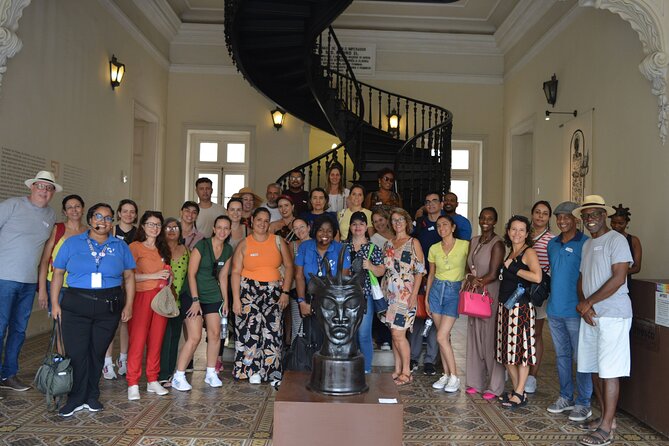
The Instituto de Pesquisa e Memória Pretos Novos, usually called IPN, is one of the most important stops. The visit lasts about 40 minutes, and admission is included.
The institute is connected to archaeological remains associated with Africans who died shortly after arrival in Rio. That makes this more than a standard museum visit. The site deals with human lives and with the way physical evidence can force a city to face what had been ignored or forgotten.
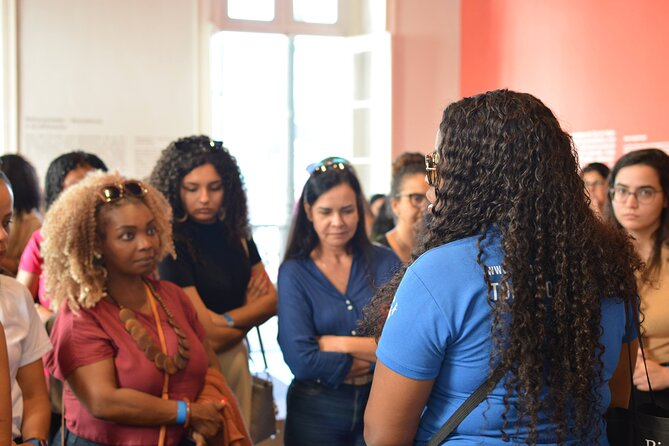
Your guide’s role is especially important here. Dates alone cannot explain what the site means. The best guides add context about the people represented, the system that brought them to Brazil, and the work of preserving memory.
This is likely to be the emotional center of the tour. If you prefer light sightseeing, it may feel heavy. If you want to understand Rio beyond its postcard image, it is essential.
One practical point: IPN is closed on Sundays. If this institute is a main reason for booking, avoid that day.
MUHCAB puts Afro-Brazilian culture at the center
The next major stop is MUHCAB, the Museum of Afro-Brazilian History and Culture. The visit takes about 40 minutes, and admission is listed as free.
MUHCAB is described as a territory museum, which means the surrounding Gamboa area is part of the story. The museum is not treated as an isolated building where history ends at the door. Instead, the neighborhood helps explain how Afro-Brazilian identity developed and remains visible.
This stop broadens the subject. IPN centers on death, loss, and memory. MUHCAB gives more room to cultural life, community, and the many African origins that shaped Brazil. Guides have used this part of the tour to discuss different African countries and the ways their descendants contributed to Brazilian society.
The museum also helps place Rio in a wider African diaspora. You are not being given a simple comparison between Brazil and the United States. You are shown that Black life in Brazil has its own history, institutions, religions, struggles, and forms of resistance.
The exact exhibitions and access conditions can vary, especially during holiday periods. All museums are closed from December 16 through January 5 and during Carnival season, so check the date carefully.
More Historical Tours in Rio de Janeiro
- Olympic Boulevard, Museum of Tomorrow & Historical Rio
★ 4.5 · 66 reviews - Rio: Olympic Boulevard, Museum of Tomorrow & History Tour
★ 4.1 · 47 reviews
Cais do Valongo, where the port tells the truth
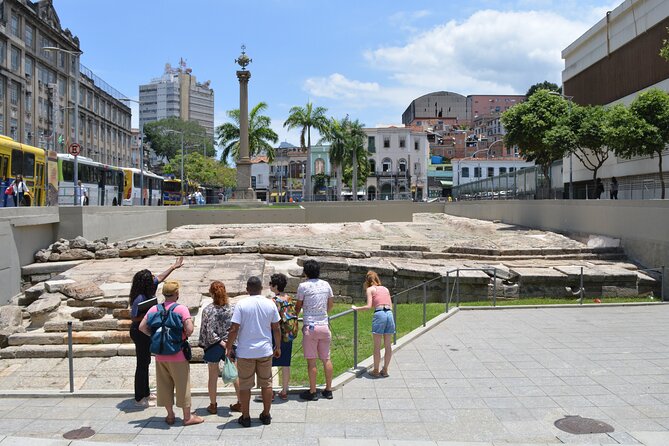
Cais do Valongo is a former wharf in Rio’s port district, between present-day Coelho e Castro and Sacadura Cabral streets. The stop lasts about 30 minutes and is outdoors.
The site is powerful because it connects the history of slavery to a specific working port. This was not an abstract system happening somewhere far away. People arrived here, were processed here, and entered a city that had been shaped around their forced labor.
Your guide will explain the significance of the wharf and its place in the wider Little Africa area. The stop is not long, so listen closely and ask questions while you can. The open setting also means weather matters. The tour requires good weather, and poor conditions can lead to a new date or a full refund.
For me, the value of Cais do Valongo is its plainness. There is no need for a grand building to make the point. The location itself carries the weight.
Pedra do Sal links memory, faith, and music
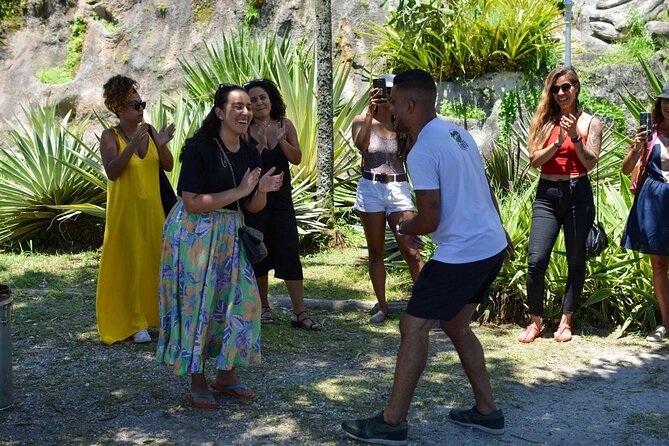
Pedra do Sal is an external stop in the Saúde neighborhood, near Largo da Prainha. The visit lasts about 25 minutes.
It is both a historic and religious landmark, and it is closely tied to the Black presence in the area. The guide’s explanation helps connect the stone, the neighborhood, and the traditions that grew around them.
This is also where the route begins to shift from the record of suffering toward the continuing life of the community. The story is not only about what was done to Africans and their descendants. It is also about what they created, protected, and passed on.
The stop is outdoors, so comfortable footwear matters. The route is manageable for many people, but it is still a walking tour with uneven urban surfaces possible. The provider does not recommend the experience for people with disabilities, although one guide adjusted the pace and route for a family member who could not manage all the walking.
Largo da Prainha is the right place to finish
The final stop is Largo São Francisco da Prainha, where the tour ends. The visit lasts about 20 minutes.
The square was once a symbolic part of Little Africa, marked by Black presence and the zungus, communal spaces associated with Afro-Brazilian life. Today it is also known for its restaurants and social atmosphere, and Time Out has named it one of Rio’s coolest places.
That contrast gives the ending some lift. After several hours of confronting the past, you finish in a public square that remains part of the city’s daily life. You can take in the setting, consider what you have heard, and continue into the surrounding area afterward.
The end point is at R. São Francisco da Prainha, 7, in Saúde. Lunch is not included, but this is the practical place to continue with a meal on your own.
What the guide adds to the experience
This tour depends heavily on the guide. The places matter, but the interpretation determines whether the route feels connected or merely divided into six stops.
Guides named in past sessions include Carolina, Rafael, Malu, Val, and others. Carolina has been praised for pacing the walk well, including for older relatives in their seventies. Rafael has been described as both entertaining and well informed, with a talent for making the subject easy to follow. Malu was praised for a pleasant manner, while Val was noted for speaking English well enough to explain Afro-Brazilian culture and history clearly.
Guide assignments can change, so do not book on the assumption that one particular person will lead your group. What you can reasonably expect is a guide-led experience rather than a silent route between landmarks.
English interpretation has been available, though one past booking was rescheduled while an English interpreter was arranged. If language is important to you, confirm the language when booking.
The walking, timing, and group size
The tour lasts about three hours and 30 minutes and allows a maximum of 20 people. That is small enough for questions without making the experience private.
There is a short ride on Rio’s VLT public transport, included in the final price. This is useful because it gives your feet a brief rest and shows how the historic port area connects with the modern city.
The tour is usually offered in the afternoon. One guide explanation for that timing is practical: Rio can be extremely hot earlier in the day, and an early start can leave people tired and hungry before the history is finished. By afternoon, you may be more comfortable walking and paying attention.
The trade-off is daylight. If the tour begins at 2 p.m., it may become darker near the final stops, which can make photographs less satisfying. If photography is your priority, keep your expectations modest. If listening and understanding matter more, the afternoon timing makes sense.
Wear comfortable shoes, bring water, and eat before you arrive. There is no lunch included, and hunger is a poor companion for a serious history lesson.
Is the 82.53 price fair?
At $82.53 per person, this is not a cheap orientation walk. The price includes all fees and taxes, the IPN ticket, and the VLT ride, but not lunch or tips.
The value comes from the subject and the guide rather than from a long list of paid attractions. You are paying for a focused route through six significant places, expert interpretation, museum access, and the convenience of having the history linked for you.
A self-guided visit could cost less, especially since several stops are free. But it would be harder to understand how Santa Rita, IPN, MUHCAB, Cais do Valongo, Pedra do Sal, and Largo da Prainha fit together. The tour earns its price if you want context, English guidance, and a thoughtful route through a part of Rio that many standard sightseeing plans skip.
It is also a strong addition to the famous attractions rather than a replacement for them. If you have time for only one Rio outing, your choice may depend on your interests. If you have several days, this is the history-focused half day that gives the rest of the city more meaning.
Who should book this Little Africa tour?
I would choose this experience if you care about history, African diaspora studies, religion, social change, or the human stories behind a city’s monuments. It also suits anyone who wants to see Rio beyond beaches and viewpoints.
Families can enjoy it, provided children are ready for serious subject matter and walking. Older adults may manage it well if they are comfortable on foot, and the pace can sometimes be adjusted, but the provider does not recommend it for people with disabilities.
This is not the right pick if you want a relaxed food tour, a scenic drive, or nonstop photo opportunities. Much of the power comes from listening, asking questions, and accepting that some stops are difficult.
Cancellation is free up to 24 hours before the start time for a full refund. Changes or cancellations made later are not accepted for a refund. Since the experience depends on good weather, a weather cancellation brings the choice of another date or a full refund.
Should you book it?
Book it if you want Rio’s Afro-Brazilian story explained by a guide who can connect archaeology, faith, slavery, culture, and present-day life. The strongest parts are IPN, Cais do Valongo, and the guide-led links between sites. Give yourself food, water, and good shoes, and do not expect a lightweight sightseeing stroll.
Skip it only if walking is difficult, the subject is not a priority, or your schedule falls on a Sunday or during the museum closure periods. For an afternoon of serious, well-placed history in Rio, the price is fair and the route is unusually worthwhile.
FAQ
How long does the Little Africa tour last?
The experience lasts approximately three hours and 30 minutes.
Where does the tour begin?
It begins at Santuário de Santa Rita, at Largo de Santa Rita, s/n, Centro, Rio de Janeiro.
Where does the tour end?
The tour ends at Largo São Francisco da Prainha, at R. São Francisco da Prainha, 7, in Saúde.
Is transportation included?
Yes. The tour includes a short ride on Rio’s VLT public transport, and the cost is included in the final price.
Is admission to the Pretos Novos Institute included?
Yes. The ticket for the Instituto de Pesquisa e Memória Pretos Novos is included.
Is lunch included?
No. Lunch is not included, so you should eat before the tour or plan to buy food after it ends.
Is the tour available on Sundays?
The New Black Institute is closed on Sundays, so the tour does not offer the usual IPN visit on that day.
Are the museums open all year?
The museums are closed from December 16 to January 5 and during Carnival season.
Can I cancel for a full refund?
Yes. You can cancel at least 24 hours before the experience for a full refund. Cancellations or changes made less than 24 hours before the start time are not refunded.
Just added around Rio de Janeiro
- Skip the Line: Lagoa Misteriosa Admission Ticket with Scuba Diving Experience★ 5.0 · 81 reviews
- Rio de Janeiro: Tijuca Peak Guided Hike★ 4.7 · 56 reviews
- Rio de Janeiro: Sunrise Lookout and Christ the Redeemer Tour★ 5.0 · 121 reviews
- Sugarloaf Mountain Fast-Pass Ticket and Guided Tour★ 4.4 · 62 reviews
- Rio de Janeiro: Sugarloaf Mountain Hike and Climb★ 5.0 · 45 reviews
- Rio de Janeiro: Samba Class and Samba Night Tour★ 4.6 · 115 reviews
- Rio Surf Experience★ 4.9 · 37 reviews
- Rio Samba Bus: hop-on hop-off city tour in Rio de Janeiro★ 3.8 · 94 reviews
Historical Tours, compared.
Historic Center and Getsemaní Shared Walking Tour
Read our review →
Lima’s Vibrant Heritage: Exploring the City’s Landmarks Half-day
Read our review →



Lima: Historic Center Street Food, Market, and Eateries Tour
Read our review →
Nazis in Buenos Aires: a historical walking tour
Read our review →
Browse the lists this tour appears in