
Reviewed · URUGUAY TOURS
Private Have It Your Way Tour in Montevideo
Montevideo is easiest to understand from a moving car, with short walks mixed in. This private tour links the Old City, grand public squares, the coast, residential districts, football landmarks, and the hilltop Fortaleza del Cerro. I especially like the chance to shape the day around your interests, and the friendly local guides, including Favio, Paola, and Dahian, add plenty of personal context. The main catch is pace: in four to six hours, you can see a lot, but some stops are brief.
I also like that lunch, wine, a vineyard, a winery, an estancia, or professional photography can be added by arrangement. That flexibility makes the tour useful for a first visit, a cruise stop, or a return visit when you want to see something beyond the standard sights. Just remember that food, museum tickets, and gratuity cost extra, and poor weather can force a cancellation or change of date.
Key points at a glance
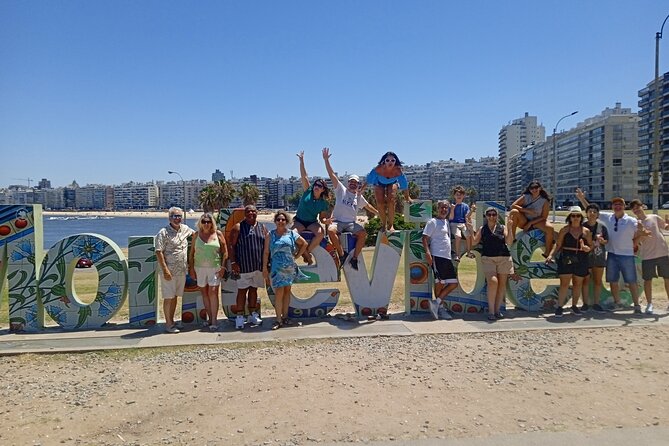
- Private from start to finish: Only your group participates, with transportation, air conditioning, WiFi, and bottled water included.
- A broad Montevideo sampler: See the Old City, La Rambla, Pocitos, Punta Carretas, Buceo, Carrasco, Prado, and Cerro in one outing.
- Built around your interests: Ask for Uruguayan barbecue, a wine tasting, a vineyard, an estancia, football, photography, or a neighborhood not on the standard route.
- Strong local guiding: Favio, Paola, Dahian, Anabella, and other guides have been praised for English, local knowledge, humor, and flexibility.
- Good for limited time: The tour works especially well when you have one day in port or want an overview before exploring alone.
- Plan for extra costs: Lunch, museum admission, the Legislative Palace, football museum entry, and tips are not included.
Why a private car works well in Montevideo
Montevideo is spread out. The Old City sits at one end of the central city, while the coast, residential districts, Prado, Batlle Park, and Cerro pull you in different directions. Walking alone can give you a good taste of the center, but it will not easily connect all these areas in half a day.
This tour solves that problem with private transportation and short walking stops. You can get out at a square, look closely at a building, walk through part of the Old City, then return to the car for the next district. Travel time is included in the four to six hour duration, so the day is not four to six hours of sightseeing on foot.
The private format matters. You can ask to slow down, skip a stop, spend more time at a café, or avoid too much walking. One couple with limited mobility requested a gentler city visit and a winery stop, and the tour was adjusted with drives and optional walks. Another group of five received a larger vehicle for added comfort.
The guides are not always the same. Favio is the main name connected with the experience, while Paola, Dahian, Anabella, Fabio, and Santi have also led tours. English ability was praised repeatedly, including clear English from Paola and American English from Favio. If language or walking pace matters to you, confirm those details when booking.
A few more Uruguay days worth comparing
- Montevideo: Sightseeing Hop-On Hop-Off Bus Tour
★ 4.5 · 320 reviews - Skip the Line: Casapueblo Museum Admission Ticket in Punta del Este
★ 4.5 · 281 reviews - Colonia del Sacramento:Best Walking Tour (Historic Old Town)
★ 4.9 · 180 reviews
Entering the Old City at Mercado del Puerto
Mercado del Puerto is a strong opening if you want food and atmosphere right away. The 19th-century market is filled with restaurants and restobars centered on meat cooked over open grills. This is the place to consider a classic Uruguayan parrillada, the country’s famous mixed grill.
The market stop is listed at about 20 minutes, which is enough to look around but not enough for an unhurried meal. If you want to eat here, say so before the tour and allow extra time. Lunch is not included, and the market can be crowded when a cruise ship is in port. One New Year’s Day visit became especially busy because few other places were open and many passengers were looking for food at the same time.
A practical point: Mercado del Puerto is optional. If grilled meat is not your priority, you can use the time elsewhere. If food is central to your visit, ask about parrilla, empanadas, or a chivito, Uruguay’s well-known steak sandwich. One guest particularly enjoyed a Chivito Arocena during a longer city outing.
Plaza Zabala and the quieter side of the Old City
Plaza Zabala gives you a calmer view of the Old City. It is named for Bruno Mauricio de Zabala, the founder of Montevideo, and its gardens were designed by French landscape architect Édouard André. Iron fences and gates frame the square, while the Taranco Palace sits along its southern side.
The planned stop is short, about 10 minutes, and walking is optional. That makes it a useful photo stop rather than a place for a long visit. Ask your guide about the palace and the Museum of Decorative Arts if architecture or interiors interest you. Museum admission is not always included, and museum charges can range from about $3 to $14.
This is one of the places where a private tour has an advantage over a fixed group schedule. You can walk around the gardens, stay with the vehicle, or ask for more explanation about the surrounding streets. The square is near other Old City sights, so it fits naturally with the next stop.
Plaza Matriz and Montevideo’s civic heart

Plaza de la Constitución, usually called Plaza Matriz, is the historic center of the Old City. It began as the main open space of the original fortress city of San Felipe and Santiago de Montevideo. Today, it remains one of the best places to get a feel for the city’s older street plan.
The visit lasts about 25 minutes and can be done on foot. You can expect to see the cathedral and important civic buildings around the square, while your guide explains how this public space fits into Montevideo’s past and present.
This is a good place to ask questions. Several tours have been especially strong on architecture, artists, buildings, and the way old Montevideo connects with modern life. If you care more about local context than checking off sights, give your guide room to explain what you are seeing instead of rushing to the next stop.
More private tours in Uruguay:
- Private Transportation from Carrasco Airport to Port in Montevideo
★ 5.0 · 84 reviews - Montevideo Private Your Way – Perfect for Cruise Passengers.
★ 5.0 · 82 reviews - Bogotá: Private City Tour, Monserrate, Emerald and Botero
★ 4.9 · 798 reviews - La Paz: Private City Tour with Cable Car & Moon Valley Visit
★ 4.9 · 508 reviews
Plaza Independencia and Palacio Salvo
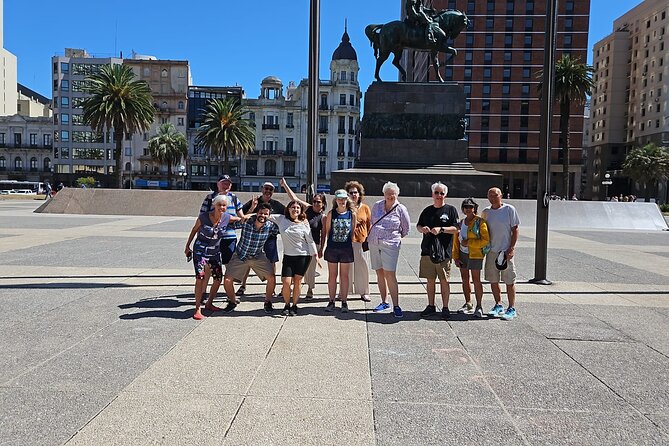
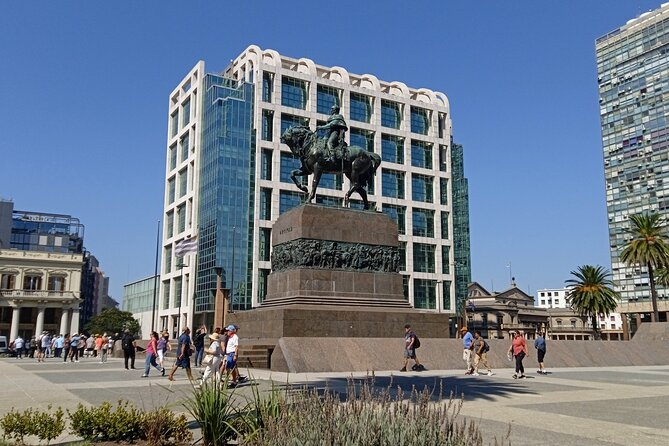
Plaza Independencia is Montevideo’s largest and most important square. It occupies the former site of the city citadel and is centered on the monument and mausoleum of General José Gervasio Artigas, a key figure in Uruguayan national history.
Allow about 30 minutes here. The square gives you a clear look at the transition between the Old City and the newer center. Its most famous building is Palacio Salvo, completed in 1928 and known for its unusual eclectic design. At the time, it was one of the tallest buildings in South America.
This stop is valuable because several parts of Montevideo meet in one view: national memory, grand architecture, the former defensive edge of the city, and the busy central streets beyond. It is also a good spot for photographs, though the short time may feel limited if you want to study Palacio Salvo in detail.
Following La Rambla beside the Río de la Plata

La Rambla is the long coastal avenue that follows Montevideo’s edge beside the Río de la Plata. The route is described as about 24 kilometers, while one account of the tour refers to roughly 22 kilometers. Either way, it is a major part of the city and not just a quick waterfront drive.
The coastal road helps explain Montevideo’s relaxed feel. You will see beaches, broad views, and a series of neighborhoods rather than one single city center. The tour can include Pocitos, Punta Carretas, Buceo, and Carrasco, each with its own character.
You can ask to stop for a short walk or simply enjoy the view from the vehicle. This flexibility is useful on a windy day, since Montevideo’s waterfront can be breezy. It is also helpful if you want to cover ground without spending the whole tour on foot.
For many visitors, La Rambla becomes one of the most memorable parts of the day because it shows how locals use the city. The promenade is not only a scenic road. It is part of daily life, exercise, beach time, and neighborhood identity.
The Legislative Palace and Batlle Park
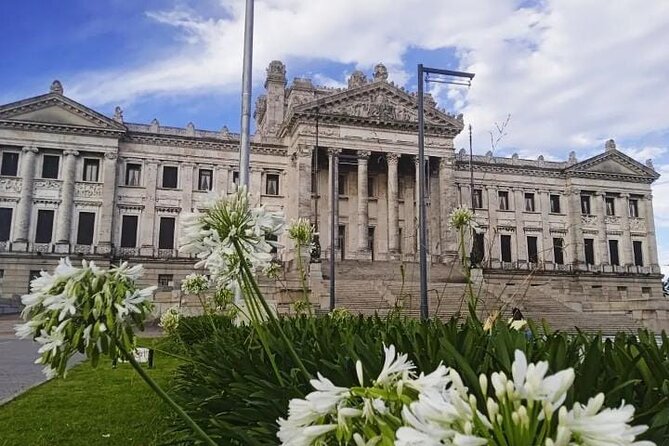
The Legislative Palace is the headquarters of Uruguay’s national legislature. Its General Assembly includes the House of Representatives and the Chamber of Senators. The building has a grand presence, and the exterior alone makes it worth seeing.
The standard stop is about 15 minutes. Entry costs $3 and is not included. If you want to go inside, confirm the timing with your guide, since a brief city tour may not leave much room for a full visit.
After the palace, the route can pass through Batlle Park before reaching the Estadio Centenario. Batlle Park gives you another view of Montevideo beyond the Old City and waterfront. It also helps connect the city’s civic buildings with its sporting identity.
Estadio Centenario and Uruguay’s football story
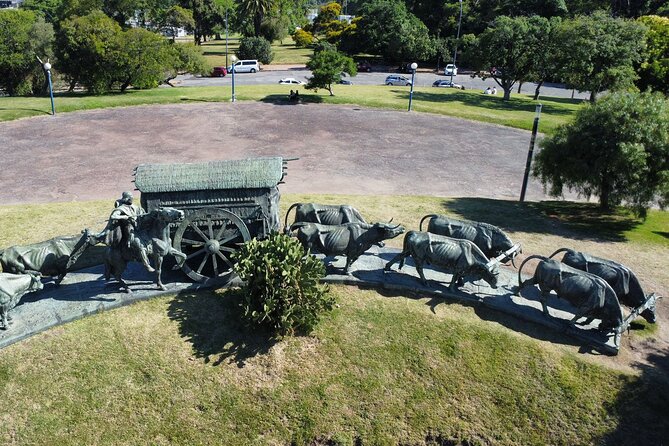
Estadio Centenario is an important stop for anyone interested in football. Uruguay was the first world champion, and the stadium hosted the finals connected with that early World Cup era. The building is more than a sports venue. It is part of the country’s national story.
The football museum has a separate charge of 300 Uruguayan pesos. Ask ahead if you want enough time for the museum, since the wider city route already covers many districts and landmarks.
This stop can be adjusted to your interests. If football is a major reason for visiting Uruguay, give it more time and consider the museum. If it is not, you can keep the visit brief and use the extra time for a neighborhood, the waterfront, or food.
Prado Park, gardens, and the Japanese garden
Prado is a quieter residential district centered on an extensive park. The area includes a botanical garden, El Rosedal with roses arranged around stone arches, and the Japanese garden. The Blanes Museum, housed in a 19th-century chalet, adds an art stop for those interested in Uruguay’s artists.
The planned visit lasts about 40 minutes and admission to the park areas is free. It is one of the better choices if you want a break from monuments and traffic. You can stroll among plants and gardens, take photographs, or simply enjoy a slower stretch of the day.
Las Carmelitas, a much-photographed church built in the 1920s, is another Prado-area sight. The district gives the tour a different rhythm from Plaza Independencia or Mercado del Puerto. Still, forty minutes passes quickly if you want to visit the museum and several gardens, so decide in advance what matters most.
Fortaleza del Cerro and the view over Montevideo
The General Artigas Fortress, also called Fortaleza del Cerro, sits on the Cerro de Montevideo. It was built in 1808 on the orders of Governor Francisco Javier de Elío and is regarded as one of Uruguay’s major national symbols.
The listed stop lasts about 30 minutes and has no admission charge. Its position gives the tour a broader view of Montevideo and helps you understand the city’s geography after seeing the coast and central districts.
The fortress is a strong final stop because it shifts the focus from individual buildings to the city as a whole. You have seen the old center, the coastline, the parks, and the newer residential areas. From Cerro, those parts make more sense as one spread-out capital.
Adding wine, food, or a neighborhood of your choice
The tour’s best feature is its open-ended design. You can request a winery or vineyard, an estancia, professional photography, Carrasco, or another part of Montevideo that interests you. These additions may change the route and length, so arrange them before the day begins.
A winery visit can take the tour outside the city. One customized outing included Bouza Winery, about 30 minutes from Montevideo, with a winery visit and tasting near a collection of vintage automobiles and trucks from the 1930s. Wine fans can also ask about tastings focused on Tannat, Uruguay’s best-known grape, sometimes paired with cheeses.
Food needs the same planning. Lunch is not included, but the guide can suggest restaurants. You might choose parrillada at Mercado del Puerto, a chivito, empanadas, or another local meal. Do not assume there will be snacks during a six-hour outing. Request food in advance, especially if you are arriving from a cruise ship and have a fixed departure time.
Price, timing, and overall value
The price is $150 per person. That is not the cheapest way to see Montevideo, but the value improves when two or more people share the private vehicle and make good use of the customization.
You are paying for private transportation, air conditioning, WiFi, two bottles of water, and a guide rather than a simple transfer. You also avoid trying to connect distant districts by taxi or public transport during a short stay. For a couple with only one day in port, the time saved can justify the cost.
The value is weaker if you prefer to spend several hours in one museum, sit over a long lunch, or explore the Old City slowly. The standard route covers many places, and some stops last only 10 to 15 minutes. Ask for fewer stops if you prefer depth over coverage.
The tour is often booked well ahead, with an average booking time of about 59 days. That matters during cruise season or when you need a particular guide, vehicle, winery, or schedule. Confirmation is provided at booking, but the operator may vary depending on group size and availability.
Free cancellation is available up to 24 hours before the start time. Changes or cancellations inside that window are not refunded. The tour requires good weather, and if poor conditions make it unsafe, you are offered another date or a full refund.
Who should book this Montevideo tour?
I would choose this tour if you have limited time, want to see several sides of Montevideo, or prefer a private day with an adjustable walking level. It suits couples, families, solo visitors, cruise passengers, and anyone who wants local help with food, wine, architecture, football, or neighborhoods.
It is also a good first-day option. The route gives you enough orientation to decide where to return on your own. You can learn the basic shape of the city, then spend later time in the Old City, on La Rambla, or at a restaurant.
I would be more cautious if you dislike driving between stops or want a slow, specialist visit to one site. Ask for a shorter list of stops and a longer lunch or museum visit. Also check holiday dates. On New Year’s Day, many businesses and attractions may be closed, and busy conditions can make Mercado del Puerto less pleasant.
Should you book it?
Book this private Have It Your Way tour if your goal is to get your bearings fast while still having room for personal choices. The strongest reasons are the private vehicle, broad coverage, helpful English-speaking guides, and the ability to add wine, football, food, gardens, or photography.
Before booking, send a clear wish list. Tell the operator how much you want to walk, whether lunch matters, and which stops deserve extra time. If you do that, the $150 price can buy a very efficient and personal introduction to Montevideo. If you want an unhurried Old City walk, choose fewer stops rather than trying to fit everything into one half-day.
FAQ
How long does the private Montevideo tour last?
The tour lasts approximately four to six hours, including travel time between sights.
What is included in the price?
Private transportation, WiFi on board, air conditioning, two bottles of water, and a guide are included. Only your group participates.
Is lunch included?
No. Lunch is not included, but the guide can provide restaurant options. Parrillada, chivito, empanadas, and other food choices can be discussed before the tour.
Does the tour include entry to museums and the Legislative Palace?
Some admission fees are extra. Entry to the Legislative Palace costs $3, museum fees may range from $3 to $14, and the Estadio Centenario Football Museum costs 300 Uruguayan pesos.
Can I request a winery or vineyard visit?
Yes. Winery tours, vineyard visits, estancia tours, professional photography, Carrasco, and other areas can be added according to your interests and arrangements with the operator.
What happens if the weather is poor?
The experience requires good weather. If it is canceled because of unsafe conditions, you will be offered a different date or a full refund. Free cancellation for other reasons is available up to 24 hours before the start time.
Just added around Uruguay
- Shared Montevideo Tour for Cruisers★ 4.0 · 118 reviews
- From Montevideo to Punta del Este Complete★ 4.0 · 123 reviews
- Private Transportation from Carrasco Airport to Port in Montevideo★ 5.0 · 84 reviews
- Montevideo Private Your Way – Perfect for Cruise Passengers.★ 5.0 · 82 reviews
- Montevideo Highlights: Shared City Tour for Cruise Passengers★ 4.5 · 141 reviews
- The Best Punta del Este Day Trip from Montevideo★ 4.0 · 158 reviews
- Colonia del Sacramento Full Day from Montevideo★ 4.0 · 165 reviews
- Full day Punta del Este tour★ 4.5 · 177 reviews
Uruguay Tours, compared.
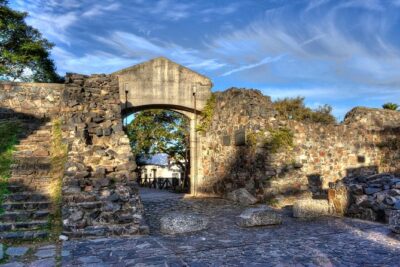
Colonia del Sacramento Full Day from Montevideo
Read our review →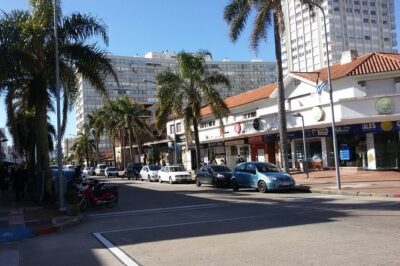
The Best Punta del Este Day Trip from Montevideo
Read our review →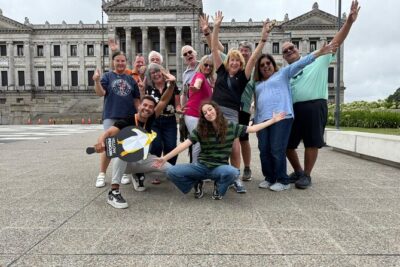
Montevideo Highlights: Shared City Tour for Cruise Passengers
Read our review →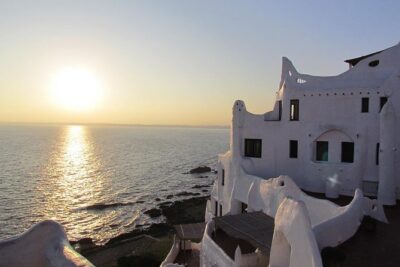


Private Transportation from Carrasco Airport to Port in Montevideo
Read our review →Browse the lists this tour appears in