
Reviewed · MUSEUMS
Official Ticket: Oceanographic Museum Univali – Piçarras – SC
The most striking part of the Univali Oceanographic Museum is its scale. In about an hour to an hour and a half, you move from fossils and early ocean science to sharks, rays, deep-sea fish, sea turtles, penguins, whales, and live aquarium displays. I especially like the white shark jaw, said to be the only one exhibited in Brazil, and the full-scale blue whale panel outside, which helps you grasp just how enormous a 33-meter animal really is.
I also like the sensory experience with marine animals, especially for children who learn better by handling than by reading labels. The museum’s seven color-coded wings make the route easy to follow, though dim lighting and missing explanations on some pieces can limit the experience. At $15.68 per person, it is a fair choice for families and marine-life fans, but less convincing if you expect large, highly active aquariums.
Key Points Before You Go
- Seven themed wings: Follow the story from the origin of life and oceanography to marine mammals.
- More than 1,400 pieces: See fossils, shells, preserved specimens, skeletons, teeth, jaws, and taxidermied animals.
- Live marine animals: Aquariums add movement to displays that otherwise focus on preserved material.
- Rare specimens: Look for the white shark jaw, abyssal fish from depths beyond 2,000 meters, and all five Brazilian sea turtle species.
- Sensory animal experience included: The touch-lab style activity gives children and adults a more direct connection with marine life.
- Short indoor outing: Plan on 60 to 90 minutes, with admission available Tuesday through Sunday from 2:00 PM to 5:30 PM.
Why This Museum Is Worth Your Time in Piçarras
Piçarras is on Santa Catarina’s coast, so a museum about the sea fits naturally into a visit here. The Univali Oceanographic Museum gives you something a beach day cannot: a look at the animals, adaptations, fossils, and ocean research behind Brazil’s marine environment.
I would not treat it as a quick room of aquariums. The collection includes more than 1,400 pieces, and much of the display is devoted to preserved animals, skeletons, shells, teeth, jaws, and scientific material. Live aquariums are mixed into the route, giving the exhibition some movement and helping you connect a shell or skeleton with a living animal.
The museum works best when you enjoy both natural history and visual displays. You may spend only an hour here, but the material covers a wide span, from the first stages of life to modern ocean exploration. Families can keep the visit moving by treating each colored wing as a new chapter.
There are limits. Some areas may feel dark, and several pieces do not have as much written explanation as you might want. A few aquarium areas may also feel less full than expected. If your main goal is a large aquarium with constant animal activity, the admission price may feel less appealing.
More Museum Tours in Brazil
- Petrópolis Day Trip from Rio de Janeiro including Imperial Museum and Crystal Palace
★ 4.0 · 101 reviews - 7-Hour Shared Group Santos Tour : Mont Serrat, Coffee Museum and Sightseeing
★ 5.0 · 68 reviews - Olympic Boulevard, Museum of Tomorrow & Historical Rio
★ 4.5 · 66 reviews
The Blue Wing Begins With Fossils and Ocean Exploration
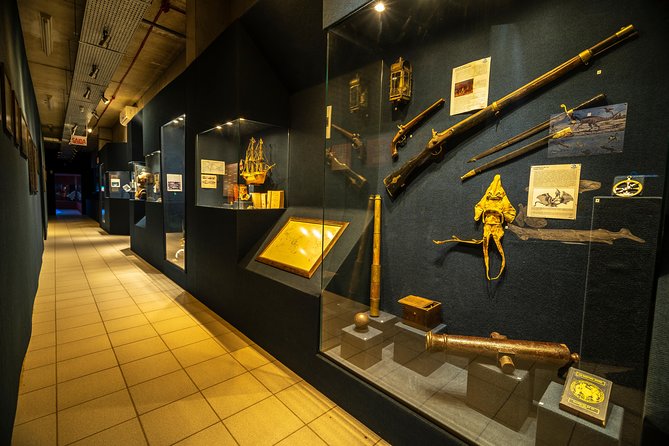
The Blue Wing sets up the story. Fossils from different geological ages show how life changed over time, while historical objects explain how earlier civilizations understood and imagined the sea.
This section also follows the great voyages of discovery and introduces important figures in oceanography. The final part looks at modern technology used to explore the ocean. That combination gives the museum a useful sense of progression: first the origin of life, then human curiosity, then scientific tools.
I like this opening because it gives context to the specimens in the later rooms. A shark jaw means more when you have already considered how people began studying oceans. The wing may appeal most to adults and older children, while younger children are likely to move more quickly toward the aquariums.
Red Wing: Shells, Corals, Crustaceans, and the Touch Experience
The Red Wing focuses on marine invertebrates. You see calcareous structures from sponges and corals near aquariums containing living examples of related animals. That pairing is useful because it puts a static skeleton beside a moving creature.
Mollusks receive plenty of attention through shells and preserved specimens, including a whole giant squid. Echinoderms are represented by sea stars, sea urchins, and sea cucumbers. The route then reaches crustaceans such as shrimp, crabs, and lobsters.
The sensory experience with marine animals is one of the strongest reasons to bring children here. A touch-lab setting can turn a display into a physical memory, and it gives adults a chance to see marine life from a different angle. The activity is included with admission, but the supplied details do not specify which animals are available at every session, so I would avoid promising a particular species.
This is also the area where good labeling matters most. Shells can look similar to an untrained eye, and some people have found that not every piece has enough explanation. If you want to get the most from the collection, read the labels that are available and allow children to ask questions as they go.
Green Wing: Sharks, Rays, and Brazil’s Notable Jaw Display
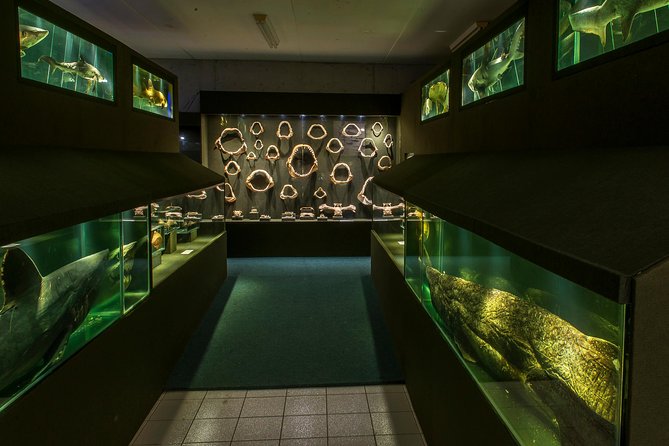
The Green Wing is devoted to cartilaginous fish, mainly sharks and rays. It includes coastal, deep-sea, and endangered species, along with teeth and jaws that show how these animals feed.
The major draw is the white shark jaw, described as the only one of its kind on display in Brazil. Even without seeing a living white shark, the jaw gives you a clear sense of the animal’s size and power. Younger children often respond to teeth and jaws faster than to a scientific chart, so this room has strong family appeal.
The wing also explains reproduction among sharks and rays. That matters because these animals are not simply a collection of frightening teeth. Their reproductive methods show how they have adapted to very different marine habitats.
Four aquariums represent the natural settings of these fish. The living displays help balance the preserved specimens, though you should keep your expectations measured. This is an oceanographic museum with aquarium elements, not a huge public aquarium built around dozens of large tanks.
Same trip, a completely different kind of day:
- Rio de Janeiro: 6-Stop Highlights of Rio with Lunch
★ 4.4 · 5,157 reviews - Christ the Redeemer Entry Ticket by Corcovado Train
★ 4.4 · 4,476 reviews - Rio de Janeiro: Rocinha Favela Walking Tour with Local Guide
★ 4.8 · 3,052 reviews - Rio de Janeiro: Sugarloaf Cable Car Official Ticket
★ 4.6 · 2,873 reviews
Brown Wing: Fish From Coastal Waters to the Abyss
The Brown Wing presents the major families of bony fish. You see the variety of body shapes and adaptations that allow fish to live in different parts of the ocean.
Large fish receive special attention, including the tarpon, described as a primitive coastal species, and the oceanic swordfish. The aquariums here include fish from the Indian and Pacific oceans, bringing a wider geographic range into the museum.
The rarest material is the deep-sea fish section. These animals live in the abyssal zone more than 2,000 meters below the surface, where pressure, darkness, and limited food shape every aspect of life. You may not find these specimens as immediately dramatic as sharks or turtles, but they are among the more unusual pieces in the collection.
This wing is a good reminder that the ocean is not one single habitat. A coastal tarpon and an abyssal fish face completely different conditions. The museum’s strength here is comparison, although the experience would be stronger if every specimen had a full explanation.
Gray Wing: Five Brazilian Sea Turtle Species
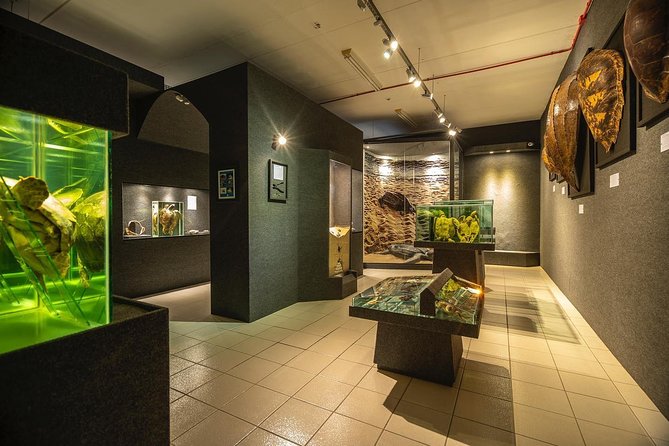
The Gray Wing concentrates on marine reptiles, with sea turtles making up most of the collection. Brazil has five sea turtle species, and all five are presented here.
The displays cover different stages of life, from small hatchlings to giant adult turtles. That range helps you understand the scale and life cycle of these animals rather than seeing only one polished adult specimen.
The wing also addresses biology and ecology. For families, the smaller turtles may be the most accessible part of the exhibit. For adults, the value is in seeing all five Brazilian species together and comparing their forms.
Sea turtles are familiar to many people who visit Brazil’s coast, but familiarity can hide how unusual their lives are. The museum gives you a clearer picture of their long growth cycle and connection to marine habitats. If your beach visit includes concern for ocean wildlife, this is one of the more relevant sections.
Beige Wing: Penguins and the Wandering Albatross
The Beige Wing turns to seabirds. It presents all penguin species and shows how they are distributed across the Southern Hemisphere.
Penguins often provide an easy entry point for children, but the display also places them within a larger story about seabird biology and ecology. Their presence here is not just about cute animals. It helps show how birds have adapted to a life connected to the ocean.
The highlight is a diorama of an oceanic island featuring endangered wandering albatrosses. Albatrosses are built for long-distance travel over open water, and the island setting gives the display a sense of place that individual specimens cannot provide.
This section may be quieter than the shark and turtle wings, but it adds useful range. The museum is not limited to animals people commonly associate with aquariums. You also see species that spend much of their lives above the water.
Black Wing: Whaling, Dolphins, Seals, and Manatees
The Black Wing begins with the history of whaling and its commercial use in Santa Catarina. That opening is important because it places marine conservation in a local setting rather than treating it as an abstract global issue.
The collection then presents dolphins and whales found in southern Brazil, with information about their biology. South American fur seals and sea lions are also included, as are manatees found in northeastern Brazil.
The geographic range is one of the strongest features of this wing. Some animals connect directly to southern Brazil, while others show the wider variety of marine mammals found along Brazil’s coast. The material also lets you compare animals that live in very different ways, from fast-moving dolphins to slow, plant-eating manatees.
I would give this room extra time if you care about conservation or local maritime history. The whaling section may be sobering, but it gives meaning to the museum’s scientific work. It also prevents the animal displays from becoming a simple parade of attractive specimens.
The Outdoor Ocean Giants Panel Makes Size Easy to Grasp
Outside the museum, an Ocean Giants panel shows the largest marine animals from each major group at full scale. Its headline example is a blue whale measuring 33 meters and weighing 170 tons.
Numbers alone are hard to picture. A 33-meter length is impressive on paper, but a full-scale comparison gives you a much better physical sense of the animal. This is a useful stop before or after the indoor exhibition, especially for children who want a clear answer to the question of which animal is biggest.
Because the panel is outside, you can treat it as a natural end point or a short pause during the visit. It also provides a good photo opportunity, though the supplied information does not specify the exact design or layout of the panel.
How Much Time and Money Should You Allow?
Admission is $15.68 per person, and the visit takes about 60 to 90 minutes. The ticket includes access to the exhibition and the sensory experience with marine animals. An educational package is available for groups but is not included.
I consider the price reasonable if you plan to examine the seven wings and use the touch experience. Families may find the admission worthwhile because the museum offers several kinds of engagement: live aquariums, large displays, preserved specimens, and hands-on contact.
The value is weaker if you expect a large number of active animals in big tanks. Some aquarium sections may seem sparse, and the dim lighting can make the route feel less lively. Think of the ticket as payment for a marine science collection with aquariums, not as admission to a full-scale aquarium park.
The short duration helps. You can fit this visit into an afternoon without giving up a full day at the coast. The opening period listed is December 1, 2025, through February 28, 2027, Tuesday through Sunday from 2:00 PM to 5:30 PM. The hours are not especially flexible, so check the local time before you go.
Who Will Enjoy This Museum Most?
I would recommend it most strongly to families with children, people interested in marine biology, and anyone who wants a weather-proof activity in Piçarras. A child who already knows the names of sea animals may spend a long time identifying specimens, while a younger child can focus on the larger displays and sensory activity.
It also suits visitors who like collections and science displays. The museum does not rely only on entertainment. You will see preserved material, fossils, historical objects, and information about ocean research.
I would be more cautious if you have limited time and want only live aquatic displays. The museum’s live animals are part of a much larger collection, and some pieces have limited explanations. If you prefer bright, highly active exhibits, the setting may feel subdued.
Service animals are allowed, and most people can participate. The experience is not described as a guided tour, and no guide names are provided, so plan for a self-paced visit through the seven wings.
Practical Tips for a Better Visit
- Start with the Blue Wing: It explains the larger story and makes the later specimens easier to understand.
- Save time for the touch experience: It is included and can be the most memorable part for children.
- Look closely at the unusual pieces: The white shark jaw, whole preserved giant squid, abyssal fish, and wandering albatross display deserve attention.
- Do not rush the turtle wing: All five Brazilian sea turtle species are shown, with life stages from small young turtles to very large adults.
- Expect dim areas: If you need bright displays or detailed labels on every object, adjust your expectations.
- Check the afternoon schedule: The museum opens Tuesday through Sunday from 2:00 PM to 5:30 PM during the stated operating period.
- Use the outdoor panel: The full-scale blue whale comparison helps make the museum’s size claims real.
Free cancellation is available if you cancel at least 24 hours before the experience begins. A cancellation within 24 hours is not refundable, and changes within that period are not accepted. The cutoff follows local time.
Should You Book the Univali Oceanographic Museum?
Book it if you want a compact, educational look at Brazilian marine life, especially if you are traveling with children or already enjoy sharks, turtles, fossils, and unusual specimens. The touch experience, the seven themed wings, the rare white shark jaw, and the full-scale blue whale panel give the visit more range than a basic aquarium stop.
Think twice if you expect a busy aquarium with large tanks and constant animal activity. The museum can feel dark, some labels are incomplete, and the aquarium displays may not satisfy someone looking for a major aquatic attraction.
At $15.68, I see it as a solid short outing rather than a must-see for every visitor to Santa Catarina. For the right audience, the chance to move from ancient fossils to abyssal fish and Brazilian sea turtles in one organized visit makes the admission worthwhile.
FAQ
Where is the Univali Oceanographic Museum located?
The museum is in Piçarras, in Santa Catarina, southern Brazil.
How long does a visit take?
Plan on approximately one hour to one hour and 30 minutes.
What are the museum’s opening hours?
The listed hours are Tuesday through Sunday from 2:00 PM to 5:30 PM, for the operating period from December 1, 2025, through February 28, 2027.
How much does admission cost?
The listed price is $15.68 per person.
What does the admission ticket include?
The ticket includes access to the exhibition and a sensory experience with marine animals.
Is an educational package included?
No. An educational package is available for groups but is not included with the standard admission.
What can I see in the museum?
The museum has more than 1,400 pieces across seven wings covering fossils, oceanography, marine invertebrates, sharks and rays, bony fish, marine reptiles, seabirds, and marine mammals. Live aquarium animals are also included.
Can I cancel for a refund?
Yes. You can receive a full refund by canceling at least 24 hours before the experience starts. Cancellations within 24 hours are not refunded.
Just added around Brazil
- Rio de Janeiro: Vidigal Favela Tour and Two Brothers Hike★ 4.5 · 121 reviews
- Photo Tour★ 5.0 · 63 reviews
- Jeep tour through Ilhabela State Park★ 5.0 · 36 reviews
- REIKI – Crystal Therapy – by Venus’ Secret Spa – San Francisco★ 5.0 · 41 reviews
- Guided walk on the Malacara Trail★ 5.0 · 48 reviews
- Street Art and Park Bike Tour★ 5.0 · 56 reviews
- Art Of Wine – Travel Through The So-Called Wine Route Visiting Various Wineries★ 5.0 · 40 reviews
- Group Balloon Flight★ 5.0 · 73 reviews
Museums, compared.
Bogotá City Tour with Monserrate, Gold and Botero Museums
Read our review →
City Tour, Monserrate, Gold Museum, Plaza de Bolivar
Read our review →
City Tour in Cusco & visit Museum South American Camelid Private.
Read our review →
City Tour, Monserrate, Gold Museum, Botero Museum, Plaza Bolívar
Read our review →
Petrópolis Day Trip from Rio de Janeiro including Imperial Museum and Crystal Palace
Read our review →
City Tour in Cusco & visit Museum South American Camelid
Read our review →
Browse the lists this tour appears in