
Reviewed · WORKSHOPS
Fun Graffiti Workshop: The Art of Aerosol and Color
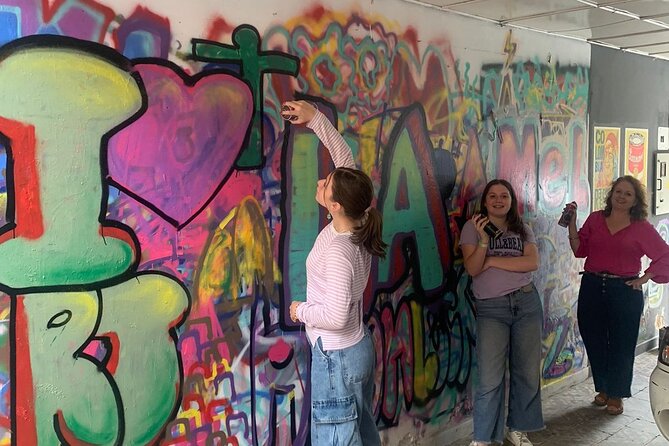
Bogotá’s graffiti culture is hands-on here. You do not just look at painted walls from a passing vehicle. You invent a graffiti name, practice spray control, and turn it into a 3D throwup piece on a real wall. The workshop is held at OCIO Gallery, with its Colombian prints and clothing, then moves into a courtyard covered with experiments and tags.
I like the simple progression from dots and lines to a finished tag, and I like that the instructor helps you plan on paper before you face the wall. Guides have included Diego and Cali, known professionally as TET, whose work appears around Bogotá. The main caution is that spray cans may be partly empty, and a mixed family group can change the pace and mood of the session.
Key points at a glance
- Start with Colombian art at OCIO Gallery: Browse prints, clothing, and murals before picking up a can.
- Learn the basics first: Warm-up stretches, can shaking, dots, lines, and spirals prepare you for the wall.
- Create your own graffiti name: Your final project is a personal tag in a colorful 3D throwup style.
- Get active coaching: The artist helps with ideas, paper planning, color choices, and the finished shape.
- Small groups work best: The maximum is 10 people, though the experience can feel different with young children in the group.
- Bring your own transport and patience: Transportation, food, and tips are not included, and supplies may sometimes be limited.
Starting at OCIO Gallery in Bogotá
The workshop begins at OCIO Gallery, Cra. 5 #26b-26, a useful setting for an art class because the gallery itself is part of the experience. Before you spray anything, you have a chance to look at prints by Colombian artists and browse printed clothing. That gives the activity a little more local context than a stand-alone craft class in a blank studio.
I like this opening because it helps you see graffiti as part of Bogotá’s wider art scene. You are not only learning how to press a nozzle. You are also seeing how artists use lettering, shape, color, and repetition to build a visual identity.
The gallery is close to La Perseverancia Market and several places to eat. That makes the meeting point handy if you want to pair the workshop with lunch or a market visit. Food is not included, so plan that separately.
The location is near public transportation, but transportation to and from the meeting point is your responsibility. The activity ends back at OCIO Gallery, which keeps the two-hour plan simple.
More Workshops in Bogota:
- Bogota: Colombian Emerald Ring Workshop
★ 5.0 · 61 reviews - Private Salsa Class and / or Latin Rhythms
★ 5.0 · 54 reviews - Rio de Janeiro: Beginner Samba Lesson in Ipanema
★ 4.9 · 1,071 reviews
A gallery visit before the spray paint
The gallery portion should not be treated as filler. It is a short chance to see prints and pictures from Colombian artists before you make your own work. The clothing line also gives you a way to buy a souvenir connected to the local art scene rather than a generic Bogotá keepsake.
The setting then changes to a courtyard behind the gallery. Its walls carry experiments and tags from earlier participants. That is useful for beginners because you can see the kind of work people produce during the class, including rough attempts and finished lettering.
It also removes some pressure. You are not expected to make a museum piece. The wall is a working surface, and the class is built around practice. Your first dots may look uneven, your lines may wobble, and your tag may change as you work. That is normal here.
For adults, the gallery and courtyard combination gives the workshop more substance. You get both a look at finished art and a place to make something yourself.
The opening routine: warm up, shake, and watch the can become a pen
The instructor explains the aim early: create a graffiti name and paint it in a throwup 3D style. Materials and quantities are shown, and you are asked for permission before photographs are taken. That small consent step is useful, especially if you prefer not to appear in pictures.
The class includes a short physical warm-up for your body and hands. You may not expect stretching at a graffiti class, but spray painting asks for repeated arm movement and steady control. The routine also helps beginners stop treating the can like an ordinary aerosol bottle.
Next comes the practical lesson. You shake the cans well and learn how the spray responds. The instructor gives a creative demonstration, including a playful imitation of a giant signature drawn in the air with a can. That show-and-tell approach makes the motion easier to understand than a technical explanation alone.
A good graffiti line comes from movement, distance, pressure, and timing. The class does not assume you already know any of that. It starts with the most basic controls and builds from there.
From dots and spirals to your own graffiti name
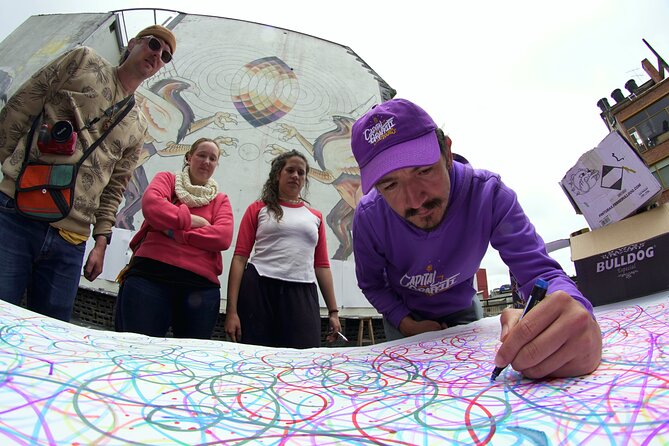
The first exercises are simple: dots, lines, and spirals. These teach you how much paint comes out, how quickly the color covers the surface, and how your hand movement changes the mark.
For a beginner, this part matters more than it may sound. A spray can does not behave like a pencil or marker. You need to get used to the sound, the pressure, and the way the paint lands. The practice sheet gives you room to make mistakes before moving to the wall.
Graphic markers and thick paper are included. You use them to think through the shape of your tag before choosing colors and spraying. That planning stage is one of the strongest parts of the class because it turns a vague idea into a manageable project.
You invent a graffiti name rather than simply copying a sample. It might be a nickname, initials, or a short word that you want to reshape into graffiti lettering. The point is not to produce a historically accurate tag. The point is to understand how letters can stretch, overlap, thicken, and gain depth.
The instructor offers ideas and pointers as you work. If your first design feels too plain, you can adjust the outline or plan a shadow. If the letters are crowded, you can spread them out on paper before wasting paint on the wall.
A few more Bogota days worth comparing
- Bogota: Bicycle City Tour
★ 4.9 · 2,156 reviews - Zipaquirá: Salt Cathedral Group Tour with Pickup
★ 4.8 · 1,606 reviews - Bogotá: Guided La Candelaria Walking Tour
★ 4.8 · 1,229 reviews - Bogotá: Private City Tour, Monserrate, Emerald and Botero
★ 4.9 · 798 reviews
Building a 3D throwup on the wall
Once the paper plan is ready, you choose your colors and move to the courtyard wall. This is the moment when the workshop changes from drawing practice to physical painting.
A throwup is a quick, bold graffiti form built around large rounded or block-like letters. The 3D effect adds depth, often through an offset edge or shadow. You do not need a previous art background to try it because the instructor breaks the process into parts.
You begin with the main letter shapes, then add outlines and depth. The instructor coaches you while you work and helps shape the finished tag so it reads clearly and has more pop. That guidance is important because spray paint can spread quickly, and small changes in spacing can make a big difference.
The wall space is included, so you are not limited to a small sheet of paper. You get the feel of working at a larger scale, with your shoulder and arm moving instead of only your wrist.
This is also where the class can become less predictable. If several people are painting at once, you may need to wait for a color or share the available wall area. The group limit is 10, which is fairly small, but the actual pace depends on who signs up.
What the instructors add to the experience
The strongest part of this activity is the teaching. A guide identified as Cali, known professionally as TET, has led the session and is associated with work on Bogotá walls. Diego has also led a family session and worked actively with children.
Those details matter because the class is not only a supply station where you receive a can and fend for yourself. The instructor demonstrates, corrects, suggests, and helps turn your first idea into a clearer piece.
Cali’s approach, as described during the workshop, includes moving from basic exercises to a tag, then sketching the final project on paper before going to the wall. That sequence is easy to follow and gives you several chances to ask for help.
Diego’s involvement with families shows that the class can work for children as well as adults, at least when the group stays engaged. Still, you should think about the kind of session you want. A group of adults or older children will likely allow more focused instruction. Very young children can bring energy and noise that changes the experience for everyone.
The instructor cannot control the behavior of every person in a shared class. If you want a quiet, focused art lesson, book with that possibility in mind.
Supplies, colors, and the main practical drawback
The $58 price includes spray cans, graphic markers, nozzles, thick paper, and wall space. You also get the gallery and cultural-house setting, plus pictures of the experience where consent has been given.
That is a reasonable package for a two-hour activity in Bogotá if you want instruction rather than a simple can rental. You are paying for the artist’s guidance, the prepared space, the materials, and the chance to make a piece without arranging a wall or buying supplies yourself.
The main issue is supply condition. Some cans may be empty or nearly empty, which can limit color choices and create frustration. This is not a minor detail if your design depends on a particular outline or shadow color.
I would keep your design flexible. Choose a few possible colors rather than building the entire piece around one exact shade. If the supplies are fully stocked, you have more freedom. If they are not, a simple two-color design may work better than a complicated plan.
The included nozzles also matter because different nozzles can change the width and character of the spray. Beginners will appreciate having the equipment provided, but you should not expect an unlimited paint supply.
How the two-hour schedule feels
Two hours is enough time for an introduction, practice exercises, a sketch, and a wall piece. It is not enough time for a long art lecture or a highly detailed mural. The structure works best when you accept that your final tag will be a first attempt, not a finished professional commission.
The opening gallery look, warm-up, demonstration, marker planning, color selection, and wall painting each take part of the clock. If the group is large or includes very young children, transitions may take longer.
You will get more from the session if you arrive ready to participate. This is not a class where you can stand back for most of the time and still get the full value. Shake the cans, try the exercises, ask for suggestions, and make changes to your design.
Most people can participate, and the class is designed for beginners with no previous spray-paint experience. That makes it a good choice if you have always wanted to try graffiti but did not know how to start.
Who should book this Bogotá graffiti workshop
I would recommend it most strongly to:
- First-time spray painters who want clear instruction
- Couples or friends looking for a creative activity
- Families with children who can follow a two-hour art class
- Visitors interested in Bogotá’s street-art culture beyond sightseeing
- People who want a personal souvenir rather than a store-bought object
It is less ideal if you want a private class, a polished finished artwork, or a predictable supply of every color. It is also not the best match if you dislike shared creative spaces or do not want to work around children.
The 10-person maximum keeps the group from becoming huge, but it does not guarantee a private or adult-only session. If that distinction matters to you, ask about the expected group before booking.
Timing, booking, and cancellation details
The workshop is commonly booked about 34 days ahead, so it is sensible to reserve early if your Bogotá dates are fixed. Confirmation arrives within 48 hours, subject to availability.
You can cancel for a full refund if you do so at least 24 hours before the start time. Changes or cancellations made inside that 24-hour window are not accepted for a refund.
The activity requires a minimum number of participants. If that minimum is not met and the session is canceled, you are offered another date or experience, or a full refund.
Tips, food, and transportation are not included. Plan your route to OCIO Gallery and allow time for a meal nearby if you want one after the class.
Is the $58 price worth it?
For a basic craft class, $58 might seem high. For a guided graffiti session in a gallery and courtyard, with spray cans, nozzles, markers, paper, wall space, and instruction, the value is easier to understand.
You are also paying for access to a prepared setting. You do not need to buy paint, find a legal wall, or work out how to use the equipment alone. The instructor’s feedback is the part that gives the activity its value. Without it, you would simply be making marks. With it, you learn how to build a name, plan a shape, and add a 3D effect.
The value drops if supplies are limited or if the group is distracted. That is why I would treat the finished painting as a bonus and the learning process as the main purchase.
Should you book it?
Book this workshop if you want an active, beginner-friendly introduction to Bogotá graffiti and like the idea of making your own tag under an artist’s guidance. The gallery visit, courtyard wall, and paper planning give the two-hour session a clear shape, and the price includes the equipment you need.
I would book it especially for an adult couple, a small group of friends, or a family with children who enjoy making art. Keep your color plan flexible, expect a shared class, and remember that transportation and food are on you.
Skip it if you need a quiet private lesson, guaranteed supplies in every color, or a finished work by a professional. For most beginners, though, this offers a memorable way to meet Bogotá’s graffiti culture with your hands, not just your camera.
FAQ
Where does the graffiti workshop begin?
It begins at OCIO Gallery, located at Cra. 5 #26b-26 in Bogotá, Colombia.
Where does the activity end?
The workshop ends back at the meeting point, OCIO Gallery.
How long does the workshop last?
The activity lasts approximately two hours.
How much does the workshop cost?
The listed price is $58 per person.
Is previous spray-paint experience required?
No. The workshop is designed for beginners and people with no previous spray-paint experience.
What materials are included?
The workshop includes spray cans, graphic markers, nozzles, thick paper, and wall space.
Is transportation included?
No. Transportation, food, and tips are not included.
How far in advance can I cancel for a full refund?
You can cancel at least 24 hours before the experience start time for a full refund. Cancellations or changes made less than 24 hours before the start time are not refunded.
Just added around Bogota
- Tour of Zipaquirá: Visit the Salt Cathedral and the main squares★ 4.5 · 55 reviews
- Bogota Walking Tour Teusaquillo, a different part of the city★ 5.0 · 41 reviews
- La Candelaria Walking Private Tour (3 Hrs.)★ 5.0 · 51 reviews
- Private Zipaquira Salt Cathedral and Guatavita Lagoon Tour from Bogota★ 4.5 · 44 reviews
- Tejo and Beer Tour in Bogotá★ 5.0 · 35 reviews
- Hiking to the largest paramo on earth : Sumapaz★ 5.0 · 49 reviews
- MINA CATEDRAL DE SAL ZIPAQUIRA Tour Privado★ 4.5 · 38 reviews
- Descubre la Magia: Catedral de Sal & Bogotá en 1 Día★ 4.5 · 39 reviews
Workshops, compared.



The First Class Machu Picchu Train by Inca Rail
Read our review →
The Textile Workshop Experience in Cusco Region
Read our review →
Browse the lists this tour appears in