

Reviewed · SAMBA & CARNIVAL SHOWS
Rio Samba Bus: hop-on hop-off city tour in Rio de Janeiro
The Rio Samba Bus is most useful as a first look at Rio, linking Copacabana, Sugarloaf Mountain, downtown, Lapa, and Christ the Redeemer in one long circuit. You can ride the panoramic bus, hop off at major sights, then rejoin the route rather than piecing the city together with separate taxis and transit.
I like the easy city overview and the chance to see Rio’s famous waterfronts from an open-sided bus. I also like the live commentary in Portuguese, English, and Spanish, plus the Brazilian music program, which adds samba and MPB to what could otherwise be a plain sightseeing ride.
The main catch is timing. The bus is advertised as a hop-on hop-off service, but later buses may not arrive exactly on schedule, and some stops are not clearly marked. If you want to visit several attractions inside one day, allow plenty of slack.
Key points before you book

- 26 stops link Rio’s main sightseeing zones: The route runs from Copacabana and Sugarloaf to downtown, Lapa, the Sambadrome, Corcovado, Flamengo, and Ipanema.
- The bus is best for orientation: Stay aboard for a broad city tour, or use selected stops to build your own day.
- Christ the Redeemer and Sugarloaf tickets cost extra: The bus gets you to the areas, but admission and cable car or train tickets are not included.
- Open and enclosed buses may be available: Enclosed vehicles have air conditioning, while open sections give you a clearer view for photographs.
- Music is part of the plan, but not guaranteed every time: Samba, MPB, and other Brazilian rhythms are scheduled onboard, though one recent ride had no music program.
- The $31 price is fair for a first-day overview: It becomes better value if you use several sections of the route, but less so if you only stay aboard for a short ride.
What the Rio Samba Bus actually does well

I see this as a sightseeing framework rather than a carefully timed transport service. The route covers more than 30 points of cultural and tourist interest, with 26 named stops, so you get a useful picture of how Rio’s South Zone connects with the center.
The bus begins in Copacabana and works through the city in a large loop. That matters because Rio’s top sights are spread out. Copacabana, Sugarloaf, Lapa, Christ the Redeemer, Flamengo, and Ipanema are not one compact walking circuit.
You receive live commentary in Portuguese, English, and Spanish. The guide adds facts and small pieces of local context as you pass landmarks, although the amount of detail may depend on traffic, the guide, and where you sit.
The ride is also designed to be fun rather than solemn. Brazilian music, including samba and MPB, is part of the advertised program. I would treat this as a pleasant extra, not the main reason to book, since the music may not operate on every departure.
More City Tours in Brazil
- Rio: Carnival Backstage Tour at Samba City with Cocktail
★ 4.6 · 520 reviews - Rio de Janeiro: Private Guided City Tour
★ 4.6 · 207 reviews - Rio de Janeiro: Half-Day Christ the Redeemer and City Tour
★ 4.4 · 101 reviews
Starting in Copacabana at the Atlantic edge
The first stops are spread along Copacabana, from Shopping Cassino Atlântico through beach posts 5, 4, 3, and 2. This gives you several ways to board, though you should confirm the exact stop and timing before setting out.
Copacabana is one of the strongest parts of the ride. From the bus, you see the broad beach, the busy promenade, and the curve of the waterfront. The view is more useful than a quick taxi crossing because you can take in the relationship between the sand, the road, the hotels, and the surrounding hills.
If you want a beach walk, choose a Copacabana stop and get off early in your day. Just remember that hopping off changes the timing of the rest of your circuit. The next bus may not appear promptly, so do not plan a tight appointment immediately afterward.
The Hilton Hotel stop and Rio Sul Shopping Mall stop serve as useful links toward Botafogo and Urca. The route then reaches the Sugarloaf Cable Car Park, one of the most practical places to leave the bus.
Sugarloaf Mountain requires extra time and money
Sugarloaf is not simply a quick photo stop. The cable car ride to Morro da Urca is a separate attraction, and tickets are not included in the $31 bus fare.
If you want to ride the cable car, leave enough time for the visit rather than trying to squeeze it between two bus departures. The view from the heights is one of the clearest ways to understand Rio’s setting, with water, beaches, urban districts, and rounded peaks all appearing together.
The bus gives you a convenient arrival point, but it does not turn Sugarloaf into a short stop. You pay separately for the cable car, and your total day cost rises quickly if you also add the Corcovado train and other attractions.
For me, Sugarloaf is a good place to use the hop-off feature because the stop connects directly with a major sight. It is less useful to hop off for only a few minutes, since the cable car visit needs real time.
Downtown Rio: Cinelândia, churches, and imperial buildings

After the South Zone, the bus heads into the center. The Municipal Theatre, National Museum of Fine Arts, and National Library surround Cinelândia, Rio’s main historic square area.
This section changes the mood of the tour. Instead of beach views and mountain silhouettes, you get monumental civic buildings and a sense of Rio as Brazil’s former capital and cultural center. You can get off here for museums or simply remain aboard while the guide points out the buildings.
The route continues through the central district to the Selarón Steps and the Arcos da Lapa. These are among the most recognizable urban sights in Rio. The colorful tiled staircase is a popular photography stop, while the Lapa arches are a major landmark of the neighborhood.
You also pass the Metropolitan Cathedral, Paço Imperial, and Candelária Church. Each stop gives you a different view of Rio’s public and religious architecture. If you enjoy city details more than beach time, this is one of the most rewarding parts of the circuit.
The practical issue is navigation. Some stops are small and not clearly marked, so it can be difficult to find the correct boarding point after walking around. Take a careful look at where the bus leaves you, and keep the stop map available.
More City Tours in Rio de Janeiro
- Petrópolis: Imperial City Tour
★ 3.7 · 95 reviews - Learn the History of Rio with an Unforgettable City Center Walking Tour
★ 5.0 · 82 reviews - Rio: Christ Redeemer by Train & City Highlights Morning Tour
★ 4.4 · 74 reviews - Rio de Janeiro: Private City Tour with Hotel Pickup
★ 5.0 · 49 reviews
AquaRio, Yup Star, Maracanã, and the Sambadrome

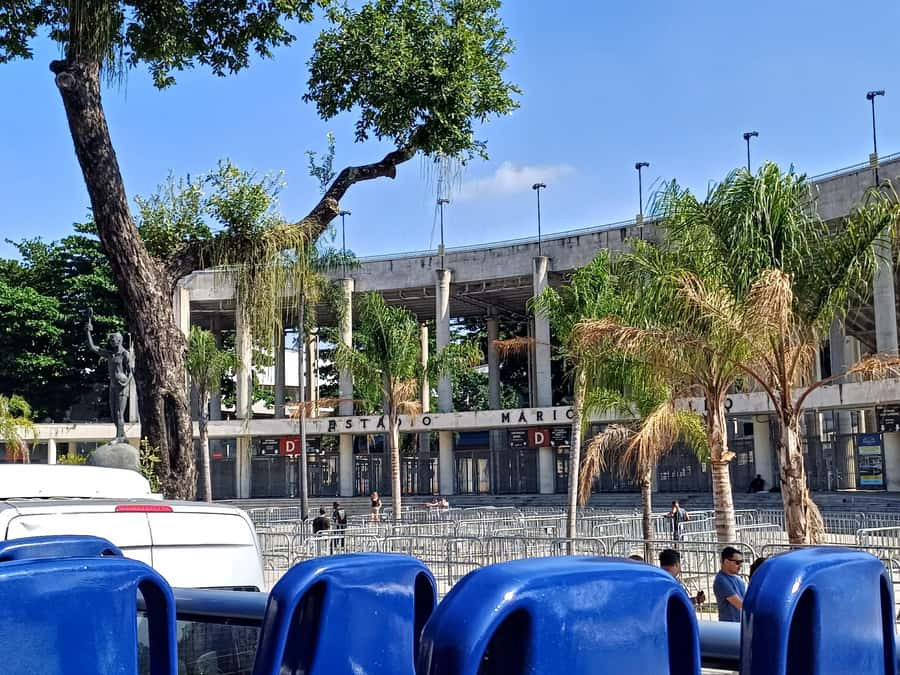
The central route includes AquaRio, the Yup Star observation wheel, and the Maracanã area. These stops are useful if you want to add a family attraction, a city view, or football history to the day.
The published route lists Maracanã on the outward section, then continues through Biopark and the Sambadrome on the return. One practical warning is that the bus may not pass directly by every major stadium sight in the way you expect, so check the actual stop position before planning a visit.
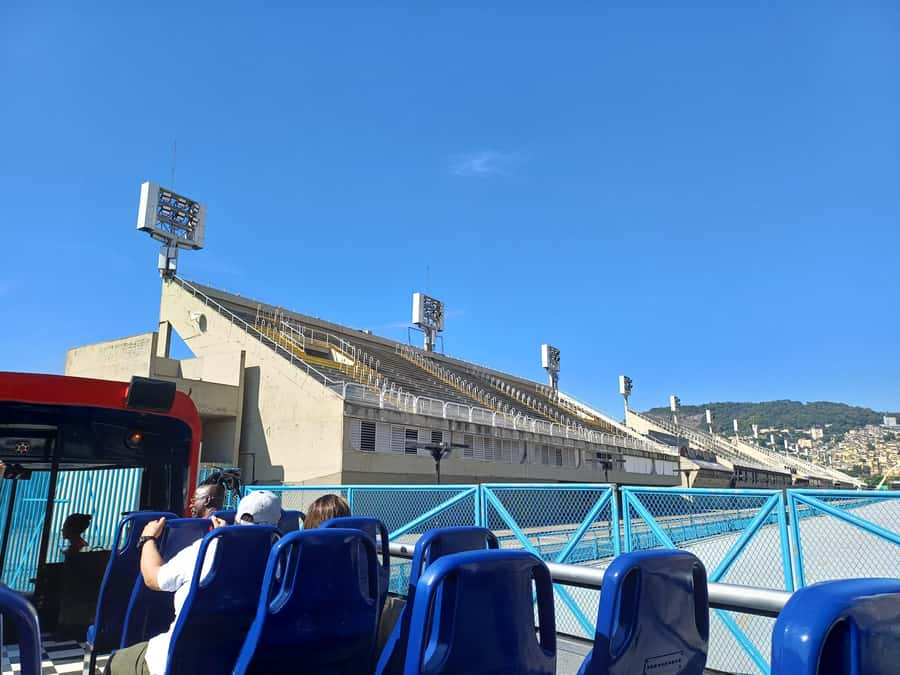
The Sambadrome is especially meaningful during Carnival, when samba schools parade through the purpose-built avenue. Outside Carnival season, the structure still gives you a physical sense of how central samba is to Rio’s identity.
AquaRio and Yup Star are separate paid attractions. They can make the tour more appealing for families or first-time visitors who want more than historic buildings, but each extra stop makes the day harder to manage on the bus timetable.
Christ the Redeemer is the day’s big commitment

The Corcovado stop is the most important timing decision on the route. The visit includes a train journey along the century-old Corcovado Railway through Tijuca Forest, followed by the Christ the Redeemer monument at the summit.
The bus fare does not include the train or attraction ticket. You also need to allow enough time for the full visit, including the ride up, time at the monument, and the return to the city.
The train journey is part of the appeal. As it climbs through the forest, the city begins to open below you. At the top, you get the classic view over Rio, including the urban core, lagoons, beaches, and mountains.
I would not combine Christ the Redeemer with too many other paid attractions on the same bus day. The monument is too important to rush, and a late return can leave you waiting at a stop with no clear estimate for the next bus.
If the Redeemer visit is your main goal, consider treating the Rio Samba Bus as the transport and orientation portion of the day, not as a promise that you can complete every listed stop.
Largo do Boticário and Parque Lage
On the way back toward the South Zone, the route includes Largo do Boticário and Lage Park. These stops offer a different side of Rio, away from the main beach corridor and large civic sights.
Largo do Boticário is known for its historic setting and colorful buildings. Parque Lage is associated with a former estate and is a pleasant contrast to the high-energy waterfront and crowded downtown streets.
The route does not give you unlimited time at each place. If you get off, plan for the next bus to be uncertain. I would choose one of these stops only if the setting interests you, rather than trying to collect every stop as a checklist.
Flamengo and Ipanema bring back the sea views
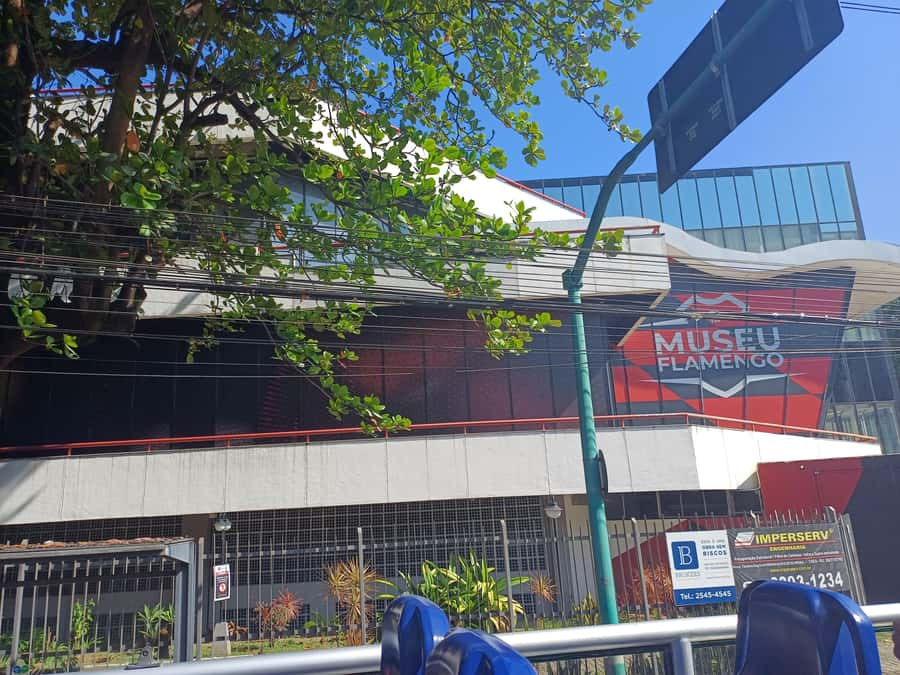
The Flamengo Museum and Aterro do Flamengo return the tour to Rio’s waterfront. Aterro do Flamengo is a broad public park and coastal open space, with wide views across the bay and toward the city’s hills.
The route then reaches Rua Garcia Dávila, Ipanema Beach Post 9, and Post 8. These final stops are handy if your hotel or evening plans are in Ipanema, and they give you another chance to walk along the beach.
Ipanema feels different from Copacabana, even though both are famous beach districts. From the bus, you can compare their shorelines and streets without spending another hour crossing the city.
The final beach stops also show why the bus can be useful for a first day. You get a broad sense of Rio’s neighborhoods before deciding where to return on foot or by another form of transport.
Open views, air conditioning, and the music program

The bus fleet may include enclosed vehicles with air conditioning and open buses where you have a clearer view. I would choose the open section when the weather is pleasant and photography matters.
An open upper deck can make the waterfront and mountain sections much better. You see more, hear the city, and have a better chance of taking clear pictures when the driver slows or stops briefly for photographs.
An enclosed, air-conditioned bus is the safer comfort choice on a hot or rainy day. Bad weather can blunt the experience, especially when much of the appeal comes from views of the coast and hills.
The musical element is a nice idea: samba, MPB, and other Brazilian rhythms give the ride local character. Still, recent operation has not been perfectly consistent. Plan to enjoy it if it happens, but do not buy the ticket solely for a live performance.
Timing is the key weakness
Departure times are listed from 9:15 a.m. through 5:15 p.m., with several morning and afternoon departures. The initial departure is the easiest one to understand, but later buses may not keep to the published intervals.
That matters because the advertised two-hour duration fits a ride around the route more than a full day of hopping off at major sights. If you stay aboard, you can get a broad overview in roughly that time. If you visit Sugarloaf or Christ the Redeemer, expect the day to become much longer.
I would use the bus in one of two ways:
- Stay aboard for the full circuit and use it to learn the city’s layout.
- Choose one or two major stops, then accept that the next bus may involve a wait.
I would not build a schedule with several timed attractions, a restaurant reservation, and an airport transfer all depending on the bus. A wait of 40 minutes has been reported, and unclear stop locations can make the delay more frustrating.
Is $31 good value?
At $31 per person, the price is reasonable for a first introduction to Rio, especially if you stay aboard for much of the route and use the live commentary. You cover a lot of ground without paying separate fares for each neighborhood.
The value drops if you only ride for a short stretch. It also drops once you add Sugarloaf cable car tickets, the Corcovado train and monument, museums, AquaRio, or the observation wheel. Those costs are all separate.
For a family, the bus can simplify the day, but the total rises quickly with multiple attraction tickets. For a solo visitor or couple, it is most worthwhile on the first day, when learning the city’s shape saves time later.
Hotel transportation is not included. You need to reach the starting point or another stop yourself, so check the route before booking. The service begins in Copacabana, and missing the departure point can mean losing valuable time.
Free Wi-Fi is included, which helps you check maps and organize the next stop. Cancellation is free up to 24 hours before departure, and you can reserve now and pay later, both useful if your weather plans are uncertain.
Who should book the Rio Samba Bus?
I would recommend it to a first-time visitor who wants a broad view of Rio with minimal planning. It suits you if you like sitting back, hearing local commentary, taking photographs, and choosing one or two stops rather than racing through the entire route.
It is also useful for families and anyone who wants an air-conditioned option in poor weather. The multilingual commentary helps if your group does not speak Portuguese.
I would be more cautious if you need precise departure times, want to visit many attractions in one day, or dislike waiting. A regular taxi or app-based ride may be more practical for a tightly planned visit to Christ the Redeemer and Sugarloaf.
My booking advice
Book the Rio Samba Bus if you want a relaxed city introduction and understand that hop-on hop-off means flexible sightseeing, not exact public-transit timing. Start early, identify your nearest stop, and save the most important attraction for a day when you can tolerate delays.
The best plan is to ride through Copacabana, Sugarloaf, downtown, Lapa, and the waterfront, then choose either Sugarloaf or Christ the Redeemer as your main stop. At $31, that gives you a useful overview and a fair amount of sightseeing value without trying to force all of Rio into one circuit.
FAQ
How long does the Rio Samba Bus tour last?
The stated duration is 2 hours. That describes the bus tour itself, while hopping off at attractions, visiting them, and waiting for later buses can make your day much longer.
How many stops does the bus have?
The route lists 26 stops, covering more than 30 tourist and cultural points of interest across Copacabana, the South Zone, downtown Rio, Lapa, Flamengo, Ipanema, and nearby areas.
Are Christ the Redeemer and Sugarloaf tickets included?
No. Tickets for attractions are not included. Sugarloaf cable car tickets and the Corcovado train and Christ the Redeemer visit must be paid for separately.
What languages are used for the commentary?
Live commentary is provided in Portuguese, English, and Spanish.
Where does the route go?
The bus starts in the Copacabana area and passes Copacabana Beach, Sugarloaf Cable Car Park, Cinelândia, the Selarón Steps, Lapa Arches, the Metropolitan Cathedral, Paço Imperial, Candelária Church, AquaRio, Yup Star, Maracanã, the Sambadrome, Corcovado, Flamengo, Rua Garcia Dávila, and Ipanema Beach.
Is hotel transportation included?
No. Transportation to and from your hotel is not included, so you need to reach one of the listed bus stops yourself.
More Hop-On Hop-Off Tours in Rio De Janeiro
- Buenos Aires Hop-On Hop-Off Bus, Free Walking Tours & Discounts
★ 4.5 · 2,218 reviews - Buenos Aires: Hop-On Hop-Off City Bus Tour
★ 4.2 · 1,855 reviews - Buenos Aires Hop-On Hop-Off Bus and Exclusive Benefits
★ 4.4 · 1,714 reviews - Cartagena: City Sightseeing Hop-On Hop-Off Bus Tour & Extras
★ 3.9 · 681 reviews
More Samba Shows in Rio De Janeiro
- Rio de Janeiro: Beginner Samba Lesson in Ipanema
★ 4.9 · 1,071 reviews - Rio: Pub Crawl in Lapa with Cachaça Tasting and Live Samba
★ 4.7 · 881 reviews - Hop-ON Hop-OFF Sightseeing Bus in Rio de Janeiro – Rio Samba Bus
★ 3.5 · 457 reviews - Rio de Janeiro: Samba Class in Copacabana
★ 4.6 · 262 reviews
Just added around Rio De Janeiro
- Skip the Line: Lagoa Misteriosa Admission Ticket with Scuba Diving Experience★ 5.0 · 81 reviews
- Rio de Janeiro: Tijuca Peak Guided Hike★ 4.7 · 56 reviews
- Sugarloaf Mountain Fast-Pass Ticket and Guided Tour★ 4.4 · 62 reviews
- Rio de Janeiro: Sugarloaf Mountain Hike and Climb★ 5.0 · 45 reviews
- Rio de Janeiro: Sunrise Lookout and Christ the Redeemer Tour★ 5.0 · 121 reviews
- Rio de Janeiro: Samba Class and Samba Night Tour★ 4.6 · 115 reviews
- Rio Surf Experience★ 4.9 · 37 reviews
- Rio Highlights: Christ, Sugarloaf, more in a Private Tour★ 4.9 · 55 reviews
Samba & Carnival Shows, compared.


Carnival Backstage Tour at Samba City with Cocktail
Read our review →
Hop-ON Hop-OFF Sightseeing Bus in Rio de Janeiro – Rio Samba Bus
Read our review →


Ginga Tropical – Brazilian Samba and Folklore Show
Read our review →
Pedra do Sal: Live Samba Night with Local Guide & Drink
Read our review →
Browse the lists this tour appears in