
Reviewed · CYCLING TOURS
Santiago: Highlights, Parks and Politics Bike Tour
Santiago’s political story comes alive on two wheels. This three-hour ride links shady Forestal and Bustamante Parks with the Gabriela Mistral Cultural Center and La Moneda, so you see the city’s trees, monuments, bike lanes, and public spaces in one steady outing. I especially like the small group of no more than 10 and the chance to hear local context from guides such as Juan Pablo, Isabella, Camille, and Valentina.
I also like the easy beach cruiser bikes and the thoughtful stop for handmade ice cream, coffee, or espresso. The main consideration is the subject matter: politics and Chile’s recent past receive more attention than sightseeing by bike alone, and wheelchair users cannot join this route.
Key points at a glance
- A mostly flat three-hour route links central Santiago’s parks, cultural sites, and political landmarks.
- Forest al and Bustamante Parks offer shade and a calmer ride before the city streets take over.
- La Moneda and GAM give the tour its strongest historical and political focus.
- Small groups capped at 10 make it easier to ask questions and stay together.
- Water, sunscreen, a helmet, and a cruiser bike are included, along with handmade ice cream or coffee.
- Spanish and English guides add local slang and practical suggestions for food, wine, and the rest of your stay.
Why this bike ride gives Santiago more meaning
Many city tours show you a sequence of buildings. This one tries to explain why those buildings matter. You pedal through central Santiago while the guide connects parks, monuments, public art, and government buildings to Chilean politics and everyday society.
That approach suits me because Santiago can look polished and modern at first glance, with broad streets, tall buildings, and carefully planted parks. A local guide helps you read the city beyond its surface. You hear about political events, social change, and the role of public spaces. The focus includes the important events of October 2019, a period that still matters greatly to Chileans.
You do not need to be a serious cyclist. The route is described as inclusive, and the flat pace makes it approachable for people who want to see more ground than they could cover on foot. Still, you should be comfortable riding a bicycle in an urban setting. The tour uses streets and bike lanes, so this is not a park-only ride.
More Bike Tours in Chile
- Santiago: Markets Bike Tour
★ 4.8 · 107 reviews - Santiago Center Cultural Bike Tour
★ 5.0 · 51 reviews - Santiago Evening Bike Tour
★ 5.0 · 46 reviews
Starting near Plaza Mori and Baquedano
The meeting point is Constitución 153, next to Plaza Mori and near Baquedano Metro Station. That location places you close to central neighborhoods and makes the tour a practical first or second activity in Santiago.
You receive a beach cruiser city bike, a helmet, and bottled water. Helmets are mandatory under Chilean law, and the tour provides one. Sunscreen is also included, though I would still dress for the day and bring a camera.
The small group format matters here. Ten people is enough for a social outing, but still small enough for the guide to keep an eye on the group and answer questions. Safety is part of the guide’s job, especially when the route moves from quiet park paths to city streets.
The tour is offered in English and Spanish. Guides named Juan Pablo, Isabella, Camille, Valentina, and Ales have led this experience at different times. The strongest part of their role is not simply naming landmarks. It is explaining the local meaning behind them and helping you understand the city as someone who lives there.
Forestal Park brings shade and breathing room
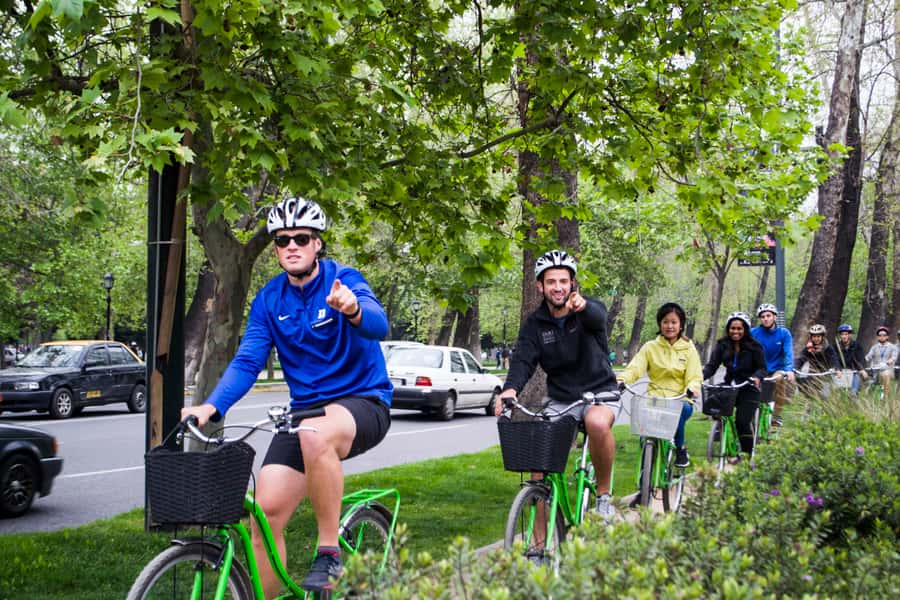
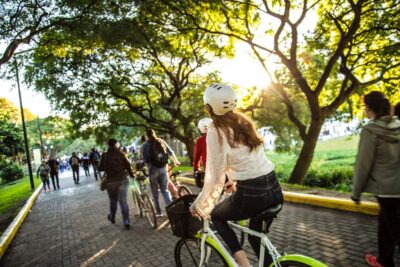
The first stretch takes you through Santiago’s green spaces, including Forestal Park. This is a good way to begin because the trees provide a break from the hard edges of downtown. You can settle into the bike, get used to the pace, and take in Santiago from a lower, slower angle.
I like this part because you get a sense of how the city makes room for public recreation. The park is not treated as a quick photo stop. It forms part of the ride, giving you time to move, listen, and look around without a lecture at every corner.
A bicycle also changes your sense of distance. On foot, central Santiago’s parks and cultural landmarks can feel like separate stops. By bike, they become part of one connected urban story. You see how the parks relate to nearby neighborhoods, streets, and large buildings.
The guide also introduces Chilean slang during the outing. That may sound like a small extra, but it gives you a useful way to listen for local speech during the rest of your trip. You are not just memorizing vocabulary. You are getting a little help with how people in Santiago speak among themselves.
Bustamante Park and the feel of local city life
The ride continues through Bustamante Park, another leafy stretch in the central city. Together, Forestal and Bustamante Parks provide the tour’s most relaxed cycling. Their shade and open space balance the heavier political material that comes later.
This part is useful if you want to see Santiago as a lived-in city rather than a list of grand public buildings. You pass through spaces made for ordinary city life, with trees, paths, and room for people to move at a gentler pace.
You should not expect a wilderness ride. These are urban parks, and the point is their place within Santiago. The appeal comes from the contrast between green space, nearby architecture, and the city’s growing network of bike lanes.
That network is one of the tour’s practical details. You get to experience the lanes rather than hear about them in the abstract. For anyone interested in urban cycling, this offers a look at how Santiago is making space for bikes in a busy capital.
More Bike Tours in Santiago:
- Bogota: Bicycle City Tour
★ 4.9 · 2,156 reviews - Buenos Aires: North or South Buenos Aires Bike Tour
★ 4.7 · 719 reviews - La Paz: Mountain Bike Down the World’s Most Dangerous Road
★ 4.9 · 386 reviews - São Paulo: Downtown Historical Bike Tour
★ 4.9 · 191 reviews
GAM connects culture with Chilean history
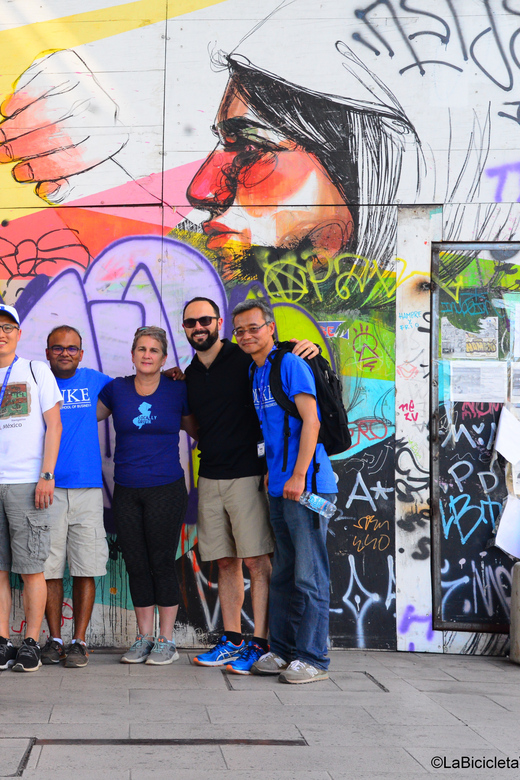
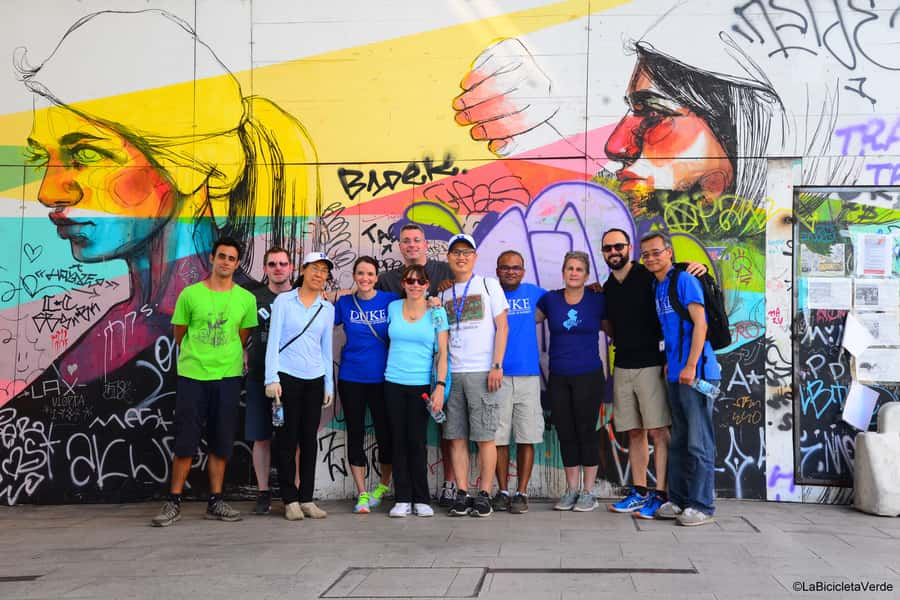
The route leads to the Gabriela Mistral Cultural Center, usually known as GAM. This is one of the tour’s key stops because the building and its public setting open a path into Chile’s cultural and political past.
Your guide talks through the background of the monuments and figures you encounter. The point is not only to admire the architecture. You learn how cultural spaces can carry political meaning and how Chile’s past continues to shape public life.
GAM gives the tour a useful middle ground. The parks show the city’s everyday side, while La Moneda brings you directly to the seat of national government. GAM sits between those ideas, linking art, public space, memory, and political change.
If you enjoy history, this is likely one of the strongest sections. The tour’s political focus is clear, and it does not avoid recent events. If you want a purely recreational cycle with little talking, you may find the explanations more extensive than expected.
La Moneda puts the politics in view
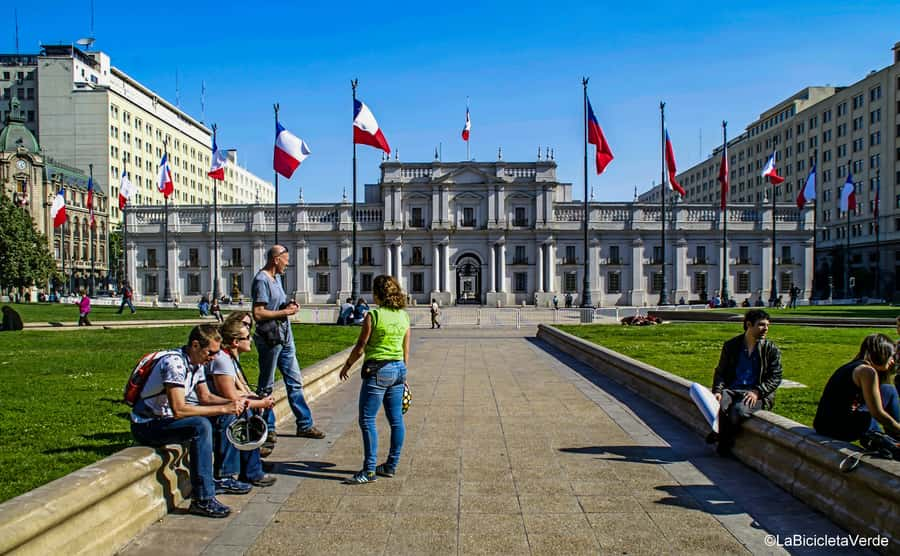
The ride then reaches Palacio de La Moneda, Chile’s Presidential Palace. This is the clearest point for understanding why the tour is called Highlights, Parks and Politics.
La Moneda is not just an impressive building to photograph. It is a place where Chile’s political story becomes visible. Your guide explains the building’s role and discusses the political history that shaped Chilean society. The presentation aims to give context without pushing a partisan line.
That balance matters. A political tour can easily turn into a personal speech. The guide’s job here is to explain, answer questions, and help you understand the subject from a local point of view. Juan Pablo, for example, is described as offering the right amount of historical detail without bias, while Isabella and Valentina are praised for making the political material clear and engaging.
You should allow yourself time to listen. This is not a stop where you simply take a quick picture and move on. The value comes from understanding why the site matters, particularly when the discussion turns to the relationship between government, society, and public protest.
The tour also places October 2019 in the wider story of Santiago. That period is important to Chileans, and learning about it at or near major civic spaces gives the discussion a clear setting. You come away with more than a date. You get a better idea of why political events remain part of daily conversation and public memory.
Bike lanes, city streets, and a comfortable pace
After the parks and major sites, you spend more time riding through the city. This is where the tour becomes more active. You use parts of Santiago’s growing bike-lane network and see the capital from street level.
The route is described as flat, and the pace is intended to be manageable. That makes it a good option if you want a workout without making exercise the main event. You still need to pay attention to the road, follow the guide, and stay with the group.
The beach cruiser bikes help keep the ride comfortable. They are suited to a city outing rather than speed. You can sit upright, look around, and listen while moving between stops.
I would not choose this activity if you dislike cycling near traffic or want a completely quiet route. The parks offer calmer stretches, but the city section is part of the point. You are seeing how central Santiago works and how bicycles fit into it.
The guides also keep an eye on the group. That matters in a small but mobile tour, especially if people have different cycling speeds. The experience is designed to keep everyone together rather than turn the afternoon into a race.
Ice cream, coffee, and useful local advice
Handmade ice cream is included, with coffee or espresso available instead if you prefer. This is a modest detail, but it improves the rhythm of the afternoon. Three hours of cycling and listening feels easier with a short refreshment stop.
You also receive bottled water and sunscreen. Bring local currency if you want to purchase something at a market or another stop. The tour does not include hotel pickup, drop-off, insurance, or personal purchases, so plan for those separately.
The guides can also offer suggestions for food and wine in Santiago. That is one of the practical benefits of taking this kind of local tour early in your stay. You can ask what neighborhoods or places fit your interests and use that advice for the rest of your visit.
Do not expect a full food tour. The ice cream or coffee is a pleasant inclusion, not the main purpose of the outing. The real value lies in the guide’s explanations, the route, and the chance to cover several central areas without arranging each stop yourself.
What you get for the $45 price
At $45 per person, the tour is priced as a guided city experience rather than a simple bicycle rental. The fee includes the bike, helmet, water, sunscreen, guide, and ice cream or coffee. It also gives you a structured route through several important parts of central Santiago.
I see the value most clearly if you want context. Renting a bike would cost less in some cases, but it would not provide the political background, local slang, route planning, or help staying oriented through the city.
The price also benefits from the small group. A group limited to 10 is more personal than a large coach-style outing, and the guide can respond to questions about Chilean culture and history.
The value is weaker if you mainly want a fast sightseeing circuit or already know Santiago well. This tour spends time explaining places. You are paying for the interpretation as much as the transport between landmarks.
Free cancellation up to 24 hours before the activity and the reserve-now, pay-later option make it easier to fit into a changing schedule. Check the available start times before booking, since the tour lasts three hours and the exact departure time can vary.
Who should book this experience
I would recommend it to first-time visitors who want an efficient introduction to central Santiago. You get parks, public buildings, cultural sites, bike lanes, and political context in one afternoon.
It also suits anyone interested in Chilean history, public life, or urban change. The emphasis on politics is stronger than on cycling technique, and that makes the tour more rewarding for curious listeners than for people seeking a hard ride.
The route works well for casual cyclists because it is flat and uses comfortable cruiser bikes. You do not need to be a sports person, but you do need to ride a bicycle and manage a city route.
Families and mixed-age groups may find the steady pace appealing, though the political material may be more suitable for older children and adults. Wheelchair users cannot take part because the experience is built around cycling.
Book it earlier in your stay if you can. The guide’s advice about food, wine, slang, and neighborhoods can help shape the rest of your time in Santiago.
Should you book the Santiago bike tour?
Book this tour if you want to understand Santiago while moving through it. The combination of Forestal and Bustamante Parks, GAM, La Moneda, bike lanes, and local political context gives the afternoon a clear purpose.
Choose something else if you want a silent ride, a challenging cycle, or a tour focused mainly on food and markets. This is a talking tour with a serious subject at its center, softened by parks, an easy pace, and a stop for ice cream or coffee.
For $45, the strongest return is the guide. Names such as Juan Pablo, Isabella, Camille, Valentina, and Ales are tied to a style of guiding that mixes history, safety, local language, and practical Santiago advice. If that sounds like your kind of afternoon, this is a smart way to get your bearings and see the city from a more thoughtful angle.
FAQ
How long is the Santiago bike tour?
The tour lasts three hours. Starting times vary, so check availability when you book.
How much does the tour cost?
The price is $45 per person.
Where does the tour meet?
You meet at Constitución 153, next to Plaza Mori and near Baquedano Metro Station.
What languages are available?
The tour is available in English and Spanish, with a live bilingual guide.
What equipment and refreshments are included?
You receive a beach cruiser city bike, a helmet, bottled water, sunscreen, and handmade ice cream. Coffee or espresso is available instead of ice cream if you prefer.
Is the route difficult?
The tour is designed as an inclusive ride and is described as mostly flat. You do not need to be a sports person, but you must be able to ride a bicycle in an urban setting.
Can wheelchair users join the tour?
No. The activity is not suitable for wheelchair users.
Just added around Santiago
- Santiago: World-class Wines, Visit to 4 Vineyards and Tanino★ 5.0 · 91 reviews
- Santiago: Full day tour in Portillo and Laguna del Inca★ 3.9 · 61 reviews
- Santiago: Inca Lagoon Tour with Local Vineyard and Tasting★ 4.9 · 43 reviews
- Santiago: Valle Nevado Ski Day Trip with Hotel Transfers★ 4.5 · 47 reviews
- Santiago: The Essentials City Tour & Optional Concha y Toro★ 3.4 · 40 reviews
- Santiago Cathedral’s Bell Tower Official Tour★ 4.7 · 58 reviews
- Santiago: Concha y Toro with transfer, tasting & gift cup★ 4.0 · 50 reviews
- From Santiago: Rafting in the Maipo Canyon★ 4.9 · 83 reviews
Cycling Tours, compared.

La Paz: Mountain Bike Down the World’s Most Dangerous Road
Read our review →
Lima Bike Tour Miraflores – Barranco + Huaca Pucllana!
Read our review →
Browse the lists this tour appears in