
Reviewed · CYCLING TOURS
Quito Cultural Bike Tour – Group
Quito’s best stories are often found away from its grand squares. This four-hour bike tour threads through La Floresta, Guapulo, La Alameda, El Ejido, and La Mariscal, mixing street art, old parks, city views, markets, and local tastes. It gives you a quick but useful read on how Quito works.
I like the small group, limited to seven people, and the mix of riding with real stops rather than a nonstop pedal. I also like that the route uses parks and bike paths where possible. The main caution is Quito’s altitude, at 2,867 meters, plus a few hills that may have you walking the bike for a short stretch.
Key points at a glance
- La Floresta street art: Begin near Ochoymedio Arthouse Cinema and look at murals while learning about the artists behind them.
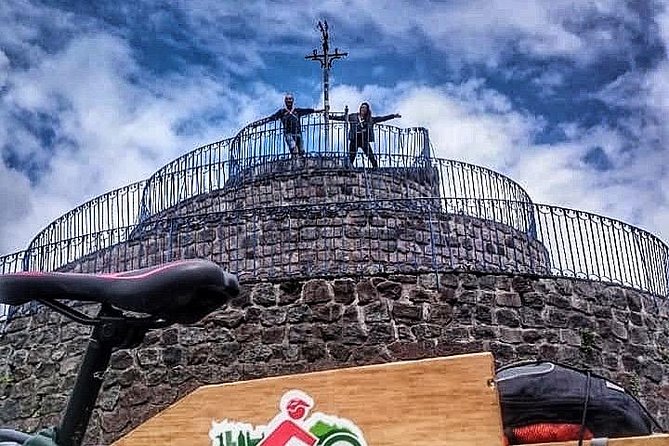
- Guapulo viewpoints: Ride to striking overlooks for a different view of Quito.
- Quito’s oldest park: Visit La Alameda, home to Ecuador’s oldest astronomical observatory.
- Local shopping: See an artisan market and a fruit and vegetable market in and around El Ejido and La Mariscal.
- Food along the way: Expect tastes of chocolate, local food, juices, and other small samples.
- Seven-person group: The limited size makes it easier to ask questions and keep the pace manageable.
Starting near Ochoymedio in La Floresta
The tour begins at Nuovo Caffe on Avenida Francisco de Orellana, close to the Ochoymedio Arthouse Cinema in La Floresta. Arrive about 10 minutes early. You’ll be fitted with a Quito Bike Tours urban bicycle, helmet, reflective vest, chain, lock, and key.
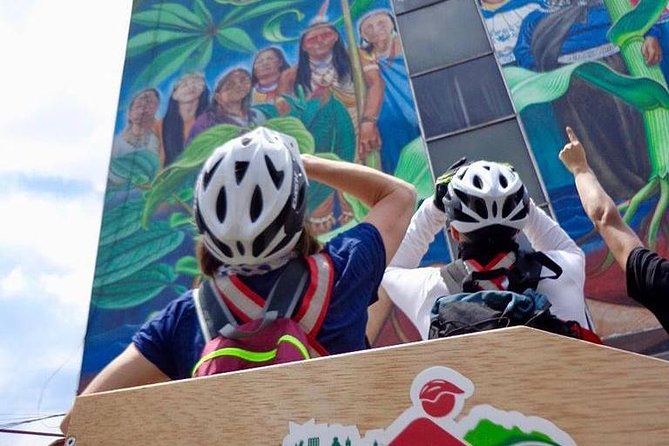
La Floresta is a smart place to begin because it gives you a sense of Quito beyond the postcard center. The opening ride focuses on street art, with your guide explaining the artists and the ideas behind the work. This is not just a quick pass by painted walls. You get a cultural introduction while moving through a neighborhood known for its creative side.
The chocolate tasting adds a pleasant local-food note right away. Since the tour includes several food and drink samples rather than a full meal, think of these as small discoveries, not lunch. If you need a substantial breakfast, eat before you arrive.
The supplied information names guides including Milton, Alejandro, Roberto, Daniel, Kevin, and Joselyn. Your actual guide will depend on the departure, but the company provides a licensed bilingual guide in English and Spanish. Past guide pairings have included Milton and Alejandro, Roberto and Milton, Roberto and Daniel, and Kevin and Joselyn.
More Bike Tours in Quito:
- Premium Cotopaxi -Full Day Bike Trip & Quito Tour
★ 5.0 · 64 reviews - Cotopaxi National Park Hiking & Biking Tour
★ 4.5 · 56 reviews - Bogota: Bicycle City Tour
★ 4.9 · 2,156 reviews
La Floresta’s lookout and local pace
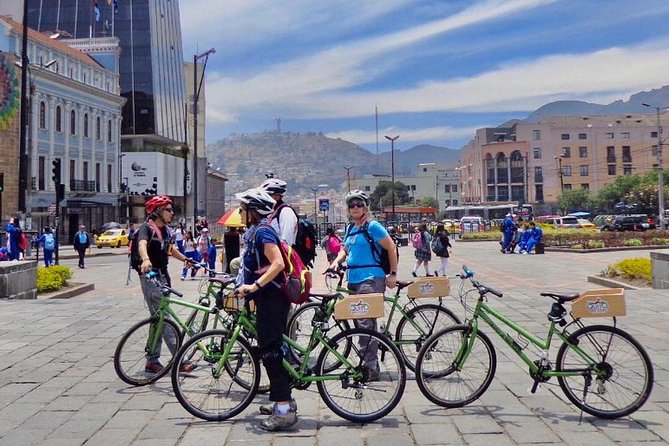
After the street art, you spend more time in La Floresta and visit a lookout. The stop is designed to show a part of Quito that many people miss when they stick to the main historic sights.
I like this section because it combines scenery with ordinary neighborhood life. You are not only taking a picture from above. You also have time to pause and watch local activity, ask questions, and get a feel for how the area is used.
The ride is described as fun and not too strenuous, but you should not mistake that for flat. Quito is built among hills, and the route includes some uphill sections. One rider found the ride manageable but had to stop and walk the bike on a few hills. That is a useful expectation to set: you do not need to be a serious cyclist, but you should be comfortable riding in a high-altitude city.
Guapulo views from the saddle
The route continues to Guapulo, where the reward is a series of city views from good vantage points. This is one of the tour’s strongest visual sections. Cycling lets you connect the viewpoints rather than simply being dropped at one lookout and moved on.
You may also appreciate the change in pace here. La Floresta begins with murals and neighborhood culture, while Guapulo shifts your attention to Quito’s size and setting. The city spreads out below and around you, making it easier to understand its long, narrow urban form.
Bring sunglasses and a cap, and use sunblock even if the morning feels cool. Quito’s high elevation can make the sunlight feel stronger than expected. A rain jacket is also sensible, since the company reserves the right to change the route because of weather.
La Alameda and Ecuador’s early science
La Alameda is Quito’s oldest park, and the stop brings history into the middle of the ride. The park includes Ecuador’s oldest astronomical observatory, along with other places your guide will point out.
This is the kind of stop that gives the tour more substance than a scenic bike loop. You learn how a public park fits into the city’s past, then see how it functions as part of local life today. You can also take a break from the bicycle and listen without trying to keep up with the group.
The schedule supplied for the stops lists times out of order, with La Floresta at 9:00 a.m., another La Floresta section at 10:00 a.m., El Ejido at 11:00 a.m., and La Alameda at 12:00 p.m. Since the whole activity lasts about four hours, your exact sequence and timing may shift. Confirm the departure details when you book, but expect a morning start and an early afternoon finish.
A few more Quito days worth comparing
- Cotopaxi & Quilotoa With Optional Hotel Pick-Up & Drop-Off
★ 4.5 · 170 reviews - Quito Airport Arrival Transfer to Hotel
★ 4.5 · 150 reviews - PRIVATE CITY TOUR: Quito Colonial, Half the World and Cable Car
★ 5.0 · 144 reviews - Full Day City tour of Quito -All main attractions WITH ADMISSIONS
★ 5.0 · 102 reviews
El Ejido, La Mariscal, and everyday shopping
The route also visits El Ejido and the La Mariscal area, two useful places for seeing present-day Quito. Here you visit parks, look at local activity, and stop at a handicraft market where you can meet the artisans who make the products.
That artisan connection matters. You are not only browsing finished souvenirs in a store. You may get a better sense of the work and people behind the objects, which helps you decide what is worth buying and how much space to leave in your bag.
The tour also visits a fruit and vegetable market. This is one of the most grounded parts of the morning because it shows how people shop and eat in daily life. You might find this more revealing than another formal monument. The guide can help explain what you are seeing, and small change is useful if you want to buy something.
Bring a backpack if you plan to shop or need somewhere to store a jacket. The bicycle includes a lock, but you should still keep personal belongings secure and follow your guide’s advice when leaving the bike.
A route that balances riding and conversation
The bicycles are Fulgur Cotinga urban models with 24 speeds. Helmets and reflective vests are included, and the route uses bike paths when possible. One especially useful detail is that Sunday mornings can offer calmer riding conditions, with some roads closed to cars and used by cyclists, skaters, and walkers.
That does not mean the entire route is traffic-free. This is an urban ride, not a countryside excursion. You should stay alert, follow the guide, and expect occasional hills and city movement.
The small group is a major advantage. The stated limit is seven people, while the general activity information gives a maximum of 10. Either way, this is much smaller than a large coach-style outing. A smaller group helps the guide keep an eye on the pace, answer questions, and make adjustments if someone needs a short break.
The bilingual format also makes the experience accessible to English and Spanish speakers. The guides are described as friendly, safety-minded, and well informed about Quito’s history, wildlife, food, and neighborhoods. Names such as Milton, Roberto, Daniel, Kevin, Joselyn, and Alejandro appear among the guide team, but you should not assume a particular person will lead your departure.
Food, chocolate, and what is not included
The tour includes some food and drink tastings, with chocolate specifically included in the La Floresta portion. The route also features local food and juices. These samples help connect the places you see with what people eat, but they do not replace a meal.
Meals, snacks, and drinks are not included. Water is also not provided, and the company asks you to bring your own bottle to reduce plastic use. This is important at Quito’s altitude, so arrive with water rather than expecting to buy it during the ride.
I would eat lightly before departure, as the operator suggests, but not skip breakfast. A modest meal, water bottle, sun protection, and a rain jacket are the practical combination. Carry some money, including small change, for market purchases or incidental spending.
Tips are optional. The company says guides are paid properly and that any tip you choose to give goes directly to the guide rather than the company. You should feel free to tip for excellent service, but it is not presented as an obligation.
Is $89 a fair price?
At $89 per person, this is not the cheapest way to see Quito. It is also more than a simple bicycle rental, but you are paying for the bicycle, safety equipment, a bilingual professional guide, route planning, historical and cultural interpretation, and several tastings.
The value depends on how you like to explore. If you want a fast overview of several neighborhoods and prefer someone else to handle navigation, the price is reasonable. In four hours, you cover places that would take more planning to connect on foot, including La Floresta, Guapulo, La Alameda, El Ejido, and La Mariscal.
The strongest value comes from the combination of access and context. You are not simply pedaling past the city. You stop for art, views, history, markets, and food. If you already know Quito well, the route may feel less essential. For a first or second day in the city, it can help you choose which districts deserve more time later.
Altitude, fitness, and practical preparation
Quito sits at 2,867 meters above sea level. Give yourself at least one day to acclimatize, sleep well, and avoid making this your first activity immediately after arrival.
Most people can take part, but the altitude can make an ordinary ride feel harder. The tour is described as not too strenuous, yet the hills are real. If needed, you can stop and walk the bike for a short section. That is better than pushing too hard early in your visit.
Bring:
- A reusable water bottle
- A light rain jacket
- Sunglasses, cap, bandana, and sunblock
- Identification, original or copy
- Small amounts of money
- A backpack for personal items or purchases
- Current travel and personal medical insurance
Tell the company about known medical conditions before riding. You should also arrive in a positive frame of mind, but in Quito, a good attitude does not replace water, rest, and sensible pacing.
Who should book the Quito Cultural Bike Tour?
I would choose this tour if you like active sightseeing but do not want a demanding athletic outing. It suits people who want history and local culture mixed with movement, especially those who find a long walking tour tiring or prefer to cover more ground.
It is also a good fit for curious eaters and shoppers. The chocolate, juice, market, and artisan stops give the ride a practical connection to daily life. Families with older children and adults who are comfortable on a bicycle may enjoy the format, though each person should judge their own comfort with altitude and hills.
You may want a different experience if you need a completely flat route, dislike city cycling, or want a full meal rather than tastings. You should also avoid scheduling it before you have adjusted to Quito’s elevation.
The tour ends back at the starting point. Hotel pickup and drop-off are not included, but the meeting point is near public transportation. The company can change the route because of weather or unforeseen conditions, with a refund or rescheduling arrangement offered when appropriate.
Final call: book it for a first look at Quito
Book this tour if you want a compact, active introduction to Quito that connects street art, viewpoints, parks, history, shopping, and local food. The small group and strong guide presence are the main reasons to choose it over renting a bike on your own.
Skip it if the altitude is a concern, you have limited cycling ability, or you need a relaxed sightseeing morning with no hills. For prepared riders who give themselves time to acclimatize, $89 buys a useful four-hour orientation and several experiences that are easy to miss when exploring alone.
FAQ
How long does the Quito Cultural Bike Tour last?
The activity lasts approximately four hours.
How many people can join the tour?
The small-group format is limited to seven people. The additional activity information gives a maximum of 10 participants.
Where does the tour start and finish?
The tour starts at Nuovo Caffe, Avenida Francisco de Orellana, Quito 170517, Ecuador. It ends back at the meeting point.
What equipment is included?
You receive a Fulgur Cotinga 24-speed urban bicycle, safety-certified helmet, bicycle chain, lock and key, and reflective safety vest.
Is water included?
No. You should bring your own water bottle, preferably reusable. Food and drink tastings are included, but meals, snacks, and additional drinks are not.
What should I bring?
Bring identification, a rain jacket, camera, sunglasses, cap, bandana, sunblock, money with small change, a backpack if needed, and water. Current travel and personal medical insurance are also required by the operator.
What is the cancellation policy?
You can cancel at least 24 hours before the start time for a full refund, subject to a 6 percent refund processing fee. Cancellations made less than 24 hours before the start time are not refunded, and changes within that period are not accepted.
Just added around Quito
- Quilotoa-Baños 2-Day Tour Including All Activities★ 5.0 · 40 reviews
- Walking Tour Quito★ 5.0 · 43 reviews
- Night Tour in Quito with free time at Old Town★ 4.5 · 49 reviews
- Quito Oldtown: A Cultural-Gastro Walking Tour and Shopping★ 5.0 · 73 reviews
- Daydream in Quilotoa: Laguna’s Enchanting Embrace Awaits★ 5.0 · 50 reviews
- Quito City Tour, Mitad del Mundo, Teleferico & Panecillo Included★ 5.0 · 66 reviews
- Private Full-Day Mindo Cloud Forest,Butterfly Farm, Chocolate Tour bird watching★ 5.0 · 62 reviews
- Termas de Papallacta Hot Springs full day tour from Quito★ 5.0 · 79 reviews
Cycling Tours, compared.
La Paz: Mountain Bike Down the World’s Most Dangerous Road
Read our review →
Lima Bike Tour Miraflores – Barranco + Huaca Pucllana!
Read our review →
Browse the lists this tour appears in