
Reviewed · CITY TOURS
City Tour Panoramic Bus Departure from Larcomar
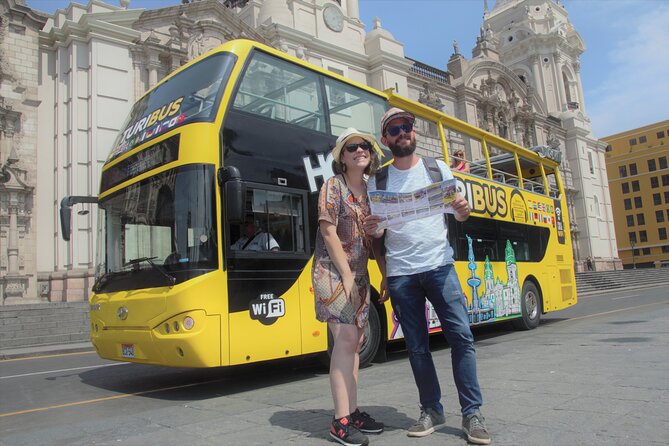
Lima changes character quickly on this four-hour tour. You begin above the Pacific at Larcomar, pass the pre-Inca Pucllana complex, then trade Miraflores for the grand colonial buildings of the Plaza de Armas. The bus gets you across the city, but the heart of the experience is the guided walk through central Lima.
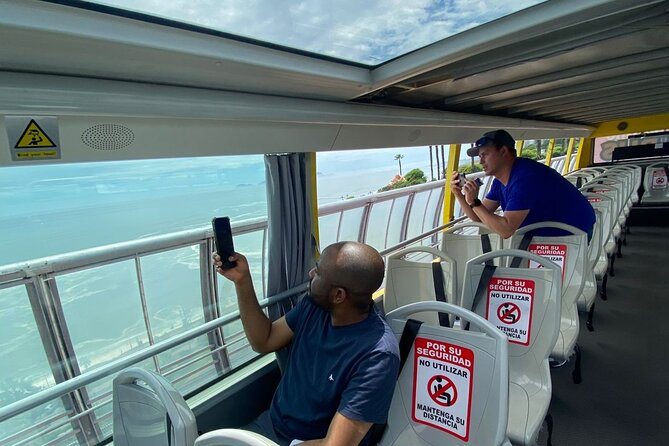
I like two things here: the sharp contrast between modern Miraflores and old Lima, and the practical comfort of air conditioning, WiFi, and USB chargers at every seat. Guides including Bryan and Yoanna have been praised for clear English, friendly help, and strong knowledge of Peruvian culture.
The main caution is traffic. Returning to Miraflores can take a long time, and the onboard microphone has occasionally been hard to hear. This is best understood as a walking tour with bus transportation, not a sightseeing bus where every major view is explained from your seat.
Key points to know before booking
- The bus is mainly transportation: The most detailed guiding takes place on foot in central Lima.
- You see two very different sides of the city: Modern Miraflores and its Pacific cliff meet colonial Lima and its ceremonial squares.
- Pucllana adds pre-Inca context: The site museum and ceremonial center give the tour an older foundation than the colonial buildings alone.
- Bryan and Yoanna have earned special praise: Their friendly, informative guiding is a major part of the experience.
- The $35 price covers useful extras: Transport, entrance fees, WiFi, air conditioning, USB charging, and the Santo Domingo convent entrance are included.
- Traffic can change the pace: Allow for a slow return to Miraflores, especially if you have evening plans.
From Larcomar’s cliff to the center of Lima
The meeting point is Turibus at Larcomar, Malecón de la Reserva 610 in Miraflores. This is a convenient start if you are staying in Miraflores or want to combine the tour with time by the Pacific coast.
Larcomar is more than a shopping center. It was built into an excavation at the top of Lima’s cliff, with much of the complex projecting above the void. The result is an unusual, floating feel, especially when you look toward the sea from the Malecón.
The site replaced Alfredo Salazar Park, though the park was reshaped above underground parking and cinemas. Look for the large bluish glass structures in the park. They are ventilation chimneys, but they look more like public art than practical building equipment.
You will not spend the whole four hours at Larcomar. Think of it as the departure point and a useful introduction to Miraflores. The real value is the way the route links this polished, modern district with the older parts of Lima.
More City Tours in Lima
- Lima’s Vibrant Heritage: Exploring the City’s Landmarks Half-day
★ 4.5 · 581 reviews - Lima: City Highlights Small Group Tour
★ 4.9 · 132 reviews - City Tour of Lima from the Airport
★ 4.5 · 84 reviews
Why the bus matters, and where it does not

The air-conditioned vehicle is welcome in Lima, particularly when you are moving between districts. WiFi and USB chargers in all seats are practical touches, especially if you are using your phone for photos, maps, or translation.
Still, keep your expectations clear. The bus is mostly used to move you around. One of the strongest practical insights from the experience is that the tour becomes a walking tour once you reach the historic center.
That arrangement has both strengths and weaknesses. You avoid arranging a separate taxi between Miraflores and central Lima, and the guide can provide context along the way. On the other hand, you should wear comfortable shoes and be ready to walk rather than sit back for four hours.
The tour is advertised at about four hours, but traffic can affect the schedule. The ride back to Miraflores may take a while. I would not book this immediately before a flight, a fixed dinner reservation, or another activity with a strict start time.
Pucllana, Lima’s pre-Inca foundation
The Pucllana Site Museum is in Miraflores, making it a natural stop before the route heads toward the historic center. It protects a magnificent pre-Inca ceremonial center, giving you a look at Lima from long before Spanish rule.
This stop matters because Lima’s story did not begin with Francisco Pizarro or the colonial grid. Pucllana helps place the city in a much older setting, when ceremonial centers shaped life in the area.
The stop is also a useful change of pace. After seeing Larcomar’s modern construction and Pacific-facing setting, you encounter a much older type of architecture in the same district. That contrast is one of the tour’s strongest features.
The supplied details do not specify how long you remain inside the museum or how much of the archaeological complex is visited. I would treat it as an important cultural stop, not a full archaeological day trip. If Pucllana is your main reason for booking, check the exact operating schedule and visit details when reserving.
The Plaza de Armas and Lima’s colonial center
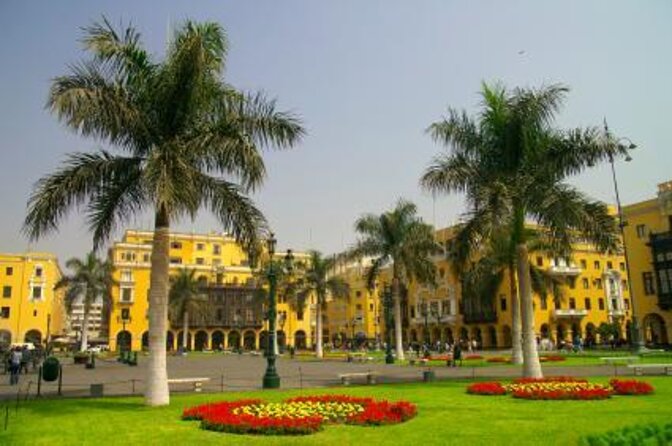
The Plaza de Armas, also called the Main Square or Plaza Mayor, is the foundational public space of Lima. This is where the city’s colonial power is gathered into one impressive frame.
The square is surrounded by the Government Palace, Lima Cathedral, the Church of the Sagrario, the Archbishop’s Palace, the Municipal Palace, and the Club de la Unión. The arrangement is easy to read on foot. Government and church buildings face one another, showing the formal Spanish urban plan.
The square is crossed by Jirón Junín, Jirón de la Unión, Jirón Huallaga, and Jirón Carabaya. These streets help connect the open plaza with the denser historic center around it.
I especially like this part of the tour for first-time visitors. You get an immediate sense of how Lima organized public life, religion, and government. The buildings are not scattered attractions. They form one coherent civic space.
Your guide is important here. The center can feel like a collection of ornate facades if you only take photos. A good explanation turns the square into a place where colonial authority, religious power, and modern government still meet.
More City Tours in Peru
- Lima City Tour Plus + Video by Drone – Group
★ 5.0 · 59 reviews - Lima Street Food: A gastronomic adventure through the city.
★ 4.5 · 42 reviews - Lima: City Highlights Walking Tour & Catacombs
★ 4.9 · 41 reviews - Lima : City Tour by Panoramic Bus – Walking & Catacombs
★ 4.3 · 41 reviews
Jirón de la Unión and the Municipal Palace
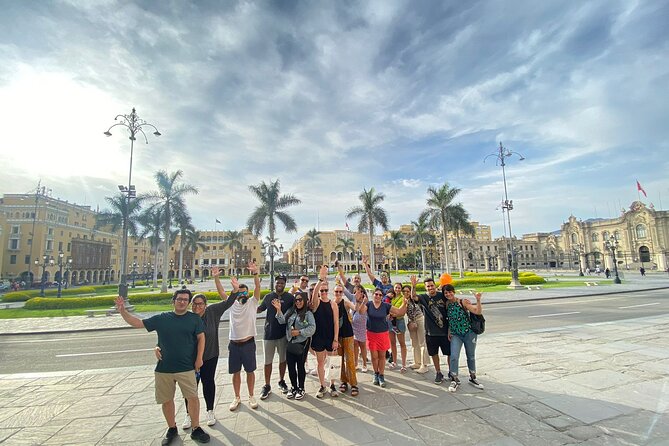
At block 3 of Jirón de la Unión, the Municipal Palace of Lima faces the Main Square. It is the headquarters of the Metropolitan Municipality of Lima and occupies a prominent place in the city’s civic center.
The stop is brief in physical distance but useful in meaning. You are not just looking at another grand building. You are seeing where the city’s municipal government operates, directly opposite the Cathedral in the Plaza de Armas.
The surrounding streets are part of what makes central Lima worth exploring on foot. You can take in the relationship between the square, the arcades, the facades, and the connecting streets more easily than you can from a moving bus.
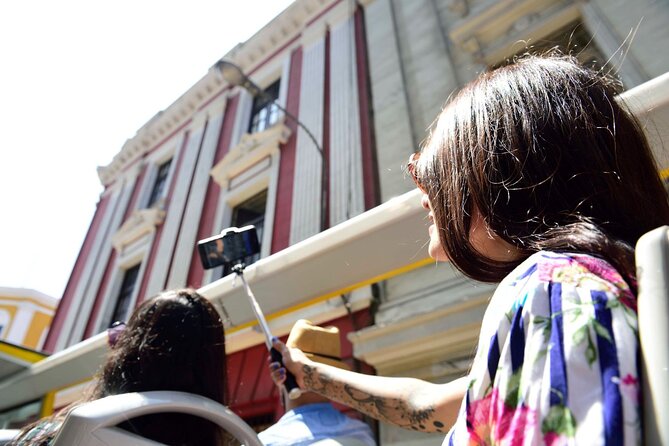
Some of the most memorable details in the central district are above eye level. Look for the carved wooden balconies and older architectural features as you walk. The tour gives you a guide to the area, but you should still leave room to pause and look around.
Lima Cathedral and the layers beneath it
Lima Cathedral occupies a site with a complicated past. Before the cathedral, the location was associated with the Inca shrine of Puma Inti and the palace of Sinchi Puma, a descendant of the Inca Sinchi Roca.
When Pizarro founded Lima, he assigned land for a church. The original ownership was formally renounced through a notarized certificate, a detail that shows how the new colonial city established its institutions on top of existing places and claims.
Pizarro laid the first foundation stone in 1535 and carried the first beam himself. The first cathedral was finished in 1538 and inaugurated on March 11, 1540, with the consecration of the Eucharist.
That timeline gives the cathedral more weight than a quick photo stop. You are looking at one of the key religious buildings in the city, but also at a location shaped by the meeting and replacement of earlier cultures.
The tour includes entry to the convent of Santo Domingo, which adds another interior religious site to the central Lima walk. The information provided does not spell out every room or display included, so I would expect a guided visit rather than an extended independent exploration.
The Government Palace and Casa de Pizarro
The Government Palace occupies the north side of the Plaza de Armas beside the Rímac River. It is the main seat of Peru’s executive power and the official residence of the president.
The building covers 19,208 square meters, but its importance comes from the long sequence of buildings that have occupied this ground. The site was used by Pizarro from 1535 onward and may previously have been linked to Taulichusco, the Inca government representative in the Rímac Valley.
During the colonial period, it served as the residence of Peru’s 40 viceroys. Later, José de San Martín and Simón Bolívar stayed there, along with most presidents of the republican era.
That is a lot of national history concentrated along one side of a square. Your guide can help connect the building to the political story of Peru instead of leaving it as a formal facade in the background.
The palace is also known as Casa de Gobierno and Casa de Pizarro. Those names reflect different eras and different ways of understanding the same place. You may not enter the palace itself, but seeing it from the Main Square is an essential part of the central Lima route.
The guides make the difference

The experience depends heavily on the guide assigned to your group. Bryan has been singled out for being informative and friendly, while Yoanna has been praised for making the walking portion enjoyable and clear. English-speaking visitors can expect a guide who is able to explain the main sights in English, though the quality of the bus microphone can affect how easily you hear every word.
The best guiding happens when you are walking through the historic center. That is where questions, close-up details, and short explanations can turn a sequence of buildings into a readable story.
There has also been a report of a guide failing to notice that someone had been left behind. I would take that as a reminder to stay with the group, especially when crossing streets or moving between the square and nearby buildings.
The strong overall score, 4.8 from 97 ratings, and 95 percent recommendation rate point to a consistently positive experience. Still, the occasional sound problem and the need for group awareness are worth keeping in mind.
What $35 includes, and who gets good value
At $35 per person, the tour is reasonably priced if you want a simple introduction to several parts of Lima in one outing. You receive the vehicle, air conditioning, WiFi, USB chargers, fees and taxes, central Lima guiding, and entry to the Santo Domingo convent.
The value is strongest for first-time visitors who want orientation without arranging several separate rides. You see Miraflores, Pucllana, the Main Square, the Municipal Palace, the Cathedral, the Government Palace, and Santo Domingo in one organized route.
The price is less attractive if you want a slow, specialist visit to one site. Pucllana, the Cathedral, or the historic center could each justify more time than this four-hour format allows. You are paying for range and convenience, not a long museum session at every stop.
Snacks are not included. Hotel pickup is also not included, so you need to reach the Turibus point at Larcomar yourself. The meeting point is near public transportation, which helps, but confirm your route and allow time to arrive before departure.
Who should book this Lima tour?
I would recommend it to first-time visitors, families, solo visitors who prefer organized transport, and anyone staying in Miraflores who wants a structured introduction to central Lima.
It also suits people who enjoy a mix of city views, archaeology, architecture, and guided walking. The route gives you more context than a simple drive through town, while the bus reduces the need to organize transport between districts.
You may want a different plan if you dislike group tours, need exact timing, or want to spend most of the day inside museums and historic buildings. The return can be slowed by Lima traffic, and the bus commentary may not always be easy to hear.
The tour requires decent weather. If poor weather causes cancellation, you are offered another date or a full refund. You can cancel for a full refund up to 24 hours before the start time, but changes or cancellations inside that window are not accepted.
Should you book it?
Book this tour if you want to get your bearings in Lima quickly and prefer a guide to connect Miraflores, Pucllana, and the colonial center. The strongest parts are the contrast between districts, the knowledgeable local storytelling from guides such as Bryan and Yoanna, and the walking tour around the Plaza de Armas.
Skip it if you need a slow, highly focused visit or cannot spare extra time for traffic. For $35, it is a practical introduction with useful comforts and several important stops, as long as you understand that the bus moves you between sights and the real sightseeing happens on foot.
FAQ
Where does the tour begin?
The meeting point is Turibus at Larcomar, Malecón de la Reserva 610, Miraflores 15074, Peru.
How long does the tour last?
The tour lasts approximately four hours.
Is hotel pickup included?
No. Hotel pickup is not included. You need to reach the meeting point at Larcomar.
What is included in the price?
The price includes WiFi, all fees and taxes, an air-conditioned vehicle, guided touring in central Lima, entrance to the convent of Santo Domingo, and USB phone chargers in all seats.
Are snacks included?
No. Snacks are not included.
Is the tour guided in English?
English-speaking guides are available. Guides including Bryan and Yoanna have been praised for clear and friendly explanations.
Is the tour accessible by public transportation?
Yes. The meeting point is near public transportation.
What happens if the weather is poor?
The experience requires good weather. If it is canceled because of poor weather, you are offered a different date or a full refund. For other cancellations, you must cancel at least 24 hours before the start time for a full refund.
Just added around Lima
- Surf lessons in Lima, Peru surf lessons best experience★ 5.0 · 40 reviews
- 7 Day Peru Private Journey★ 5.0 · 71 reviews
- Lima City Tour Plus + Video by Drone – Group★ 5.0 · 59 reviews
- 7 Day Exploration Tour from Cusco to Lima★ 5.0 · 85 reviews
- Miraflores: Amazing Peruvian Cooking Class Ceviche Seafood and Pisco Sour★ 4.9 · 57 reviews
- Lima: Magic Water Circuit with Dinner★ 4.5 · 59 reviews
- Lima: Live Magic Water Show Experience★ 4.9 · 60 reviews
- Lima Street Food: A gastronomic adventure through the city.★ 4.5 · 42 reviews
City Tours, compared.
Cusco: Half-Day City Tour with Sacsayhuaman and Q’enco
Read our review →
Private City Tour, Monserrate, Emerald and Botero
Read our review →
City Sightseeing Hop-On Hop-Off Bus Tour & Extras
Read our review →
City Tour Cusco Qoricancha Sacsayhuaman y Tambomachay
Read our review →
Main City Sights in 7 Hours – Shared Group Tour
Read our review →Browse the lists this tour appears in